
Commonly overlooked sensory red flags and signs of sensory issues that could be a clue to your child’s needs, which will decrease confusion and frustration.
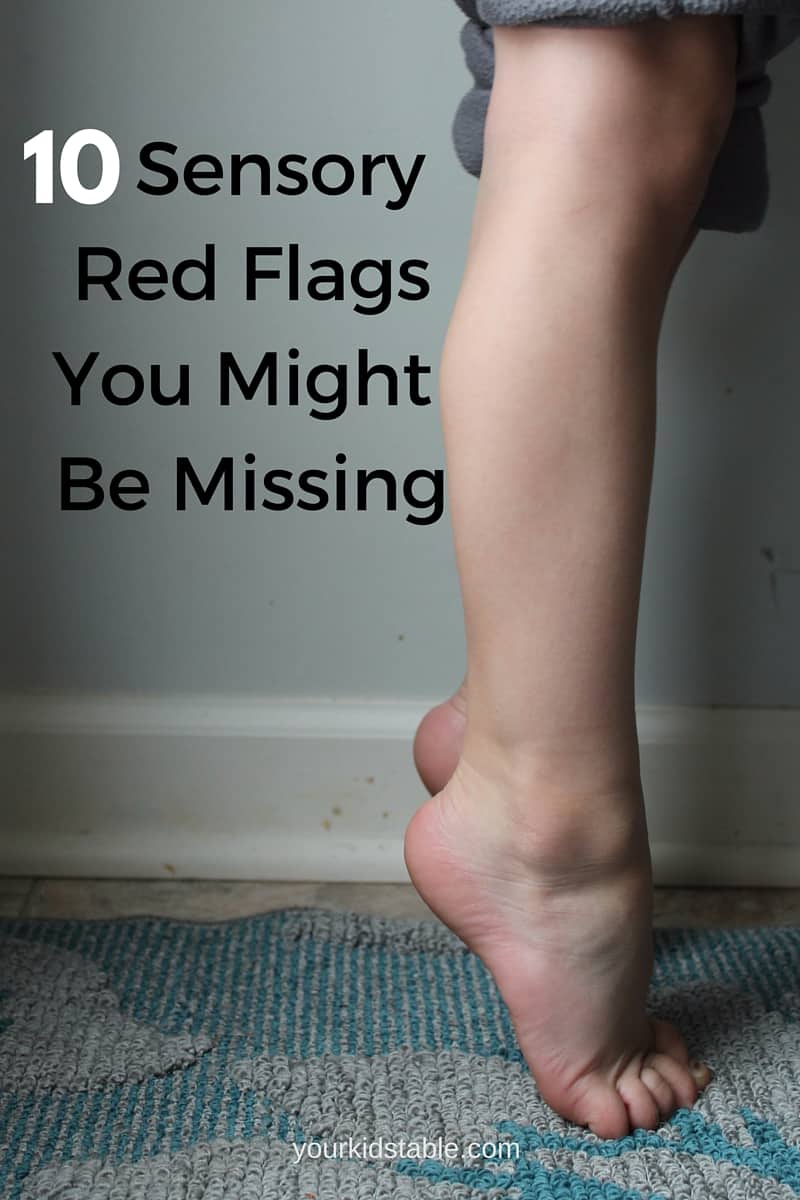
This thing happens to me all the time as a pediatric OT… I’m talking to parents during a party, a play-date, or even in line at the grocery store, and the parent casually mentions, often in passing, an odd thing that their child does.
Maybe their child walks around on their toes all the time, gags at some foods, or their toddler hates swings or being messy? Sometimes, they aren’t even that concerned about this odd “thing”.
Often times, I know this “thing” their child is doing is a sensory “issue” or sign of a sensory processing difficulties (which isn’t as bad as it sounds!)
Just because your toddler doesn’t like messy hands doesn’t necessarily mean there is a problem, but it is worth paying attention to.
Sensory processing can be very complicated, and the truth is many parents have never heard about it. Some realize their child may have some sensory issues that sometimes cause odd, confusing, or frustrating behaviors.
When I find myself in these situations, I usually feel a bit stuck because sensory processing isn’t exactly a quick topic, especially for parents who’ve never even heard about it.
If you’ve found your way here, my bet is that you know at least a little something about sensory processing, but if not, that is okay, too.
Either way, I have an exciting solution to that problem, but before I get to that, let’s talk more about these sensory red flags.


Key Timestamps:
02:11 – What I really mean by “red flags”
05:47 – The sign most parents dismiss
09:15 – When reactions to food aren’t a choice
14:02 – Why parties can feel overwhelming
19:39 – The truth about the “wild child” label
25:08 – When it looks like they’re ignoring you
10 Sensory Processing Challenges and Red Flags
Before we dive into these behaviors, I want to make it VERY clear that just because your child may have one or several of these red flags, it doesn’t mean that they have sensory problems, autism, or any other diagnosis.
We ALL have sensory processing needs and differences. Seeing your child’s behavior through the sensory lens will allow you to understand them and support their needs, which means less confusion and frustration for everybody!
And, if you’re concerned that your child’s sensory issues need addressed by a professional, then check out sensory integration therapy.
You’ll find a guide to walk you through figuring that all out so you have peace of mind! If you are concerned your child has autism, or already know they do, check out the link between autism and sensory processing.
1. Avoids Movement – If your child gets scared at climbing playground equipment, roughhousing, or riding a swing, they are likely avoiding vestibular and possibly proprioceptive input.
Those are our sixth and seventh senses that give us our sense of balance and body awareness.
2. Gagging at the Sight, Taste, and Smell of Foods – Although not always sensory, gagging immediately when confronted with foods is often because the oral system is being overwhelmed. Read more about sensory issues with food.
3. Frequently Walking on Toes – Children often do this because they are sensitive to the sensations they are feeling on their feet and prefer as little of their foot to be touching the surface as possible.
Sometime children toe-walk because they like the pressure it puts on their ankle, which is more proprioceptive feedback. Or, it can also be the result of a vestibular system that isn’t processing properly.
4. Clumsy – There are a variety of reasons that a child may seem to fall or bump into objects more than other children, and one of the most overlooked reasons is because the child’s proprioception and possibly vestibular systems aren’t working too well.
The wiring may be all jumbled up.
Some children with this sensory red flag don’t put their hands out when falling, or seems unaware of how to catch themself when off balance.
5. Hides at Parties or Avoids Them – If your child hates going to parties or other public places, it is possible that they may be overstimulated by the noise, lights, and/or people accidentally touching them.
For kids that have this response due to a sensory processing difficulty, a party can be downright torture as the sounds, sights, and unexpected touches can just be painful to them, literally. Head to sensory sensitivity in kids to learn more.
6. Prefers Tight Clothing – Sometimes kids will want to layer clothes or wear really tight fitting clothing to give themselves more proprioceptive input. It may seem strange, but the sensation they receive is calming to them and may even help them focus better.
Or, your child may be extremely particular about some sort of fabric. This all relates back to sensory. Head over to sensory issues with clothing to learn more.
7. Wild Child– There are a variety of reasons that kids seem to bounce off the walls at times, but kids that always seem to be jumping, climbing, running, pushing, and roughhousing are typically seeking out proprioceptive input, and sometimes vestibular as well.
Unfortunately, these kids are often described as “bad” or wild, but really, they are just trying to get their needs met. Read more about sensory strategies for sensory seekers or “wild kids”, and a three part plan for “dealing with” hyperactive kids.
8. Likes Bright, Fast Paced TV Shows – I know a lot of kids like these types of shows, but if your child only wants to watch fast, bright shows, then it may be an indication that they want more visual stimulation.
If that is the case, your child may also like looking at lights and brightly colored or high contrast books.
9. Bites Toys or People When Unprovoked – If your child seems to bite others or their toys often, usually for no reason, they are probably looking for some deep, intense proprioceptive input or oral sensory input.
10. Doesn’t seem to notice when being talked to or needs directions repeated – Yes, sometimes kids ignore, and sometimes this is normal, but if it is a frequent recurring issue than it is a sign that your child’s auditory or hearing system is not processing information well.
Check out 11 more sensory red flags in the follow up post.
Does Your Child Have Sensory Red Flags?

All of these behaviors are like a red flag that your child is waving to tell you something about their sensory processing.
It is a clue into what they need from a sensory standpoint. That need may be help avoiding something like bright lights or seeking something like chewing on toys.
To start figuring out what types of sensory activities might be helpful for your child, follow these steps:
1. Identify which type of sensory need your child has. There are four big categories for sensory issues: seeking, avoiding, low registration, and varied. If that feels overwhelming or you have no idea, I highly recommend our free 1 hour workshop that will help you figure it out!
2. Once you know which type of sensory need your child has then you can match the types of sensory diet activities that will be most helpful for them!
3. Organize when and how often you use the sensory activities by using a sensory diet, which has nothing to do with food, but is a diet of supports and sensory input that help calm and organize your child’s brain.
(Steps 2 and 3 are also taught in the free sensory workshop!)
Get the 21 Sensory Red Flags Printable Checklist
Wish you had all these red flags and 11 more you might be missing in a list you could download and/or print out?
I’ve got you covered! Click here to get the 21 Sensory Red Flags checklist sent right to your inbox!
Transcript
Okay, let’s talk about it. 10 sensory red flags. I’m air quoting for those of you listening on Spotify or Apple 10 sensory red flags that are easy to miss now. I wanna first clear the air on sensory red flags. Listen, I do not mean any negative connotation by that or that there’s something broken or wrong with your child.
I’m calling these red flags because I think so often I see these in kids, or I will be talking to parents at a birthday party or the park and. I will hear them talking about these types of things as quirks, and it’s almost like parents have some sense that something’s going on here, but I can’t quite put my finger on it, which makes, although I am so happy that I think sensory processing.
Sensory quote unquote issues, uh, not my favorite word, but the word most commonly used. Uh, what I often refer to as sensory needs and truly everything I’m about to list is a sensory need. It is a result of how a child’s brain. Is processing the sensations from their environment and even inside of their body.
Okay? That’s really what sensory processing is. And of course, sensory processing is highly individualized. No two people have the same exact sensory processing. Each of our systems are a little bit fine tuned, a little bit uniquely wired, and certainly. In kids with autism and ADHD, we see bigger changes and these changes, uh, and the way that.
A brain is wired, can have a pretty and a ripple effect across their development and their skills as they get older. Because sensory processing our sensory systems, we actually have eight of them. We have eight senses, not just five that develop in utero. Okay, so when these sensory systems are struggling to process sensory input.
Or overreacting or underreacting or excessively seeking it out. Again, there are just other effects, uh, that can come as a result of that because the other layers of development, like motor skills and learning and communication are all stacked on top of it. Executive functioning skills, another one. So like attention and following directions.
All these things are stacked on top of our sensory system, so. It’s going to, it’s gonna kind of affect all of that. Okay. So again, when I’m talking about red flags, I’m just saying like, Hey, this is just, if we can understand that a child. Is acting a certain way or doing a certain thing that might be, we might label as a behavior or we might say is bad, or we might say is weird, or you may hear other people saying that, and we don’t understand why we might come at it from a behavior approach when this is something that a child cannot help and it’s because of how their brain is wired.
So. Again, the name Sensory Red Flags is just to indicate that, hey, this is just a sign. This is a sign that something might be going on with your child’s brain wiring and understanding it is gonna be so helpful because when you understand it, you can then give your child supports. You can actually use certain activities to help encourage.
New connections and new pathways in the brain that will help them process this sensory input so it doesn’t have such a significant impact on their life. You following me? Does that make sense? I hope so. Gosh, if you ever have any questions, don’t hesitate to hit and leave a comment or to reply to one of our emails.
We have a great, uh, printable that is gonna go along with this too. It’s totally free. And it’s our sensory mini toolkit. So you’ll be able to see all of these there too, and get some next steps for tips. I’ll share that at the end. So with that, let’s get into these 10 red flags. Right. These are really easy to miss.
They might not look like sensory processing challenges, but I do want us to keep one thing in mind that for some of these red flags, and I’ll indicate them as we go through, there can be other causes. Okay? So it’s not always, this is a hundred percent due to their sensory processing. But it’s, but it really could be.
Okay. There’s, there’s a, there’s a lot of kids that are kind of struggling these things because of sensory processing, but I will call out when there are some other things going on potentially. I also want you to keep in mind that this is not a diagnostic tool. I do not expect you to treat this. Like, oh my goodness, my kid has eight out of 10 of these sensory red flags.
They have major sensory processing challenges. That is not what this is. It is truly to help you start to see that there might be going, there might be more going on beneath the surface of your child’s challenges and those kind of tricky things that you see them doing on a regular basis so that you can help and support them in a new way.
Okay. Alright, so sensory red flag number one. Avoids movement. Alright. This is a big one. And this is always linked to sensory processing, in particular the vestibular sense. Alright, so I’m gonna get a little nerdy here for a second because deep in our inner ear. And it is constantly perceiving motion.
This sense is also closely tied into our visual system. They share the, serve the same nerve. Uh, as that information goes up into the brain, that matters because I always, I always want to help a kid that is struggling with movement sensitivities. So. This absolutely can show up as really hypersensitive car sickness.
But what I’m really talking about here is a child that doesn’t want to take their feet off the ground. They, they may struggle to climb up stairs. They may not wanna get on a swing, they may not wanna climb up the slide. I once worked with a little girl. Who was just a toddler. And you know, I live in Pittsburgh here.
Uh, if you’ve never been here, it is super hilly. We have lots of steep hills, lots, uh, kind of tight, uh, roadways that bring you down some pretty steep passes. And there were a couple of these roads around this little girl’s house. And so. Her car seat was in the middle of the back seat and whenever they were going down a hill, she would go into absolute fight or flight.
The family didn’t realize the connection at at first. I mean, this is, this is kind of a leap, right? To understand how could. Going down a hill in a car caused this much emotional upset. But they started to see these patterns. When they would carry her down the stairs, she would cling tightly to their neck.
She didn’t want a rough house. I would bring a, uh, big yoga ball to treatment. She was so curious about it, but she would not roll forward on it or let her feet leave the ground at all. Of course not until, and that work was so important. Now, that is an example of really extreme vestibular sensitivity. Her brain was telling her this is not safe.
The way that her brain was wired was that it was, she was unsure. She was probably feeling dizzy. She was probably feeling very ungrounded. She was, it was probably feeling like she was standing at the top of the Empire State Building and looking down. That was probably the level of what was going on inside of her brain.
So that creates a baseline of anxiety in kids, puts them in a constant state of being on alert, uh, having that fight or flight activated. So these kids tend to have more meltdowns, uh, they tend to have more big emotions. And later we’ve seen a correlation because of vision that these, that kids can also struggle with.
Reading challenges, kind of copying information from the board when these vestibular sensitivities persist. Okay, so that’s number one, avoids movement. Number two, if you have a kiddo that gags or shutters at the site, at the smell or at the taste of food, this is 100% related to their sensory processing.
It is their, again, their system is saying, alert, alert, alert. This food is dangerous. Okay, now this, this often comes after food has been tasted and it’s again, a wiring in the brain that is saying, this is uncomfortable and I cannot tolerate this. Now again, to be clear, when kids have these really intense sensory sensitivities, like the one I just described in one, and we’re in another sensitivity in number two.
Sometimes it’s really important that we help their brain start to learn how to take in these sensations, but we have to do that in a very slow, methodical way. We never wanna force kids because it will send their brain into, we always wanna start by supporting them by just understanding, whoa, whoa, this is really intense for them.
Their brain is sending the signal. It is not a choice that they are making. Okay, number three. Now this is one that could have a couple of different reasons why your kid may be seeing this, but one of the big reasons is sensory processing and that is walking on toes. Gosh, we have gotten so many questions about this one over the years because it stands out.
It stands out pretty quickly. Uh, mostly kids will do this. And there are bare feet and you will start to see it very early on in toddler years. But I mean, gosh, I have seen this in a lot of kids up through elementary years now when it’s due to a sensory processing concern, like kind of pro like reason for what’s going on with their sensory system.
It. It could be a couple of different things. One, it could be because of that vestibular system. Again, when they’re up on their toes, they’re actually getting a lot input, which they might like because their sensory system might be wired to not be getting enough of it, and so they want more. So being a little tipsy, turny on the tops of their toes feels really good.
They’re seeking that input. They also may be wanting some proprioceptive input. The receptors for that sense are all in our joints. And in our muscles. And so when we lock our ankles and we press in hard on our toes. There’s a lot proprioceptive input happening, and so kids can find that really motivating.
Now, third, there can also be a sensory sensitivity. The bottoms of our feet are super, uh, filled with lots of tactile receptors, and when kids have tactile sensitivities, the bottoms of their feet can be really sensitive, and so they may be walking on their toes to try to lessen that contact. With the bottom of their foot.
And a combination of all three of these reasons. Now, there are also muscular reasons that kids will do this. Uh, sometimes, you know, their tendons are shorter and PTs will support this work. So it’s, it’s not always related to sensory. There are also links to retained reflexes. Uh, so. It’s possible that that is a layer that is underneath and what is going on as well for this walking on toes.
All right, let’s move on to number four. If you have a kiddo that is very clumsy, this one is so easy to miss because we all probably have people in our life that we would say are clumsy. That maybe drop things often or bump into things all the time. Well, this was related to our proprioceptive sense.
That’s our sense of body awareness. That’s the one that has all of the receptors in our joints and in our muscles. It’s frequently drop something or bump into something. It can be related to this proprioceptive sense and some more involved sensory processing systems. We’re gonna keep it simple here in this episode, so.
Uh, knowing that this is how the brain is perceiving where the body is in space, so when a child walks around a corner, that that child knows how much room to leave so they don’t hit their arm as they walk by. That’s having a very good sense of where that arm is in space. When a child is consistently bumping into things, it’s a, it’s a pretty big indicator that they are maybe not having a very good understanding of where their body is in space.
Hence, the bumping into things on a regular basis, or even tripping and falling. Okay. Five. If you have a kiddo that does not like going to, this can be a sensory red flag. Now, there can be other factors going on, like social anxiety or general anxiety a hundred percent. But there is, for some kids, the underlying cause to not wanting to be at birthday parties or really struggling at birthday parties or having meltdowns at birthday parties is because it’s loud, it’s overstimulating.
There are a lot of kids, uh, that may be bumping into your child. If your child has some sensory sensitivities they to touch, they might not like being touched by a bunch of kids or that unexpected touch of being bumped into or crashed into when kids are excited. And there’s a lot of kids, especially if they’re in a small space, if it’s really loud, a lot of kids are yelling.
There’s often bright lights on, sometimes blinking lights on, depending at what type of venue you are at, and I think so often. Learning for us as parents, because these are social experiences that we look forward to with our kids. We have these memories probably from our own childhood of enjoying these parties and we want our kids to have these valuable social experiences and so.
It is understandable once or twice when a, your child is going to a birthday party and you know, oh, maybe they’re just off or while they’re really tired or they’re having a hard day, and those things can happen because remember. As we’ve talked about in previous episodes, when a child is dysregulated from a lack of sleep, a lack of nutrition or hydration, their their capacity is going to lower.
They’re going to be dysregulated. They’re going to be more irritable. They’re not gonna be able to tolerate the amount of sensations that they would if they were regulated, if they were well rested and had eaten. And believe me, I know a lot of these, these challenges. Feel like a catch 22 because you’re trying to put your kid to bed early and they’re not sleeping.
You’re trying to feed them and they’re not eating. And now you have a kid that’s hungry and tired and you’re trying to do the thing like go to the birthday party or go to Target or go to the doctors, and their capacity might actually be much higher, but they’re just so dysregulated. That it’s, it’s actually much lower in that moment.
So sometimes kids can be refusing for that reason, but if your kid is pretty regulated and you know, they’re like calm, they’re grounded, it’s time to go to the birthday party, you start to see the dysregulation go up because they’re already anticipating what’s gonna happen, or you get there and they were totally fine and you start to see them unravel.
It’s really important. To consider these sensory processing aspects and that they may have some sensitivities to the things that are going on in their environment. Okay. Number six, if your kid killer about their clothing, in fact, I what I have this labeled as, because it seems so unusual, and again, it just seems like, wow, that’s so quirky.
But it is totally related to the sensory system, and that is if your kid prefers tight clothing, like they want compression gear on all the time. Or they wanna be naked. That happens too. That is completely related to either, again, they want that proprioceptive input. When we have tight clothing on like compression gear, we get a lot of proprioceptive input when we first put it on.
Our body does habituate to it over time, but for maybe 20 or 30 minutes, it feels, it feels pretty good. It feels, it can feel really tight. It can feel organizing, and so your child may prefer that at the same time, they may be wanting that because it’s a little bit, it’s a little bit more calming, but the looser closed bump into their body all the time.
It’s not a consistent form of pressure. They may feel a tag or easily, and they have some tactile sensitivities. These touch sensitivities. We have touch receptors over every surface of our skin. Again, concentrated in our hands, tongue, and the bottom of our feet. I should say the palms of our hands, but they are everywhere so that we know when we’re being touched somewhere, whether it’s in the middle of our back or elbow or the, or the middle of our hand, the tip of our nose, or we have something in our mouth.
We can feel it. Our body’s like, oh, yep, I just felt something there. Now, typically. Our body ignores the signals for clothing. You probably right now, unless you also have sensory needs, which many of us do, are probably ignoring your clothing. You are not thinking about what your shirt feels on your back or your pants feel on your legs, or you know the scheme on your sock because your body is ignoring it.
Our brain is ignoring it. Our brain has to ignore thousands upon thousands of sensations all day long. Otherwise, we wouldn’t be able to focus on anything else. Hence why, if your child’s brain is wired in a way that it’s staying alert, alert, alert with the clothing on their body, it’s going to distract them, it’s going to keep them dysregulated.
It aren’t gonna be able to focus. And so you may see your child being really particular about the types of clothing they wear, or they may be seeking out input by wanting that tight clothing. All right. Number seven. Alright. This one you may know, I feel like this has become way more common knowledge, which is a great thing.
But number seven is if you have a wild child, that is often a term that is used, but it does mean a child that is kind of running nonstop. Uh, that is always on the go. And sometimes, uh, boys can get this label and say, oh, they’re just boys, being boys. And is between typical kind of explore explorative movement or even just, oh gosh.
Kids need a lot of movement for their brains to grow and develop. That is a typical part of childhood. But when is, when is it excessive? And showing us that the brain is wired in a way that, wow, this kid has had so much movement and it still doesn’t seem like enough. They’re still having a hard time paying attention.
They’re unable to do anything else because they’re so fixated on that movement. That’s really where the distinction is, and when it becomes. A challenge for a child to be able to sit down at the table, to be able to sit down at circle time or you know, there’s a story time at the library, or they’re older and they are struggling to do homework, they’re struggling to stay in their seats at school.
Those are indications that, wow, I’m seeker. And this isn’t just a challenge, this isn’t just a personality trait, let’s say that. Okay. And again. The point isn’t to have a label. The point is to understand that the thing that we see our kid doing, the quote unquote behavior, or this red flag, is actually related to how their brain is wired and not a choice that they’re making on being bad.
Because this one in particular, the wild child thing, hold these kids can get a lot of labels for being bad, for being hyper. For being out of control. And parents likewise can get labeled as bad parents for this behavior. So when we can understand that that is not what this is and it is a result of a child’s brain.
Then we can start to better support them because yes, there are specific types of activities that you can do to actually meet a sensory seeker’s threshold so that they can regulate and calm down. Some movement activities will only wind kids up more or just kind of never meet. Alright, moving on number eight.
If you have a kiddo that likes bright, fast paced TV shows. And again, I think there are a lot of bright, fast-paced TV shows on television. But kids are sort of drawn to it. Like you can almost see them, um, lock in search for them. And if you compare them to slower moving kind of television shows, they may not be as interested.
Uh, they’re really looking for that extra simulation. These kiddos often. Also are seeking kind of visual input in other ways. They may love ceiling fans, they may love spinning fidgets, uh, kind of seeing things that are really stimulating to their visual system. So, again, helpful to know that oh wow, they’re looking to be visually stimulated.
I can give them some of that visual stimulation as well. Alright, number nine. This is a big one. This is so often related to sensory, although not always, and that is biting when unprovoked. Now, I this, to be quite honest, any child that’s biting even in a, any, even in a provoking situation, it can still be related to sensory.
Why? Because our jaw has, gives us the biggest dose of proprioceptive input. So remember. I said our joints have those proprioceptive receptors. When a child bites down, they get a mega dose of proprioceptive input. It is a quick and sure way to start to help them regulate so it can feel very frustrating.
It can be heartbreaking as a parent or if you’re a therapist working with a kid and you think everything’s going okay and the neck just got bit hard. Where did that come from? I mean, it is real hard for, uh, another individual, the one that has gotten bitten to then not be dysregulated, to not be reactive, to not be protective or in fight or flight, even when that’s your own child or you’re working as a professional because it hurts.
It hurts real bad. And now kids can learn that they get a response after this. There can absolutely be a behavioral component to this, but often in its. Root. We see this biting, especially when we see it a lot. And again, you’re often gonna see these kids bite other things. They may bite pillows, they might bite their pencil tops.
They’re biting other things in their environment because that biting gives so much proprioceptive input. Okay, so again, layers to this, but a sensory component. And number 10, probably one that makes most parents, uh, really frustrated and very, very common for kiddos with sensory means, and that is, doesn’t notice being talked to.
Now, notice how I phrase that, doesn’t notice being talked to. What we tend to see as parents, myself included, even though I know this. Is that when we yell something from across the room, Hey, pick up your toys. Hey, it’s time to eat. Hey, can you put your shoes away before it’s time to eat? Now we’ve added two things and they say nothing and they do nothing.
The natural conclusion is I’m speaking loudly. Their hearing is fine. Clearly they’re ignoring me. While that can be the case. When you have a kid that is consistently doing this it auditory processing, if they are thinking about something else, if they are reading, if they are focused on an activity, if they are watching television, they literally may not have processed what you’ve said.
So you, it’s like they didn’t hear it. Okay, so the sound came in, but because of their focus, this is very common also for individuals with ADHD, especially when they’re hyper-focusing because the brain’s activity is focused on whatever they’re, they’re engrossed in and not other sounds from the environment.
And so if you feel that rub in, in that, uh, frustration. Especially if you’ve seen other signs on this list that we’ve talked about, it’s so important to know that this is not your kid being bad. This is not them deliberately not listening. Other times the kids deliberately don’t list, but I want you to watch when you’re talking to them, particularly from across the room, from another room, they’re engaged in something else and you see no response from them.
Consider that they actually may not have heard you, and then look for how often that pattern repeats. Again, the goal here of this episode is to start looking to start seeing, oh my gosh is this, this is something else. This isn’t them being bad or weird. This is because of their sensory system. This is literally how their brain is working.
That is the beginning. That is the first step. When we recognize it, then we can start to add in supports. Then we can start to do activities that help improve that processing and that function that, oh my gosh, that is so exciting. Alright, so we’re gonna wrap up this episode and I missed to let you know about our sensory mini toolkit so you can get all of these.
Quote unquote red flags plus 11 more for free. So you can kind of reference all these, see them in one place, plus a starter set of sensory activities to start doing to support your kid and to help with that processing. Of course, if you wanna go deeper, you are so welcome to join us in the connection hive, where I give you my personal support and we have a whole vault of sensory activities with quick demos.
Okay. You can find both of those links below. And for my therapist listening, thank you so much for being here. Thank you so much for continuing to learn to have resources for your parents. We do have the doors open to our brand new therapist membership, uh, which is the therapist all access membership. It includes all of our sensory printables that you can use for the payload forever, as well as our frameworks.
And so link below for that in the show notes too. I hope you check it out. Before we sign off, I just wanna remind you that you are learning how your child’s actions and behaviors are connected to what’s going on in their brain, and that is an. Door opening to make new connections, new pathways in their brain.
And the thing that I love that is so surprising that I have found as a parent is that that opens another doorway to deeper connections with our kids. No matter where you are today, how you’re feeling, I just want you to know that you are capable. There is no finish line for you or for your child. That it’s just the next little step, whatever that is for you.
I’m so glad that you were here and talk to you soon in the next episode.
MORE RESOURCES FOR YOU
Join the new Therapist All-Access Membership: YourKidsTable.com/TAAM
Ready for a simple plan to overcome the attention, sleep, sensory, and big emotion challenges? I’ll show you how for uniquely wired kids 1-18 years old in just 2-5 minutes a day. Join me in The Connection Hive– https://YourKidsTable.com/TCH
LET’S CONNECT:
Instagram: https://Instagram.com/Yourkidstable
Facebook: https://Facebook.com/Yourkidstable
Pinterest: https://Pinterest.com/Yourkidstable
If you enjoyed this episode, we’d be so grateful if you left us a review! It’s a huge help in encouraging us and letting us know what parents with uniquely wired kids need the most.
More on Kids Sensory Red Flags
Does Your Child Cry All The Time? This Might Be Why…
33 Signs of Sensory Processing Disorder
How to Identify Sensory Issues in Toddlers
4 Simple After School Routines That Will Cut the Chaos.
Alisha Grogan is a licensed occupational therapist and founder of Your Kid’s Table. She has over 19 years experience with expertise in sensory processing and feeding development in babies, toddlers, and children. Alisha also has 3 boys of her own at home. Learn more about her here.


Hi there,
My 2 yr old doent like washing his hair. He’s very quiet or reserved at kindy, lays on the ground and pushs his trucks back and forth in front of him -watching the wheels go around and picks at your nails when holding hands.
How do we work around these issues , should i be doing / playing with him in certain ways or avoiding/distracting these things altogether when he does them. Cheers
Hi Owen,
You definitely don’t want to discourage his play. For the hair Washing, have you read this post? He likely has a sensory sensitivity that can be worked on!
Best,
Laura
Your Kid’s Table OT
My daughter does not like her hair washed either . The feeling of her hair wet in her back and water in her ears freaks her out. We ordered ear plugs and I think it just makes her feel more in control. Also try getting pieces of his hair wet through the day or let him wet pieces of his own hair . Hope this helps !
My great grandson pulls fibers off fuzzy blankets, the Spider-Man design off his bed( sticker) cloth covering off side of leather couch cushions. Takes cup holders off car seat. He has to dismantle everything and then leave laying
Hi Rita,
Sounds like he likes the tactile sensation from these things and also likes to understand how things go together and work! Thanks for sharing,
Best,
Laura
Your Kid’s Table OT
My child feels pain in her critoris whenever she sees blood from anywhere
Hello,
My 2 month old infant is not responding well to things like the ceiling fan, baby swings, lights, music. She loves them for about 1 minute and will kick and smile but then it usually ends in her crying or throwing up, even if she ate 2/3 hours ago.
Why is this? Is she too young for this kind of stimulation?
Hi Samantha,
It’s possible the throwing/spitting up is not related to the sensory stimulation, so please make sure you are closely following the guidance of your pediatrician regarding this if it is impacting her growth. However, if you are noticing a consistent reaction to movement, especially head movement and change in direction, it sounds like a vestibular sensitivity which may be worth looking into. At her age, if you are in the state, early intervention is usually covered for free and they could see if they could work toward helping her.
Best,
Laura
Your Kid’s Table team member
Hi,
My son likes chewing on his Muslim square. Whilst taking he produces spit and foam around his mouth area what could be wrong?
My daughter (5 y/o) recently developed an aversion to soft furniture. She prefers hard surfaces. She won’t sit on the couch, she sits on stools at the dinner table and even prefers to fall asleep on the floor. We generally accommodate her but would love to know the best way to get her comfortable on softer surfaces, especially her bed.
Thank you!
Hi Sandy,
It sounds like a tactile issue, or that she doesn’t like feeling enveloped by the soft furniture, which could be a result from low tone or core strength making it difficult to get up from this position. I’d start on the tactile side of things first and go from there!
Best,
Laura
Your Kid’s Table team member
Hello. My 10 month old crosses her index and middle finger often, also presses her fingertips together often. She examines toys and scratches fabric. She pulls her hands away from me when I try to hold her hand. She waves her hand in front of her face and studies her fingers often. She does not clap or wave (though I think tries sometimes). She does have great eye contact, responds to her name most of the time, smiles and laughs with us, sleeps and eats well. Wondering if this sounds like SPD or ASD?
Hi LaShea,
At 10 months, a lot of these behaviors can be typical, the key is if they are repetitive and continuous past stages when they are considered typical. It definitely sounds like some sensory things are going on. Have you chatted with your pediatrician? She would qualify for early intervention services at her age which can be helpful in determining if anything bigger is going on. You can request this from your pediatrician.
Best,
Laura
Your Kid’s Table team member
Hi.my three year old walks on his toes most often,is afraid of swings.doesnt like most fruits and desserts.loves chips zlot.
Hi Lache, It sounds like your son would benefit from sensory integration work. Have you taken our free sensory course yet?
Hi. My baby is 8 months old. Since he was born he doesn’t play, touch anything except his own hands .. He won’t hold a toy or anything else that we put in his hands. He’s not rolling either. Wondering could this be sensory related or somthing else.? I’ve never seen anything like this
Hi Gosia, this may be sensory related, but it sounds to me more like a developmental/motor red flag. Does he visually track you or objects around the room? Does he seem interested in his environment despite not engaging with his hands? I’m not sure where you live but are early intervention services available to you? If so, it wouldn’t hurt to seek an evaluation because they could get a better understanding about what is going on.
Best,
Laura
Your Kid’s Table team member
Hi
My 5 year old son is afraid of mess. So as your post mention does not like much art such as painting, except his mums nails 🙂
It’s also with food he eats not a wide or mixed foods so more sausages ready cut, fruit, milk, rice crackers. So no spaghetti meatballs always with fork or just handle with hands, although has a fine motor skill delay and chooses food with his skill set.
He is seeing OT for fine motor skill delays however any thoughts or experiences would be helpful to hear.
Hi. My son is 2yr 4months. When he started walking he was walking normally. Few months back he started walking on his toe. He likes to touch rough surfaces with his nails. Response to his name some times. Pay good attention when we teach him anything or playing and reading books. He ask his older brother what we teach him ( example what is this?, what color is this?). Eating drinking we don’t have any problem. Sleeps through out the night too. Likes to go out to play/ walking.
Does he has any sensory issue?
Hi Ayaz! Here is a blog post that goes over more signs of sensory issues! Hope this helps!
Best,
Kalyn
My 18 month old meets all milestones but is not consistent with name responding. She’ll come or look if she isn’t busy. I’ve been keeping track and she responds about 5 times a day. She is verbal and points to choose water or milk. She’ll point to items in a book but not so much to share interest ( this only has happened a few times in the past 3 days. However she walks on her tio toes not all the time and rubs or pats other babies heads when saying hello. She does know how to save and give high fives. Should I be concerned about autism or is this typical behavior? Thanks
Hi Gina! It’s hard to say, since she’s so young and certain behaviors could be just her being a toddler. However, if you feel concerned, you should definitely consult your pediatrician, who can then test for autism. The walking around on her toes and wanting to rub/pat things does sound sensory related, though! And even if your child has sensory sensitivities, that doesn’t mean she has autism. Hope that helps 🙂
Best,
Kalyn
My 17 month grandson has started this and I’m not sure how to handle it nor do his parents. He has gotten in ‘grumpy’ moods and if I or anyone looks at him he will whine and say ‘i don’t want you’. This isn’t necessarily because he tired, I can be facetiming with him and out of the clear blue he will say ‘i don’t want you’ and push the phone away. Any thoughts on this behavior?
Also, what are your thoughts on making a child stand in the corner vs just making them sit down for a time out? ty
Hey Sandra,
I would try to look for clues to see if he’s overwhelmed or needing more sensory input, so he can’t manage to stand/sit still while talking with you or others! He could need his own space as he’s overwhelmed or need to move, from a sensory standpoint!
Hope that helps!
Desiree
I think it’s very important to adjust your phrasing and possibly mindset here. I’m hearing a lot of, “this is broken and needs to be fixed” however, especially considering the Sensory factor of the Meyers Briggs test or (HSP) Highly Sensitive Personalities a lot of people are just born with heightened sensory processing. And that’s ok. In fact, it can honestly be a superpower if you’re open to it.
Hi,
I need some input or advice on my 3 year old son. He is a great little boy when we are at home. He is a bit behind in his speech, he says a lot of words but he does not necessarily know how to put 3-4 words in a sentence together. He does point at stuff if I’m not understanding what he needs. But when we are in a crowded place like a party or anywhere with people he freaks out and wants to go home. A lot of times I’m (mom) the only person he wants, or dad, and doesn’t like to interact with extended family members unless he’s really comfortable. Even then he doesn’t really like to interact very much. Also doctor/ dentist appointments are a nightmare. He screams the whole time. What could this mean ?
Hi there! He likely has some sensory processing sensitivities going on! Have you read this post on crowds and parties?
Best,
Laura
Your Kid’s Table OT
Hello,
My son is two years old and seems to have some sensory issues regarding his hands. He does not like getting his hands dirty and will cry until they are clean, he is very meticulous if he finds hair on his hands or any other surface (we have a dog and a cat), and will also grab stuff with his knuckles instead of his fingers and palms. I’m really kind of concerned and would love to get some input. Thank you in advance.
Hi Lauren! Thanks for reaching out! Definitely sounds like he is sensory sensitive. Try using sensory bins to help him become more comfortable with different textures. Here is a list of ideas!
Best,
Kalyn
My grandson is 2 years old he says a few words not too many but he points at everything when he has any kind of toys in his hand or anything in his hand he likes to throw it backwards and whether it’s softer hard but he’s not bad he doesn’t cry he doesn’t you know he’s a very good kid he’s and he plays with kids good he likes to watch cocomelon and he’ll sit on his tablet and just watch it but he’s not talking and he’s too years old and 2 months and he says only like three words but he’ll point and he’ll get you by the hand and he’ll take you where he wants to show you what he’s trying to tell you
My newly 7 year old doesn’t like tags, seams on his socks, buttons on his shirts or jean/buttons on pants. He’s very sensitive to when people change their tone even and can get offended easily. He absolutely HATES bullies, there always seems to be bullying incidents I’m dealing with. He doesn’t like his teacher because she “yells too much”. He always thinks I don’t love him (mostly when I am correcting his bad behaviour). He doesn’t like to pay attention to “long talks” explaining what he did/should have done. He doesn’t want to play hockey any more cause the players are too good and “rough”. He has HORRIBLE melt downs.There have also been other contributing factors like we moved to a new city 5/6 months ago, have been very isolated, I’ve been going through mountains of stress and for almost a year before we moved 1/2 months into our move I as being controlled by a narcissist that convinced me her VERY strict parenting was the way everyone should parent. Finally my eyes were opened by a family member to realize how crazy she was and how hard it has been on my son. So there is that also. Not seeing our friends we say almost daily etc. He has also always beenVERY intuitive with other people and their feeling and emotions etc.. asks very in depth questions and he very in depth thoughts… could he have sensitivity sensory? Or could this be stress etc from the move? Because he’s fine at birthday parties and around kids and movies and swimming etc.
You need to ask a professional in person, not someone online who can’t observe you or your son.
Hi Amanda! Thanks for reaching out and sharing some of your journey! Your son sounds like he is a very sweet kid! So sorry to hear about all the past stress and trauma both you and your son have endured. All of those life changes can definitely impact a child. That being said, some of it may be sensory related, and some of it may not. Him not liking tags, seams, buttons, etc. is definitely sensory related! If youre interested in learning more about sensory, check out our free sensory workshop- save your seat here!
Best,
Kalyn
I believe your son is highly sensitive and you may benefit from reading Dr. Elaine Aron’s books on highly sensitive children. Hope this helps!
Email: joynotes.cj@gmail.com
How have your days been, with little one? Similar
My son is one years old. He has to climb and be as close as he can to the televsion (but is very capable of watching it from a distance). He also looks for it in reflections (like our windows, or picture frame).
Some of the toys he has emits bright colored lights while it talks/sing and he ALWAYS puts his eyes directly against it. It’s concerning as I hope it’s not going to damage his eyes. But, I’m wondering if this is similar to the sensory symptom/red flag you listed related to lights. Any suggestions on what more stimulation I can provide?
Hey Erin, Thanks for reaching out! Sounds like you son is visually seeking! I’d try to use bright colors in the environment, fidget spinners, lots of visuals, glow in dark objects. These can help give him the input he’s seeking!
If you want to learn more about sensory, you can save a seat in our free workshop here: yourkidstable.com/workshop
Hi, I look after a girl nearly 3 years old. With me, a gem! Couldn’t ask for a better behaved child. Sometimes get over excited or repeats words. Used to bite people/herself and toys but not any more. Used to tell me she was scared when climbing at the park but again, this has lessened.
However, with her family completely different, screams a lot, struggled to sleep or do things that she can easily do with me but not with her family.. like holding hands while walking, goes to bed, eats lunch, swimming lessons etc.
the other day whilst with the family they did a new game, she was super excited to play but then all of a sudden screamed and bit the toy. I haven’t seen this for a long time. And doesn’t do this with me. Very good communications skills and physical skills.
I’m wondering if this a sensory thing or just an environmental thing?
Hi Kels! Thanks for reaching out! It’s hard to say. It could be either an environmental thing, a sensory thing, or a combination of both. If she tends to struggle more in big groups of people, it could be a sensory thing- her being overstimulated or triggered by the loud/busy environment, especially if she is sensory sensitive. You can find more info here!
Best,
Kalyn
My son is 10 and was told at 2 years old he has processing disorder as he walks on his toes and can’t stand the smell of certain foods and won’t touch fruit. At 6 he was still walking on his toes and the pediatrician kept to the same. Any advise his 10 now
Hi Marzelle! Thanks for reaching out! We have a free sensory workshop that can help provide more tips and info for your sensory child! Also, here’s another blog post about sensory processing!
Best,
Kalyn
Hi there. I have a two year old son who never seems hungry. I’ll put food in front of him and it will sit there. For the past year he would mostly eat puree. He would occasionally eat a few bites of a chicken nugget or Mac and cheese but never enough for a meal. We are still giving toddler formula to supplement because he has issues gaining weight. Since he turned two he will no longer eat the occasional things he use to and doesn’t like us to feed him puree any longer. He mostly wants a few chips then appears to be done eating. I will try cutting back on toddler formula but that never seems to help fuel his hunger. When I read about sensory issues he does have a few signs like doesn’t like dirty hands, seems to favor crunchies. Every now and then he’ll surprise me and eat half of a grilled cheese or eat something new at daycare. I’d love to hear any thoughts. Thanks so much, Tiffany
Hi Tiffany! Thanks for reaching out! Definitely consult with your pediatrician, due to his age and weight loss. Your doctor can potentially refer you to a feeding therapist that can offer some hands on help. In the meantime, try using some sensory bins and oral motor exercises to help with the sensory sensitivities and oral muscles that work to chew/swallow. With food, the main thing will be to keep offering without any force or pressure. Also, when serving him a meal, try including 1-2 of his go-to foods on the plate, this will help entice him to try the other foods plated and make him feel more comfortable. For more in-depth tips, definitely check out our free picky eating workshop— save your seat here!
Best,
Kalyn
Hi
My one year old hates everything! Lights, loud noises, water, sand, grass, swings etc.
I really don’t know what to do or where to go with this.
Hi Kiera! Thanks for reaching out! Your child may benefit from sensory activities to help with all these sensitivities! For additional help, check out our free sensory workshop— save your seat here.
Best,
Kalyn
Hi!
My husband and I have had custody and are going through adoption processes for my 6 year old brother after our dad passed suddenly last year. His name is Evan. Evan has endured a lot of trauma from the lifestyle that my dad was raising him in while my dad was using drugs. There are a ton of things that we notice him do that are so much different than our two children, developmentally.
He was never introduced to school and started when we gained custody of him. He was never taught anything regarding learning so he is obviously behind. However, he exhibits some behaviors that I have inquired with his therapist about that really worry me. He has an incredible staring problem and stares at my husband while he is eating, even with us correcting the behavior over every meal. He lies about mundane things and seems to lack the confidence to not be utterly crushed every time his behavior is corrected, despite how gentle or firm we are. He has baby-like tendencies (whining, crying any time he is told no) and there is documented abuse like being left on his back for extended periods of time as a baby and malnourishment to the point that he was vomiting regularly.
We are really struggling with some behavior issues in school, as well, like having meltdowns when he is corrected. We try the disciplinary methods that we know as well as encouraging him and building him up.
Do you think we should seek any secondary opinions to see if there are some behavioral issues that we can treat differently? Do you think his behaviors are associated with the trauma that he has experienced? Any advice on how to manage the staring/correcting issues?
Thank you so much for your assistance!
Hey Chelsie,
So sorry for all that you are dealing with and trying to figure out. It can be hard! If you are thinking that any of his behaviors are stemming from a sensory standpoint, you can reach out to an occupational therapist for an evaluation. With everything he has been through, it’s hard to say what started what and where the behaviors are coming from. Hope that helps!
Best,
Desiree
Chelsie,
One thing to investigate or consider is that staring off into space or “looking through” someone can be a symptom of epilepsy.
Just a thought about staring at your husband. Your Dad was the biggest scariest thing around for him, and maybe he feels the need the keep men in his sightline so they don’t surprise him with movements. I’m not sure what type of correction you are doing, but not all “strange” behaviors need to be immediately extinguished. He may stop doing it if and when he feels safer around your husband.
It sounds like he needs reflex integration therapy. There are many developmental clinics that offer this. Best wishes, Stephanie
Hi my name is Natalie I am 25 years old and for as long as i can remember ive always been what seems like, obsessed with tucking my hair behind my ears very tightly, tucking my sun/glasses behind my ears and against my head front and behind my ears, even when my sun glasses are off my face and pushed in my hair im constantly readjusting them so they are set perfectly behind my ears as tight as possible. at first i didnt think anything about it even when i would brush my hair out from behind my ears 20times because i just didnt feel like it was done right its tight enough the first 21 times. as i am an adult now ive gone through several pair of glasses because they just dont seem to do justice anymore and im starting to see that this is bigger than i thought. Is this anything youve heard of or understand to help me in anyway like finding a name for my issue.i do have anxiety and i am taking medication for jt so i just assume maybe thay has somthkng to do with it. Ive never talked to anyome about this ever in my life
Hi Natalie! Thanks for reaching out! What you’ve described definitely sounds sensory related! Behaviors like this can be a result of difficulties with sensory processing. We have a blog post that explains more in detail. While it’s targeted towards kids with SPD (sensory processing disorder), the information can still be helpful for yourself! Check it out here! Hope that helps, and it’s great that you are reaching out about this! You are definitely not alone! We are here to help if you have any additional questions 🙂
Best,
Kalyn
Hi there, my 8 year old son has recently started to show some sensory issues and I am a little concerned. He has always been a little difficult in some social situations, more so with family than friends I think, perhaps because he’s more central in these situations and so feels more pressure or something, I’m not sure, but he holds his own and usually gets through it. Afterwards he cannot wait to get some quiet time on his own for a couple of hours. This is something we have always managed and understand about him.
However, there have been some issues that are massively more apparent than they used to be. For instance, he finds social situations harder than he used to because now he is extra worried about germs and he gets quite stressed. There has been a worrying amount of hand washing and he has had fall outs with friends over coughing or perceive dirt. He is incredibly clumsy. He walks on his tiptoes when he isn’t wearing shoes (even with shoes on mildly, but you’d need to look closely).
He also has a complete meltdown when he has his hair cut because of the hair scratching and tickling him. It’s understandable of course, but his reaction is extreme and not something he ever did as a young child. He’s noisy and loud, but what 8 year old boy isn’t, I’d not note it, except he’s quite sensitive to other people being the same.
Sorry for the long post, I feel as though I have made excuses over the years but things are getting more obvious now. Do you think this is something I need to get addressed in terms of his mental health or sensory needs or simply try to manage ourselves and get a bit of advice on how to handle this?
By the way, he’s generally happy, he’s bright and doing well at school, but there has been a few issues with his interactions and he doesn’t seem to work very well with others despite best intentions.
I suspect a level of high functioning autism and as he’s quite anxious I am cautious about labelling him, but don’t want to ignore it and potentially miss something I could have helped him with.
I’d welcome any advice you can give.
Thanks
Mel
My 2.5 year old has been swiping other children in the face or pushing them when they come into his space. He doesn’t do it necessarily I’ve noticed when the child communicates with him as they approach. He doesn’t have intent to hurt them. He has been doing this ever since his baby sister was born (4months now) and moving up rooms at daycare.
Hi, I have a son and he’s 2 years and 6 months old. My major concern is that he doesn’t have a lot of words in yet and he doesn’t like it when you try to teach him stuffs like the alphabet and numbers, he fusses about it and after few minutes, he says “all done” and tries to close the book. He answers to his name, make hand gestures and points when he wants something or will open the fridge and bring out what he wants😁. He is very receptive. Is there a way to get a toddler to say more words?
Hi Joy! Thanks for reaching out! For the speech, I’d say it’s normal for kids to develop speech at their own pace and can be normal for them not wanting to sit and attend to a learning task. I’d try to get him engaged in letters, etc while doing a sensory task, like swinging or bouncing on a ball to see if that helps but make it a shorter “lesson”. If you are having concerns with speech I’d mention it to your pediatrician or if you are in the US you can reach out for early intervention evaluation!
Best,
Kalyn
I wanted reach out and thank you for posting about this topic. My daughter is 3 and was diagnosed with global delayed development, eilepsy, and autism. Alot of the sensory topics you had mentioned my daughter showed way before before being diagnosed and wished I could have caught it before hand before getting all this with 6 months span. This is something I think every parent no matter if there is a diagnosis or not should know about. It wasnt until she was seeing OT that I learned about this topic (and I have a 9 yead old) and am now learning ways to help her. So thank you for writing and even giving links on ways to integrate I think it is amazing, and really helpful for parents and even for the kids!
Hi Christina! Thank you so much for reaching out, sharing part of your story, and providing such awesome feedback. We are thrilled to hear that you found this post helpful and that your daughter is surrounded by so much support to help her thrive! Our goal is to continue to spread knowledge and awareness, ensuring that parents and caregivers know that they are not alone in this!
Best,
Kalyn
Hey everyone. My son is only 14 months old right now , I know it’s very young and I have been told many times to not worry yet or told it’s all normal development. But he does already show signs that he has issues processing sensory. A couple of examples, he isn’t walking on his own yet but he is always going on his tippy toes while he’s practising. His hearing is good but doesn’t respond to to me calling his name sometimes it’s like he’s ignoring me. He makes eye contact a lot and smiles soo much . He does hand flapping, he’s always struggled with sleep going to sleep and saying asleep. I guess I just want to know if anyone else noticed signs very young like this and it turning out to be signs?
Hi Jessica! Thanks for reaching out! Based off everything you described, there could definitely be some signs of sensory processing disorder. We have a blog post that talks more about this. Check it out here, and let us know if you have any further questions!
Best,
Kalyn
This is a comment to Jessica. I have a daughter
That has Autism . In your comment you said
He hand flaps. That is a major sign if he does
This alot. My daughter did this alot. As he
Gets older and is still hand flapping I would
Get him tested.
Hi my 2 yr 4month old granddaughter is clever . She takes you to what she wants but isn’t speaking yet . She does say dada, mum, gaga (granda) makes plenty of noise but not interested in learning words. She sits with her books as if she is reading them. She is very full on eye contact cuddles kisses with her parents and is coming around to being more affectionate with family.. my daughter had a speech therapist visit her and within 30 minutes she said to my daughter…. I think we have a little girl with Autism. My daughter felt as if the woman had hit her in the face. ( Shocked) . What do you think of this.
Hi Catherine! Thanks for reaching out! Glad to hear she’s currently seeing a speech therapist! It’s important to know that while most children with autism have sensory issues, it doesn’t necessarily mean that a child with sensory issues has autism. We would encourage her to consult her pediatrician for a referral to test for autism. In the meantime, check out our blog post about autism and sensory, here!
Best,
Kalyn
Hi, my 6 year old daughter is a great kid, hits all targets, behaves exceptionally at school, out for meals etc and follows instructions when asked. However, odd times she gets so excited (usually hyped up with friends or animals) and she starts behaving differently, not naughty or nasty, but like she’s been given a whole dose of caffeine, a tube of smarties, shook up and let go 😂 and no matter how many times I call her, she doesn’t listed. When I hold her and talk to her it’s like her eyes are glazed and it just doesn’t go in! Unsure if it’s a behaviour I just need to work on (remove her from the situation until she will focus), or possibly a sensory overload?
Hi Sarah! Thanks for reaching out! What you’ve described sounds like it could be sensory related. In which case, you could try exactly what you said- removing her from the situation, or even trying some proprioceptive activities during these situations to see if it helps center and calm her. Since it only happens when she’s super excited, it could just be a sensory overload, where she’s in need of an outlet for those sensory needs! Hope that helps!
Best,
Kalyn
Hello,
My son has just turned 3, not speaking for communicating – what he wants. He will drag you or hold you gently by his hands to ask for things. We tried to wait till he tries to communicate- and it’s bringing out some words like ‘ yogurt’ from him.
He is very good in his eating and sleeping patterns. He can recite A, B C to Z and numbers 1 to 10 and backwards 10 to 1. Can identify fruits and vegetables and usually names them coherently. Identifies shapes of objects well. We find that he understands us – our speech but finding it difficult to answer back. He recites some nursery rhymes as well and is improving daily for its clarity.
He will make eye contact with both his parents and sister and loves to play with us. But in a social group we found he prefers to play alone.
Please give us your advice on this and many thanks for the great article.
Worried parents ( mom and dad). And to add his sister is a great 6 year old and was an early talker.
Many thanks and sorry for this long question.
Hi David! Thanks for reaching out! It sounds like he’s making great progress! All kids are different- with that being said, there doesn’t seem to be any red flags with what you’ve described here, but always reach out to a pediatrician for any concerns! 🙂
Best,
Kalyn
My son is nearly 17 months old. He’s walking, but there are many things I’m worried about. He’s suffered with ear infections alot and I believe it’s effected his hearing. He doesn’t wave clap or point and hardly mumbles now. He was saying mum dad and pretty (obviously not properly)around 8 months. He doesn’t say anything at all and doesn’t babble anymore.
Hi Katy! So sorry to hear he’s struggling with his speech and certain milestones. Try not to stress! I would discuss your concerns with your pediatrician, and see if they can do a speech evaluation and maybe even refer you to a speech therapist or occupational therapist! In the meantime, keep practicing with him: sounding words out, reading together, word play, etc.
Best,
Kalyn
Hi this is exactly what i am going thru with my son turning 3 in June i also get worried as far as him wanting to play alone, i feel a lil better other kids act this way
My 2 and a half year old daughter seems to like staring at lights. She doesn’t seek them out as such but she will occasionally look up and look away or it she is laying on the floor she will stare at them until she gets up. Does this sound sensory or is it just a quirky toddler thing that she will grow out of?
Hi Dani! Thanks for stopping by! Staring at lights can provide visual stimulation, so this could potentially be something sensory. However, if it’s not affecting her or causing any disruptions, then it’s most likely nothing to worry about.
Best,
Kalyn
I’m autistic. When I run into a parent whose kid is showing possible signs of sensory issues, usually I don’t even bring up labels, just speculate about the possible motivation the kid might have. For example, for a tiptoeing child, “maybe he doesn’t like what the ground feels like”, or for a picky eater “some kids are picky because they’re really sensitive to what taste or texture a food has”. Personally, I don’t think a diagnosis is as important as just having a parent who sympathizes and understands that you’re not trying to be badly behaved, you’re just really uncomfortable with that thing. If a parent isn’t ready to consider a diagnosis, you can still help the kid by encouraging them to see potential sensory issues from the kid’s perspective.
Hey Ettina,
Oh I love the way you approach this and phrase things to parents. That’s so wonderful! We absolutely agree, having a diagnosis isn’t as important as being in tune with the kiddos needs. Thanks for sharing this 🙂
Best,
Andrea
Hello. I am here because I am at lost. I have a almost 6 yrs old who recently starting gaging on stuff. Even if we said “oh no the dog poop” he starts gaging. Or if he sees something on the floor like for instance I dropped the bbq bottle and spilled the bbq. He saw it and gagged. Or even his own poop he can’t wipe his but without gaging. I been called 3 times from school because he had threw up. In the morning he gags out of nowhere. He didn’t used to do this until one time he got sick with allergies and he was all stuffed on his nose and the drainage was going to the back of his throat. Is when I notice he started gagging and throwing up cuz he was disgusted of how the mucus felt on the back of his throat. But now all the other gagging for random stuff is making me wonder why if he didn’t used to be like that. Any one can help me or tell me what to do or where to get him help? I am hoping for something that will pass but is been weeks. A week he is ok then again 🙁
Hey Erika,
That sounds really difficult for you guys! It does sound like it may be related to an over response in his sensory system. Working with him using sensory bins may be a great place to start to get him used to different textures, sights and smells. We have tons of ideas HERE!
Best,
Andrea
my 4 year old son only wants cuddles from me he doesnt like water going near his face or he freaks out he moans about cetrian clothes doesnt like loud noises and goes through a staged of flicking his fingers he moans about the fire going on or the heater on in the car
Hey Danielle,
That sounds like he might be having some sensory challenges! Those all can be such challenges on a day to day basis! Our article on clothing sensitivities in particular might be helpful. You can check that out HERE.
Best,
Andrea
Hi, I have a 7 year old daughter who has sensory, issues and has high functioning autism, recently she has been laying her dolls face down and thinks they are going to catch fire for no reason, this concerns me a lot, I have been struggling to get medical for her, so she is currently not on any medication for this
Hi! My son is almost 3 and for the last couple of months I’ve noticed he has issues with his feet. He balks at the idea of socks. As soon as the sock go on, he’s screaming and pulling them off saying “they hurt” but he’ll put his shoes on without socks. He’s sensitive to small bits of sand in his shoes however. At night when we put his blanket over him, he pushes it off saying his feet hurt (this doesn’t happen in the daytime for naps which is weird). In terms of food, he is extremely fussy, which I put down to his age, but this coupled with the recent foot problem has me concerned. He does not eat meat (unless it’s chicken nuggets), won’t let any veggies pass his lips. He eats all the usual things (bread, cereal, porridge, fruit pouches, apples, rice cakes, etc). He doesn’t display the usual signs of autism in that he is very social, interacts well with everyone and converses appropriately for his age while also maintaining good eye contact, so I’m not sure if he is on the spectrum. I just don’t know though, as I’m not a professional. Could this just be a sensory issue? Or more likely that he doesn’t know the difference between “hurt” and “annoying”?
Hey Tam,
Thanks for reaching out! There are so many kiddos who have sensory challenges that do not have autism. Many children with autism do also have sensory challenges, so I think that’s where the confusion can happen! We know it can be really stressful when kiddos start refusing to wear certain clothing and become picky eaters! I’d check out our guide to sensory solutions for clothing. It’s a great resource! Reach out to us with any questions 🙂
Best,
Andrea
Hi,
I have a 3 year old who since was a baby I mentioned reaction to loud noises and hyperactivity, not liking to touch certain substances I.e paint or playdough. Overreaction to little things, very demanding regarding what she wants, will instantly react to things like a tv advert and can get hysterical. Very clingy to myself, seems to have no sense of danger. But like to climb and run even though clumsy. Still likes to chew tea towels and towels in particular. Won’t respond to name, doesn’t know last name. Won’t use a cup, or knife or spoon. Very fussy with food.
The list is endless. I have worked and am educated in children with Behavioural problems and disabilities.
I myself asked the health visitor centre for a referral regarding her sensitivity to loud noise, which is on going as she reacted badly to the test.
I had raised my concerns repeatedly with the health visitor, but nothing, 7 month of nursery, knowing my concerns, no feedback, apart from the usual “had a good time” . I agreed that there should be an open communication between myself, nursery and the H/V. But have now received a letter stating nursery have suggested speech delay (first I’ve heard of it) and still over focused on sensory play. What concerns me, is surely they would have talked with myself before making the contact to the HV and is making me anxious as to why they didn’t. I feel like I’m being kept out the loop or they are suggesting it is something at home that is causing the issues they deal with. They also mentioned she won’t eat at nursery, which I’ve said before she is picky with food but eats when is home.
I’m a lone parent with little support and this is scaring me. She’s hardly sleeps and still will not let go of her bottle. I’ve had the tips to deal with it. But how can I let her scream all night then expect her to go nursery.
The HV want her 36 months assessment down at nursery and at home. Is this normal?
Sorry for the amount Of information.
And I myself am a high functioning autistic.
Hi Carly,
We’re so glad you reached out! It sounds like a really stressful situation for you. I want to encourage you a bit, it is very common for daycares to make the suggestion of speech therapy or occupational therapy. They see kiddos around the same age day after day. During an evaluation if the therapist doesn’t see any concerns then they won’t recommend therapy. Our free picky eating workshop would be a good resource for you to check out to give you some good next steps as far as feeding is concerned. You can save your seat HERE. Let us know if you have any questions at all!
Best,
Andrea
My son is 10 years old and walks on his tip toes quite a bit if I’m asking him something or he laughs and cries at same time if there something he wanted or asked to do. He gets easily distracted and wont look you in the eye at all. Please help. He has speech problems.
Hi Tiffany,
That sounds really challenging! You might check in with his doctor and chat with them about all of your concerns. Our free sensory workshop would also be a great fit! It will give you suggestions that you can start using right away to help calm and focus him when needed. You can save your seat HERE. Let us know if you have any questions!
Best,
Andrea
Hi, my son is 22 months old he can crawl and walk yet he prefers to bum shuffle, he likes to feel carpet and lick strange things that he shouldn’t like a bike wheel, carpet, door hinges & ect… he also doesn’t always listen when I call his name and he mainly brings his hands up to his mouth or eyes and moans and he likes biting toys instead of playing with them he even has a stack of rings he will take them off but not put them back on and he doesn’t talk yet or use a spoon he only babbles a little too I am so worried about him since he is my first child and he likes to twirl too.
Hey Lizzy,
Thanks for reaching out! It might be helpful to bring up any concerns you have with his doctor at the next appointment. It does sound like he may have some sensory challenges. Trying out an electric toothbrush might be a good place to start to give him the stimulation he is craving. Sometimes it can be helpful in reducing excessive mouthing of toys. Our article on sensory challenges in toddlers might also be helpful to give you some ideas.
Best,
Andrea
Hey Lizzy! My son is 21 months old and doing the same things! Almost every thing you mentioned he also does. No words yet.. he was saying momma and dada but stopped at around 15 months! We are in the process of getting him into speech therapy and a few other things at the moment.
Hello, i have a 6 yo who is diagnosed with autism last year. This past 3-4 months she’s been obssessed with wearing socks all the time. And the concerning part is, she will get agressives towards other girls anywhere who are around her age or younger if they are not wearing socks. Agressives: she will pinch their top part of their foot. It’s just getting out of our hands lately whenever we are in public places.. sorry for the long message and grammar errors.. i really need your help and advice.Thank you
Hi Evalyn! Thanks for reaching out! You could try removing her from the situation, or even trying some proprioceptive activities (click here) during these situations to see if it helps center and calm her. It could be that she’s having a sensory overload of some sort, where she’s in need of an outlet for those sensory needs! Hope that helps!
Best,
Kalyn
Hi
My daughter is of 4 years. She listen to her name ..Some times she replies but mostly she wants to busy with tab or phone . She has not start speaking like a 4 year child yet. She get hyperactive when she supposed to do written work and get started crying , shouting ,but doesn’t want to write.
But she is good with learning or remembering things . She knows a lot of words in hindi and english ..Recognize the pictures and letters.She licks pillow I.e. cotton and hosiery fabrics. She can’t wait at a place..This is the issue.
Hi Chanchal,
That sounds like it’s been really tough for you guys. Sensory challenges definitely could be playing a role in some of what you’re seeing. Reaching out to her doctor about some of your concerns might be helpful too. We also have a free sensory workshop that could give you some helpful suggestions for calming. You can save your seat HERE. Let us know if you have any questions!
Best,
Andrea
My daughter has to wear socks at bed time as she says she doesn’t like tickly feet. She is obsessed with marks on the walls or bits of fluff saying they are spiders. She gets upset really easily and is very hard to calm down.
Hey Emma,
Thanks for reaching out. Wanting to wear socks at bed can definitely fall into the category of a sensory preference. We know lots of kids and adults that either love or can’t stand socks in bed! If she is also having challenges calming down then you might check out our sensory workshop to give you some ideas to help her calm. You can save your seat HERE.
Best,
Andrea
This sounds EXACTLY like my daughter she just turned 3 and she is almost right on with this. She doesn’t like loud noises unless she’s the one making them and she is extremely clumsy Always spills everything knocks it over accidentally. VERY ACTIVE climbs on my head basically. Her dad passed in March w0wq from Covid and she’s been even more unpredictable since. She’s always done some odd type things but more than ever before now. Very picky eater. She used to pull her hair out and bang her head on the ground or whatever was near her. She only let’s you hug her sometimes or cuddle sometimes but mostly she freaks out if you hold her longer than a few seconds. She speaks Very well and she’s very intelligent but I am a little concerned because my sister is extremely handicapped fully autistic and in diapers. My mom is high functioning autistic and so am I. Any Info helps.
Hey Tawnie,
Thanks for sharing your family’s experience with us! It sounds like our free sensory workshop might be helpful for your daughter. It touches on some great suggestions for sensory processing. You can save your seat HERE. Reach out with any questions!
Best,
Andrea
My husband and I have noticed our 4yo daughter will squeeze (like a hug but also around the waist, legs or upper body-hug but with arms down) to her younger 1yo sister CONSTANTLY through out the day. She isn’t jealous or trying to hurt her, we know she loves her and she gets sad when we have to tell her no more “hugs” because little sister has gotten frustrated and is crying with getting 5 hard squeezing hugs in 3 minutes. Everything online says she is jealous but I don’t believe it. I’m a mental health professional and have some exposure to ADHD (and a tiny bit of sensory stuff) just enough for my radar to be on. Pediatrician thinks it’s normal behavior but no lie I tell her 10+ times an hour ask day, every day for over a year to be easy and gentle and then eventually tell her no more touching because it’s too much for my 1yo. Before her little sister was born she would squeeze animals that she loves. Again NOT trying to hurt them, it’s almost like she can’t control the feeling of the love. She also has a VERY short attention span, very hard time listening and loves to crash and jump on my furniture. Ideas to get these sensory needs met so she can better function? Do you think this is a sensory issue or ADHD?
Hey Jen! Thanks for reaching out. It sounds like it very likely could be a sensory need that she is trying to get met, especially because she was doing this before her little sibling was born. You might try a bigger stuffed animal and offer that to her as an alternative to squeeze. There are also a ton of other options that would give her the deep pressure she seems to be needing. Our article on deep pressure might be a helpful place to start.
Best,
Andrea
Hej!
Thank you for the article.
I will pin it on my open to the public board about parenting.
About #10, that’s me.
When I was in my past twentys I get my auditory system (?; g-translate needs to much time now) tested.
“It’s fine!” the doctor said. I was pretty suprised about this!
Some years later I got the tipp to get diagnosed about ADD/ADHD.
And Bingo!, that’s it!
It is not my auditory system having problems. It’s my brain.
Just to keep in mind.
But I guess there will be other qirks and problems going with “not hearing” in such a case.
Hi Fuechsin,
Thanks so much for sharing your experience. That is so helpful to us and to other readers:) We’re so glad you found out what was going on with you!
Best,
Andrea
Hi I’m currently going through hell with my 3 and a half year old and he’s going through h/v but waiting on referral. Sorry but long post ahead, he developed normally up until about 2 and a half above average knew colours, animals, Could count to 20 , letters , alphabet etc . Lockdown started and in the space of a few weeks he went from knowing everything to barely saying a word , he’s forever running around our coffee table and hand clapping, fascinated by spinning wheel on his monster truck ,lost interest in all of his toys doesn’t want to play or interact , won’t respond to his name and started noticing him staring at the settee like something or someone is there it’s really scary and I can’t figure out what has happened to my so was wondering if anybody has gone through the same situation thanks .
Hey Donna,
We’re so sorry to hear that your son has been experiencing those challenges! It can be really frustrating to not know what’s going on! It’s great that you guys are getting a referral from the doctor! In the meantime, some sensory activities would be a great idea to try to engage him in. We have a great list of sensory ideas for toddlers that would be worth a try! Reach out to us if you have any questions!
Best,
Andrea
Help please I dont know where else to go my 14 month old cannot say anything apart from dada.. cant wave… cant point…is fussy with food will spit things out turn head away and when I do fred him he will have his arms out infront of him sometimes rotating.
Also since 2 months had a very high pitched scream even now it’s worse he screams and cries most of the day and constantly wants my attention and only my attention he screams too much.
I can’t make him laugh and smile but other then that hes only quiet when I put duggee on his favourite tv programme and will only sit still whilst watching this one.
The rest of the time I’m constantly pulling him from climbing on sofa..climbing up to the window . Throwing things on the floor very hard he doesnt place things down… stopping him from eating anything he finds.. stopping him from banging his head on floor he will just get on the flood and repeatedly bang his head…
He is like a whirlwind that’s all I can say and I just cant cope any more I’ve reached out to hv before even when he was a few month old but they dont understand the screaming I’m with him constantly and our 2 and half year old and it’s so hard!
Anyone had anything like this.
We know sensory needs can be so difficult sometimes. This is especially true when we have more than one kiddo in the mix! Some proprioceptive activities might be helpful to encourage a bit more calm. We also have a free sensory workshop that would be helpful! You can save your seat HERE.
Best,
Andrea
Hi there!
I worked with Easter seals for 3 years and from what your describing, your kiddo might be Autistic. Please look into it and have him checked out by his doctor.
Hello,
What can one do to help with visual and auditory sensory issues? Thanks for any info!
Hey! Thanks for reaching out. If you’re child is easily distracted by the auditory or visual environment, minimizing the environment and reducing distractions can be really key. Here’s a great article on auditory processing challenges that might be helpful.
Best,
Andrea
My 21 month has been clenching his neck on to my elbow or knee . He randomly walks up to me and does that . He also rubs his forehead back and forth on to the wall or my forehead/knee/feet. He will also rub his face on my legs going down to my feet while I’m sitting or standing . He throws things down to the floor hard and likes to do it over and over until I take it . What can I do to help him with that??
Hi Martina,
From what you’ve shared it sounds like he really loves certain sensory information and is looking for ways to get it! Activities like jumping and joint compressions can sometimes be helpful in helping him find what his body needs. We have a free sensory workshop that you should check out. You can save your seat HERE!
Best,
Andrea
I agree mostly with this article, though many of these red flags could also be caused by slow processing issues, ADHD, inattentiveness, OCD tendancies, etc, just wanted to mention that for any newer parents to the sensory minefield,
Hi Jess,
Thanks for chiming in! You are right that there is sometimes overlap with different diagnoses. Many kids with those diagnoses may have underlying sensory issues as well. It can be tough to tease out the differences sometimes!
Best,
Andrea
Your Kids Table Team
My 15 month old is developing wonderfully. She has met every developmental milestone. She uses imaginative play, responds to name, points, makes eye contact, plays well with kids ans uses many words. However, I noticed she crosses her index and middle finger from time to time. I can usually hold her hand and she’ll relax it. I am concerned becauS as soon as I googled it, ASD was the first thing that came up (Dr. Google is gonna give me a heart attack one day). I am a first time mom and just was hoping for some reassurance that it can be something normal and just a random sensory thing. Plenty of my friends kids do something with their fingers, all same age range.
Thank you in advance.
Hi Katrena,
We’re glad you stopped by! It’s wonderful that your daughter is so social! Sometimes children will have a little quirky habit. Pediatricians usually screen for ASD at 18 months and again at 24 months. If you still have concerns, you can always chat with your child’s doctor about it. We also have more detailed information about identifying sensory concerns in toddlers that you may find helpful.
Best,
Andrea
I googled issues with cutting my toddlers nails after a melt down episode tonight and it led me to your site and made me realize all the other sensory issues my son may have. Here are just a few things that came to mind while reading tonight. When my 3 year old son gets his nails cut he screams and cries like I’m cutting his fingers off! He says it hurts and afterwards he keeps his fingers curled up or refuses to use them and holds stuff with palms only. Other things he does that has brought to light as possibly sensory issues are he hates having his hair washed, cries over being washed with a washcloth, hates the wind blowing and cries like he’s terrified, he’s an extremely picky eater only eating about 5 or 6 foods, screams and cries getting teeth brushed, he has spells of extreme rowdiness and just can’t control himself, he has a lot of fears … irrational fears. Doesn’t like getting his hands dirty especially from Eating and wants things cut up into small pieces. He is very sensitive to smell and most foods cooking that really smell good… smell awful to him and he can’t seem to handle it. He never went through a phase of chewing on things as an infant. Sucks a pacifier and cannot seem to survive without it. He cannot stand to wear anything other than “soft” clothes so nothing dressy, or jeans or he cries and gets very upset. Is becoming more shy with crowds at church and only wants to lay down on the pew and hide/cry after walking into the building.
All these things I have written off as “normal” toddler behavior but lately have been wondering if there’s more to what’s going on. Then I found your site. Do my concerns sound legitimate? He has his 4 year checkup in April. Should I mention something then or try and reach out to someone beforehand? Thank you so much for all your information!
Hey Megan,
So glad that you found us! Yes, those all sound sensory related!! You can definitely bring it up at your appointment with your pediatrician. For sensory issues, typically it would be addressed by an occupational therapist. We do have a free workshop coming up that sign ups just started today! So, hopefully you can join us (if not we will send you the replay) and it can be helpful at learning about sensory and what kinds of sensory activities may help! You can save your seat HERE
Best,
Desiree
My soon to be 5 year old son is continuously touching his privates then sniffing his hands, front and back. He chews his collars and cuffs of everything and has recently started violently banging his teeth together over and over, it’s like a tick as its whilst he’s happily playing or eating, or just sat watching tv. There seems to be a new ‘thing’ every week. I have no idea how to handle any of these quirks I end up getting cross. Can someone give me some advice please. He is also has violent outbursts hes so aggressive and often says hes going to stab me or punch me in the face, hes super bright and isn’t like that at school though he does chew his clothes at school, which has been going on around 6 weeks but the teeth banging only three weeks. What can I do?
Diane, first let me say you’re not alone! Secondly, call your son’s doctor and get a referral to an occupational therapist asap. Follow everything they ask you to do. My daughter did OT for a year and a half and it made a world of difference!
Hi Dianne,
That sounds like a really tough situation and like he is seeking to meet his sensory needs! One suggestion, you might try to give him a fidget toy to play with, especially during down time (like while he’s watching tv). Often times if children’s hands are busy it can distract them from other behaviors. He may also benefit from sensory activities throughout the day to help him meet his sensory needs.
We also have a post about sensory based therapy. It might be helpful for you to check it out to see if it is right for your son.
I hope that helps get you started!
Best,
Andrea
Your Kids Table Team
Re the private parts get him social stories on why thats not ok, books or videos on hygene, germs, and keeping privates private. We found that onesies and overalls helped, as well as deflection.
Perhaps get him to help cook or bake in the kitchen for that sensory feedback.
Re the banging teeth together seems like he either likes the noise or the oral stimulation – try music and chew necklaces or a chew bracelet. Sensory fidget toys help a lot.
Violent outbursts may be ADHD / a need for deep pressure input, seek out an OT, till then try getting him to do some heavy work – lots of outside time on play grounds, get a scooterboard and get him to wheel himself around on arms for that deep input, get a crash mat and trampoline, and spend at least an hour a day 1 on 1 quality time
Hi my 10year old daughter is showing signs of red flag. She quite often makes little cough noises to clear her throat, she says there’s something stuck. This has been like this for a few months now.Quite ofen she can be eating things then will spit them out. She says she can’t swallow them.
She has also always hated her hair being washed. Recently she goes into full on hysterics. She does not rinse it very well, so when I go to help her she has a melt down and screams that she doesn’t want me to touch her or go near her as I will hurt her.
I can count on one hand how many times she has been to the hairdresser. Last time it took 3 people to hold her down whilst she had a trim. It now seems that more and more flags are popping up and they seem to be getting worse. School have also noticed these things. They have been really good and have started the process of getting us some help. Not only to help her but also me aswell.
Hey Kadie,
It’s hard to sort through all the sensory information and we get that! I did want to mention that we do have a free sensory workshop coming up on 3.3.21! We will be opening enrollment for our free workshop next week, so keep your eye out for that. I think it’ll really help to sort through some great information!
Best,
Desiree
My daughter gets so upset when someone is scratching their head or making hand movements (like twirling my ring). Wiggling toes, drives her crazy too. Sounds make her crazy. Especially crunching. I feel like every little thing makes her go bonkers. She is 9. Has been diagnosed with ADD. Any similar situations? I’ve searched and searched for similar symptoms with movement. Can’t find a thing. Misophonia is the closest thing I can find. It’s not only the sound though.
Hey Melissa,
Thanks for reaching out. Sounds like your daughter has a lot of what we’d consider “sensory sensitivities”. We do have a post that might be helpful for you, check it out Here.
Best,
Desiree
My 5 year old granddaughter as soon as she hear the front door about to open drops whatever she is doing and runs as fast as she can to hide . And she runs in fear
Hi Miriam, did you find out why your 5 year old granddaughter runs and hides in fear I’m interested to find out why this happens. My 5 year old daughter does exactly the same! And also hides down side of her bed when I leave the room.
My 16 month old daughter walked on her tip toes and has been for 2 months. She will walk backwards now because she just discovered that she could, and she will do this flat footed. She is being scheduled for OT to see if she has sensory issues. But that is all that fits in this category. She never walks flat footed besides backwards. Please someone help.. I’m scared something is wrong with my baby girl!
Hey Marissa,
So happy you reached out for an OT eval, they can help get eyes on her and give you a piece of mind. I’d try to get different textures for her to squish her feet down on, while standing so that he can have some practice with keeping her feet flat. Then once you get the eval, they should be able to provide you with some suggestions!
Best,
Desiree
Hi my name Chioma and my two year do not talk but he play with other kid, but he do not feed his self and he doesn’t put to things that he want. He rather get it and give it to you for you to do it for him. Should I be concerns about autism
Hi Chioma,
We are so glad you’re here! We understand your concern about your child not feeing himself! It can be really difficult for some children to learn how to do that. We have a great post that gives you some great step by step ideas of how to teach your child to feed himself. We recommend speaking to your child’s doctor about any specific concerns you have about autism.
Feel free to reach out to us with any other questions!
Best,
Andrea
Your Kids Table Team
Marissa- please don’t be fearful. My 5 year old was diagnosed with autism spectrum disorder about a year ago. I noticed some red flags here and there, I talked to his peds but they all thought he was fine. When I realized that his speech was so under development compared to his peers I sought out speech therapy myself. The speech therapist referred him to OT and from there they did the ADOS to determine ASD. In the last year and a half that he’s been in speech and OT he’s improved drastically. I’m telling you this because I don’t want you to be fearful. Sensory kids are so awesome! I have learned so much from my little guy. I certain wish I had gone with my gut and sought out treatment much sooner. Kudos to you for doing that. Life with a sensory kid is a little harder but the best lesson they will teach you is patience. I wish you the best of luck in your future. Again- don’t be afraid that something is “wrong” with your little one seeking out help this early is fantastic!
My son is 13 years old and has struggled with many of these sensory issues since he was little. Everyone I have spoken to has downplayed their importance and many have told me that I am babying him because he still can’t put socks on because they don’t feel right or do the dishes because he gags. Just a couple examples. What should I do?
Hey Christina,
So glad you enjoyed the article and are getting to understanding the sensory needs. I’d look at the struggles that your son is having and try to work on them, one at a time so that you can help provide input he’s needing to adjust. We do have an article on difficulties with clothing that will be a good place to start. You can check it out here
Best,
Desiree
What if I know my son has a sensory issue but I can’t get doctors to see it? He’s been diagnosed with ASD by one doctor and denied that by another. But either way he definitely has a sensory disorder. What do I do to get him diagnosed?
Hey Jennifer!
The doctor’s evaluation is the only way to get an actual diagnosis. So I’d push for what you know to be true and find an expert in your area. I’d also be looking for ways to be working on those sensory difficulties that he has and working on providing activities that address his needs ie: sensory diet! If you haven’t seen our sensory diet post already, you can check it out here
Best,
Desiree
Christina,
I’m so glad I read your post. I also have a 13 year old son with sensory issues, and also deal with people telling me I’m babying my son, that I’m doing too much for him, and that sensory issues don’t exist. I’m really tired of people acting like I’m some helicopter parent. People have also told me that because I do things for my kid that he’ll never learn how to do them for himself. For example tying his own shoes (or tying in general), clasping buttons on jeans, etc.
I care about what they’re saying and have listened to the comments, but after considering carefully the feedback I was receiving, what doctors and therapists and with my own knowledge about sensory issues, I decided it’s not going to change how I care for my son. At the end of the day, I am his mother, and not the ones making those comments. Those people don’t know what I know and haven’t been through the same situations with my child. I just made the decision to let it roll of my back. Support groups are also a great way to find like-minded people.
Hello Mam
My cousin brother is 6 years old and he walks on his toe …..He his facing many problems due to this nowadays…..He cannot climb stairs due to the pain the ankle causes , he cannot sit down on floor, he cannot use indian toilets as he is unable to sit down so we all are very much worried for him.
We have consulted many physiotherapists, many doctors but there are no signs of improvement at all……. He has taken many medications and many physical exercises but no improvements……..We are extremely worried for him ..
So please suggest us some solution for that…we are very urgently in need of solutioon
Hey Ankita,
So sorry you are having trouble locating some help for him. I’d try to reach out to a physical therapist. They can look at stretching the legs to see if his muscles are tight and work on providing exercises to help loosen the muscles. If there is a sensory component they will be able to refer you to an occupational therapist if needed. Hope that helps!
Best,
Desiree
Alisha I wish I had access to this information 15 years ago! My 20 year old daughter has always danced to her own quirky tune but we were always told she’d be fine. We have now been told she is one of the many that have fallen through the the gaps in child hood and is being tested for autism. The daring girl has struggled to fit in with her peers all her life, was bullied in school and will probably never hold down a full time job; Some of this could possibly been have been avoided, minimised or eliminated if we had known what some (8 out of 10) of your red flags meant and should be addressed. Early intervention is so important. I’m not a huge fan of the internet but when I read articles like yours I see it’s usefulness. Thank you for such for well written and non alarmist Information.
I like that you say “may” in these descriptions. The reason being is that I exhibited three of them when I was little and some people would be hollering “red alert” over that.
Clumsy. I didn’t walk until I was 18 months old. My coordination was spot on; however, it seemed as though I simply didn’t trust my legs. Turns out I was blind as a bat. I was wearing glasses by the age of 2 and all signs of clumsiness / wariness / hesitation were erased. My mother says I was a different child after getting my eyes adjusted. Sometimes it’s a good course to rule out the super simple causes first.
“Frequently walking on toes.” They could want to be taller, as was the case with me. I didn’t only frequently walk on my toes, I dang near Always walked on my toes because my “little” brother outpaced me in growth and I was always mistaken as the youngest (I was adopted from a short family by a tall family – “li’l” bro is 6’5″ now and I’m not Quite clearing 5’5″). The solution was to make myself taller than him by walking around the house like a ballerina. I also got ignored often because my family is loud and I’m quiet. Standing on my toes was an effective way to get recognized. I can’t tell you how many times my mother asked, “is in the car?!” I was so quiet she always thought they’d left me in some Home Alone scenario. I was frustrated by being interrupted and talked over one evening that I made up a rule that we had to raise our hand and be recognized before we could talk. That lasted 5 minutes.
I hid at parties because I didn’t like people. To a point I Still don’t. They ask too many questions about things they’re going to forget in ten minutes, talk about frivolous things solely to be heard, or are utterly unaware of themselves (think of the lady at the grocery store taking up the Entire milk row while talking on her phone, grrrr), and lastly, I’m introverted. I would rather be surrounded by my furry companions and other things I like, rather than people. My family is the complete opposite – social butterflies. I usually brought a book along with me (coloring when I was little, chapter or puzzle as I got older) when they’d drag me to parties. Nowadays I say hi to the host, then beat a path for the door or, if escape is unattainable, I’ll find the rest of the introverts and “hang out” with them (we sit or stand in proximity to one another while rattling around in our own heads – and we’re happy there). I also enjoy people watching as opposed to interacting. The things one can learn when one’s mouth is closed and ears are open.
So, if your kiddo also exhibits some of these signs, remember the author does qualify the statements with “may.” Please don’t jump to the worst possible conclusion – you’re going to stress yourself, and your child, out. Instead of testing to find out why I was introverted I was put into the Talented and Gifted program at school, and teachers put me at the front of the classroom so I could see better. With those fixes in place I thrived (and gained a love for word puzzles, which led to a career in Information Technology). 🙂
Thanks for sharing your story
Thank you so much for sharing. I hate how the preschools are labeling my child. She’s unique in her own way and how cool she experiences the world with sensation. She’s going to be an amazing chef, or somm, or musician…etc. I have been going crazy and I’m a PT and just thank you for these words!
Hey Nicole,
So glad this article has helped you! We know how hard it can be when other people are seeing it differently. Love your perspective on your daughter though!
Best,
Desiree
Thank you so much for this article and for spelling out what sensory needs are so clearly – as a teacher of 5 year olds, I am noticing sensory needs more and more all the time and so often it is so difficult to explain to parents the need for going to an OT. This is a great reference tool for me and makes it so easy to understand! So a huge thank you again!!
Thank you so much Kerry! I’m glad you found it helpful!
Hi, my 4.5 yrs old is going to a speech therapist who pointed out that he does not have speech delay but a sensory issue that he cannot process what he is hearing, point number 10. Any more details on that?
Yes, so this is all about the brain “processing” the noise he’s hearing. It’s usually a problem when kids are focusing on something else. It’s like it doesn’t register in the brain. Getting their attention by touching them so they turn to you is extremely helpful.
Great article! It can be so easily overlooked, so this is great info!
Thank you Dawn!
Hello. At what age do you become concerned about sensory issues?
My son is 13 months, this week, and he actually shows some of these signs…
-He hates large family parties, he becomes so overwhelmed, that we have started taking two cars, and I usually leave early with him.
-Public Restroom – hand dryers scare the bejesus out of him! He trembles every time I lay him down on the changing table! I try to out off unless absolutely necessary.
-He hates pureed foods; we ended up going straight to regular/small bites. He won’t eat apple sauce, yogurt, or oatmeal. I have to make the oatmeal almost like a paste for him to eat it.
-He sometimes doesn’t respond when talked to. When I tell him no, with a firm voice, he just stares at me like he doesn’t know what I trying to say.
-He doesn’t say words, but babbles a lot to himself. Up until about a month ago, he would yell ‘Ahhhhh’ really loud for 5-10 seconds at time (occasionally changing the pitch).
-He loves playing with water, but curls his legs into himself if we try to set him down on the grass.
-He just started crawling couple of weeks ago, and he has no desire to stand/walk.
His pediatrician is having us go in for a hearing test, but brushed off my concern of sensory issues stating that he was too young. That he doesn’t worry about sensory issues until years down the road.
Thank you for your time!
Cari
In my experience, sensory issues can absolutely be present this young and often are. They typically don’t develop out of nowhere. I know it can be tricky hearing conflicting advice and you can look into free early intervention services if you live in the states. Click here to find out more about that. Also, it might be helpful to learn more about his sensory needs. I have a free workshop that might be helpful to you, so that you can start helping him at home.
Cari, you have some very good questions and observations and I am sorry your pediatrician “brushed off” your concern. 13 months is not too early to find support for your concerns!! I am an Occupational Therapist and work with children aged birth to 3 years old. I work in Early Intervention. There is no cost to have your child evaluated for Early Intervention here in the U.S. at this age for any of these concerns. I do not know if this is a more serious set of problems or not, but an OT can give you some strategies to help and suggestions for play ideas, things you can do with him right in your home. A hearing test is a very good suggestion, but I also recommend you repeat your question about sensory issues and his lack of a few words at this point. There is help if he needs it!!
I came across this blog about the 10 red flags and honestly, I have been concerned with my almost two year old son but never really thought of this. My son displays a lot of these behaviors.. he has just recently over the last couple months started the gagging with food but over the last month he chokes on EVERYTHING. He is indeed what you call “a WILD child,” but we always get “he’s a boy, toddler… terrible twos!” Loves the fast paced tv shows. He has just started a behavior that he will hit his mouth or tongue randomly? And he can say a few words but not as many as I thought he would at this age.. And lastly, he can be like talking to a brick wall. I, always told I’m over paranoid because of his age but should i be concerned?
Brianna trust your instincts! So many people don’t understand sensory and dismiss it quickly. I’d definitely look into early intervention and get an eval, if for nothing else but peace of mind.
But, based on what your sharing here, as an OT, I’d definitely want to do an eval, it sounds like sensory is part of what is going on. I have a workshop that could help you learn more too: yourkidstable.com/workshop
Hi,my daughter is 9 and walks on her toes clumsy and the list goes on.she hasn’t been diagnosed with nothing. She’s is struggling at school with her work etc. Is it possible the I can talk to you.
Hi Olivia, it does sound like there’s something going on that’s worth looking into. Can you request an occupational therapy eval at school, you may have to get a little demanding. I’d also check out this post on other ways to get an eval.
Lastly, I have a free workshop that I co-teach that will give you some valuable insights. Take a look at it here: yourkidstable.com/workshop
Look into Primitive reflex retention. Many of these sensory issues can be directly related to them. These issues can be solved by rhythmic movement exercises.
Sarah1v trannsmision
My son hates large parties or being around other people/kids what can I do ? I always have to leave early is it sensory?
Hey Kimberly,
Thanks for reaching out. Sensory needs can be really hard to navigate, but does sound like that’s what is happening with your son! We do have an article for what to do when they are overwhelmed at parties, you can check out some tips! We do also have a free sensory workshop that will help you navigate sensory needs! You can save your seat here!
Best,
Desiree
Hi, I have a son who is going to be 4 next month and I feel could have a sensory issues. He walks on his toes, afraid of playground equipment as in won’t even climb up the stairs or go down the slide, runs back and forth, and doesn’t ware clothes. He also loves to just jump on a trampoline for hours. I don’t no if I’m just looking for something as I have another child with Autism but he doesn’t act like this . I’ve been told he could just be coping his brother. Would these signs? Figured I’d talk to his doctor but feel I’ll just be blown off as he doesn’t have communication or other issues like my other son has.
Hi Tina, these all do seem like sensory red flags. Not sure if you’ll see this today, but I have a free 3 video series I did last week, it’s only available through today, but you can get all the videos for free here: https://yourkidstable.com/sensory-series
It was nice and helpful article. Anyway, i have a 2 y. O. son. The problem is he feels uncomfortable to wear shoes/flip flop. When i convince him to wear them to protect his feet, he always reject them and even screaming. Therefore, until now, he goes everywhere with barefoot. Besides that, sometimes he feels uncomfortable with noisy sounds. Are these included as sensory red flags signs? What should I do?
Yes! These are definitely sensory red flags. I know it can all seem really confusing. You’ve actually commented at just the right time because I have a free 3 part video series that answers all these questions. It’s only up through monday though. You can get the videos in your email by signing up here: https://yourkidstable.com/sensory-series
Glad I came to see this article ..my son is 6 now and when I read the red flags I realised..what the issue is
Avoiding movement and gagging on food loves to jump on sofa and bed..most of this has improved with his age but then we saw something more not paying attention speech issues and reading disability
Glad it was helpful Seema!
Should number 10 be a concern with a 2 year old? I feel like he doesn’t hear anything we say. His hearing is fine.
No, totally normal!
Hi! My 4 year old is a wild child in many ways, running, jumping, not finishing 1 activity before atarting the next,not sitting still while doing en activity… But also, he is sensitive to noise,not all noise, but we had him in pre school, but he couldn’t handle the noise. I have read the other articles about the wild child, but how do I help him with the noise? He need to go to school soon.
My son (12) has known sensory issues. Most, we have learned to manage or are less obvious than when he was younger. I think it’s interesting that you mentioned lights and bright screens. Even as an infant, my son would crane his neck to stare at lights. Now, he is a child who cannot tear his eyes away from any type of screen if it is in his view – almost hypnotically so. He used to have big meltdowns after screen time, and now he often still has very intense emotions and/or becomes very impulsive or spacey after screen time. I’ve always suspected it was related to sensory issues, but no one ever firmly confirmed it or gave us tips for management. Besides letting him stare at screens unrestricted, what are some other ideas to help meet this sensory-seeking need??
Visual needs are challenging for sure! I do think its a balance between letting them have some of the input they are craving and putting boundaries on them as well. At his age you can talk this out together, this will get him to buy in! Come up with a schedule and restrictions that you can both feel good about, set timers if need be. I’d also consider other visual stimuli that might help him meet his needs, could be a lava lamp while going to bed or a light up fidget spinner. There are actually a lot of bright, light up fidget like toys that would be age appropriate.
I have an also 10 month old. As a very young baby around 3.5 months he startin showing signs of not wanting to drink his bottle and at times would absolutely refuse to drink. He then was diagnosed with a milk protein allergy and reflux which we have been on meds for are getting ready to have his first scope to look in his stomach. Even still to this day he has to be distracted by watching a movie on my phone or asleep to drink his bottles. When we started solids at 4 months he did well but wasn’t gaining enough weight so we stopped baby food and did just bottles until 6 months. When we started back on baby food he ate them wonderful and seemed to really enjoy it. However over the past month baby food has increasingly become harder to feed as well. He needs distraction with that too. So we have moved from the high chair to the living room for the exersaucer or floor seat where he can play with a toy or watch tv and eat. And now even this is starting to let us down. At times no matter what he just will not open up to eat. He still will only eat stage 2 baby food and has absolutely no interest in putting food in his mouth. He will put every toy know to man including my fingers and chew on them all day long, but no interest in food. When I have tried to give him stage 3 food he gags I’m looking for any help out there. He is meeting all his other developmental milestones. He says mama and dada and likes making the shhh sound and bybyby babble. He started crawling at 7 months and at 8 months started pulling up and walking holding onto furniture. And now he will even use walk behind toys to walk through the house. Our only main issue is feeding. What advice can you give me.
Oh my gosh Stephanie, you’ve come to the right place! I have a lot of articles that will be really helpful for you. I will say that it sounds like he’s outgrown baby foods which is normal at his age. I want you to check out this new article that will be perfect on getting baby to eat solids, but focus just on using the carrot/celery and play with food. Then I want you to head to How to Transition to Table Foods. Lastly I want you to check out this article about screen time and eating.
Take a look at those and let me know if you have more questions, its a lot of info, take your time going through it!
What causes a child to have sensory red flags? I’ve had to start homeschool for my 7 yo son because of all of these sensory red flags because the school wanted me to put him on medication for ADHD and I refuse because he doesn’t have any issues with focusing so it really didn’t make sense to me that it would be a cure for his overactive behavior. I’ve even asked my pediatrician if it could be SPD and they just look at me like I’m crazy. Finally this year in basketball I had another mother come up to me and ask me about my sons obvious SPD because she was a special education teacher and she wanted to help because she saw he was having problems and wanted to offer solutions.
That’s a great question Crystal… to be honest nobody knows for certain, but research suggests that it can be genetically connected (and I’ve definitely seen this may times), there’s also a higher chance with preemies because the sensory system is the last thing to develop in utero. Sensory differences can sometimes just be that and can be supported and even change over time. Sometimes those differences are significant enough to be a diagnosis, SPD. It sounds like you’re on the track to getting more help, but if you didn’t already see it I’m going to be running two free live workshops with a good friend and sensory guru herself in a couple of weeks. I think it will be REALLY helpful for you and you’ll get to ask us questions about your son. You can sign up here.
My two year old is still constantly putting everything in his mouth. He is non-verbal right now. Any ideas on how to help with the oral stimulation?
Oh yes, Lauren! I actually have a whole article on the topic and it’s just what your looking for. Click here for everything oral sensory and let me know if you have any questions!
Hi I’m an adult with spd diagnosed as a child tho apprently according to the doctors they can’t diagnose it in an adult. I have issues with concintration balance and I seem to not be able to remember to do things such as brush teeth and what not. I also have trouble with my writing expressing myself and often say the wrong thing. I have issues understanding sarcasm or jokes and jump at the slightest things. It has also made it hard to physically do things like driving a car and catching things. I also have really weak lower arm and hand muscles and the upper ones seem to get all the muscles when I do things is there anything on adult spd. Or these particular issues I tipsy toe walked all the time.
I’m so sorry Jenny… Here is a great resource with lots of different links for SPD in adults, if you haven’t seen it already: https://www.spdstar.org/basic/spd-adults
Also, please know that this isn’t a diagnoses at all, and just a small suggestion, but some of the difficulties your having also fall under a diagnoses call Aspberger’s, that’s something you may want to look into as well. You can read more about that here: http://www.aane.org/resources/adults/aspergerautism-spectrum-diagnosis-adults/
I’m glad you reached out and hope this is of some help, let me know if there’s anything else I can do!
We have an 11yr old son that crosses his arms and tucks his hands into his armpits and squeezes himself tightly. He does this constantly day in and day out. Any thoughts?
Hi Michelle, this may be a habit he’s developed, but there certainly are sensory needs he could be filling by doing this. When he does this he is giving himself a lot of proprioceptive feedback, that is deep pressure, which is very calming in general. Has he always done this? Does he like big hugs or to crawl into tight spaces? Those are just a few other signs that he is looking for that input!
My daughter is 18 months old. Do they typically tend to display symptoms at this age? My daughter is very wild. We nicknamed her bulldozer because she tends to plow things down. She started crawling at 5 month and walking 5 days before turning 9 months. But ever since she can walk she’s been climbing on everything. Her favorite thing to do is climb on the end table and jump into whoever’s lap is sitting on the couch or even on to the couch itself. We often say she has no fear because she seems to be a little thrill seeker. She also seems to take off running and runs into things or loses her balance and falls over. If I am washing dishes she will get between me and the sink and against my legs until I’m forced to back up to pick her up. She likes to play behind the couch and she HATES to lay flat, whether it be to have a diaper changed or when they try to measure her at the doctor. She also loses if whenever we try to put her seatbelt on. We’ve found that if we leave for anywhere early and negotiate with her to get her to sit in her car seat she will eventually do it on her own but it takes about 5 mins and some sort of bribing. She doesn’t like her clothes being too tight when she sleeps and will fuss until I take them off. Her sleep is also terrible. She will also constantly move while she nurses, whether it is kicking around her legs or running her hand on my arm. She likes to hold my hand when she tries to focus on nursing. Certain foods she will gag as soon as it hits her tongue and she will push it out and spit it out (like cake type food and cornbread). She also does not like to be covered up. She does sometimes walk on her tip toes but usually only a few steps.
I’ve always thought her gag reflex to certain foods she got from me because I can’t eat foods like bananas and oatmeal because of the texture. I also have to the softest clothes (like cannot wear sweat pants that have been washed too much) I can also only sleep with super soft blankets. I seem to have a lower pain tolerance than most. Like my husband would flick me or poke me or something playing around and it hurts quite a bit. I cannot stand the feeling of wet hair on my shoulders. And hate wearing layers of clothing.
Does the behaviors of my daughter seem to be normal or sensory issues?
Could it be possible I have sensory issues as well?
Hey Melissa,
Yes, it is possible that your daughter (and yourself) are displaying sensory difficulties. While as adults we all have sensory preferences, we just don’t notice them in others as much , as we find ways to cope for ourselves ie: buying more comfortable clothing, etc. We do have an article for sensory in toddlers, so you can check it out for more information here
Best,
Desiree
HI! Can you elaborate a little more on 10? I can be right in front of my son, saying his name and even waving my hand in front of face and he doesn’t seem to realize i’m there. He just started kindergarten this year and it’s becoming quite a problem in school and with peer interactions.
Hi Kylee- I’m assuming you’ve had his hearing checked and that isn’t the issue. What happens is that some kids aren’t registering the sound, when its related to sensory processing, it’s not that they can’t hear. Tapping your child can be helpful and reaching out to touch them, as well. If possible, I’d recommend an OT evaluation from the school due to suspected sensory processing difficulties. This will be free to you and at a minimum the OT will give you and the teacher some helpful tips.
I’m a 39 yr old Autistic man. Here are my red flags. It varies, each of us on the spectrum is unique. For me, it takes a lot to make me overload / meltdown extreme (we’re talking like, a lonnng day of socializing/shopping followed by someone yelling chewing me out for awhile while a baby cries and a jackhammer outside the window while birds chirping or something…. But, if you notice signs of sensory overload don’t panic, but don’t do anything to overload my senses– I can calm myself MUCH faster if left alone so if I’m a 6 or higher plz do so, thanks, nothing you can do to help, truly…..
So here are my typical red flags, in order from 1 (mildly overwhelmed) to 10 (severe meltdown) :
1. Suddenly intensely investigating surroundings or items nearby/in hands; 2. Avoids eye contact entirely, 3. Doesn’t understand simple things being said to me or need it repeated; 4. Taps hand on something; 5. Gets physically clumsy; 6. Doesn’t want to speak or sometimes literally can’t talk; 7. Doesn’t recognize I’m being spoken to (this one may also be me just in deep thought; feel free to call my name once to check) ; 8. Freezes and avoids movement or rocks in place (sitting or standing) ; 9. Covers ears and stomps one foot rhythmically with eyes closed; 10. Runs away quickly or breaks something or curls in fetal position shivering and rocking while covering ears and flinching in pain from the slighest sound (only happened twice in my lifetime thus far)
Thanks for sharing Robert, you bring up a great point, which is once in sensory overload its often best to give kids a safe space to begin to decompress with no talking or noise or touching, of course all kids/people are different, but its important to keep that in mind
Hi! My foster son is almost 2 and he has dealt with what I feel are sensory issues. I have mentioned it to his feeding and physical therapists but I don’t feel they are thinking its SPD. He has had feeding issues since birth first with the bottle then with whole foods (he was drug exposed), generalized muscle weakness, and a visual impairment. He seems to see ok but might have some issues with depth perception. His current issues are still pulling food out of his mouth (he used to gag, now he pulls it out), he chokes on water a good bit, he runs and drums his stomach constantly, squeals and screams and has no concept of quietness, hits, runs into me full blast all the time, has sleep disturbances, he won’t step down from anything that he climbs up on, frequently finds a corner to center himself, and has an issue crawling under things like tables or chairs. I know that’s a lot. I have used a therapy brush with him and he will bring it to me and ask for me to brush his hands and feet, and I’ve used vibration to help with feeding. He is going to be re evaluated for Ot next month but is there anything else I can do to advocate for him? I don’t know if I need to try to contact someone different or what? He’s so intelligent but is struggling with social behavior/just how to function normally.
Hi Leah, what a wonderful foster mom you are!!! This little guy is so lucky to have you!! I would first say that it is very common for drug exposure to cause sensory processing difficulties. It really sound like there is some sensory stuff going on here, but also some motor issues, which is probably what the therapists are focusing on. I would ask them or the case manage if it would be possible to address the sensory component. Or, I would seek out private therapy as well (I’m assuming this early intervention). It sounds like he might really benefit from higher level sensory therapy in a clinic- its all play based so it will just be fun for him. If that is an option I’d look into that as well. In the meantime, I co-teach a free sensory course, I think you’ll find it helpful: http://www.yourkidstable.com/free-mini-course
Hi,
I came across your website because of the toe walking. My daughter is 2 yr old and she walks on her toes, which we find cute. However, she still puts everything in her mouth and oftentimes bites it. I have to tell her numerous times to take an object out her mouth and even take it away because she refuses to do it herself. Is this something I should be concerned about or is she just being strong willed (she’s cutting her last molars right now).
Not necessarily, I would keep your eye on it and in the back of your mind as well. They could be totally isolated. I’d really recommend taking this free little mini course on sensory, we cover all this and it will be really helpful: yourkidstable.com/free-mini-course
Hi, I’m not sure if my child has Sensory issues. He is 10+ and I have noticed he refuses to walk bare feet outdoors,Scared of heights, highly protects himself, scared to play on swings,sensitive towards tight hug, Always down with blocked nose, extremely soft spoken, extremely well mannered, and the most important lack of confidence and concentration. Dosen’t like to study. He has very short span of interest while it comes to academic. He hides his hw saying I finished. Dosen’t finish his class work . I’mean really concerned.
Hi Jessi, I’m so glad you reached out. Obviously, I don’t know your exact situation, but it does sound like something sensory is going on. Don’t let that freak you out though, we all have sensory differences. Are you able to get an evaluation for him, either in school or at an outpatient clinic in your area? Both, could be really beneficial. I’d suggest that you call your insurance company to check what is covered. I know this can sound overwhelming, but going through this process can give you a lot of peace of mind and help your son. Lastly, I’d sign up for the free sensory course that is in this post, that is a great start! Please let me know if I can be of more assistance
Thanks so much for this list… A great resource for my concerns when trying to explain at an upcoming Dr appt.
Thank you for these tips. We do a bit of it already, but I will try to implement more of it.
You are welcome! Let me know if you need more help:)
I have an almost 2 year old who has become more and more sensitive to noises in the past few months. Gardeners, garbage trucks, and cars are the most troubling to her. This even crosses over when they appear on her favorite tv programs or if one of the words is casually mentioned. Is there a way for me to do more than just reassure and comfort her? Is there some type of low-level therapy I could do to help? I studied to be an OTA for a while in school, so I am vaguely aware of much of what was talked about in this post but would love some additional advice if you have any. Thank so much!
This is a tough age because she is now fearful. I would play some games with here with cars vrooming- just making noises with your mouth. You could also try using noise makers and whistles for fun. Lastly, you could also read books and play with garbage trucks and try to reassure her when her anxiety goes up. You may need to take this in baby steps.
Is there a particular age in which these become red flags? In other words, are any of these behaviors ever “normal” at certain ages? I have an 18 month old who displays some of these.
Great question Kari, most of them no but there are a few exceptions. 18 month olds are pretty clumsy and may bite. They also may prefer bright tv shows because that holds their attention more. Were those the ones your child is displaying? Let me know what you are seeing and I’ll give you some more guidance:)
Useful and informative, thank you!
My 5 yrs old child screms when water or droplets drop on his clothes. He takes it off and ask to dry it .Please suggest a remedy
Hey Tina,
Thanks for reaching out to us! This is something that I’d try to talk him through and work on during play skills at home to “desensitize” that feeling. We know how hard it can be we do also have an article The Best Solutions for Clothing Sensitivity in Kids that you can take a look at for other suggestions for working on this!
Best,
Desiree
My 8 yr old son stands and walks on his tip-toes. Constantly. He will never walk with his feet flat on the ground unless you specifically tell him to, and then he’ll only do it for a brief moment and go back to his tip-toes. I’ve asked his pediatrician about it and after checking to make sure his muscles were okay, she says it’s just a habit and that once he realizes how it looks to other people, he’ll stop it on his own. But he’s 8, and he says he doesn’t care how it looks to other people, that it’s “just how I walk”. Now after reading this, I wonder if it’s something more (which I’ve wondered all along)? What does “proprioceptive” mean, in this case?
It’s true that sometimes it does just become habit. Can you click on sensory basics in the menu bar? Or any of the links to other sensory posts in this article? Is anything else ringing a bell for you in terms of more going on with sensory? Sometimes, which I didn’t mention here, walking on toes can be linked to vestibular. See this post for more on that and toe walking in general actually: http://ilslearningcorner.com/2015-12-toe-walking-doctor-attributes-toe-walking-signs-of-poor-vestibular-system/
Also, in terms of proprioception (also described further in sensory basics) walking on the toes puts a lot of pressure on that area of the foot and ankle, which can be sensory input that a child may be seeking.
Thank you so much. Lots of good information in that link. Interestingly, he has great balance and seems to crave making himself dizzy…he’ll spin himself round and round for half an hour at a time, just for the sensation. It makes me dizzy just looking at him, but he says it’s soothing…he also says walking on his toes is soothing. I love the at-home activities I can try with him. Can you help me with one more thing? Who do I go to in order to get him evaluated if this continues? He is homeschooled, so we don’t have access to typical resources. I don’t know where to go with this if he ends up needing some help with it. He does very well with his schoolwork, though I think if he were in a classroom setting he’d have trouble staying still all day.
My 4 year old is a pediatric stroke survivor. She has always seemed to need lots, okay TONS of sensory input. She spins in circles, jumps down the stairs, jumps off the couch, prefers walking on rocks, bites, and has crazy meltdowns when she gets too much outside input. Say we are in Target and its really sunny, and their are lots of people there, she starts freaking out. Too much noise and she covers her ears, but she likes putting her music on loud (maybe if she controls it?) She is only in preschool 2.5 hours 2 days a week, and neither her neurologist nor her pediatrician have said anything about sensory issues. Also, she was having issues gaining weight (her BMI was below 5% for most of her life) until we started putting her food on a divided plate.
Wow Tammi, you have some great insights here! Thanks for sharing! You are right on target. Have you signed up for the free sensory course? It’s in this post. I think it would be really helpful. You are right about the noise, too:)
I wish we would have known more 19 years ago. My daughter has pretty severe SPD. I basically had to bully and nag to get her help. One of the best things we did while we were trying to figure out what was going on was a Montessori preschool. They have a sensory curriculum. Motor skills started catching up, she was less frustrated…wonderful. She was not identified until she was 10. She is a bright successful honors student in college now eventhough she still struggles every day.
Thanks for sharing those insights Wendy, so helpful for other parents!
9. Muscles that seem loose or floppy, such that the child slouches or struggles with sitting upright for long periods of time . Children with vestibular processing delays are frequently noted to have low muscle tone. We describe children with low muscle tone as looking loose or floppy and seem to have extra movement around their joints.
Yes! This is a great one!!! Thanks for sharing:)
My 2.5 year old likes to knock things over and flipping things over. When I say flip things I mean large items, like his water tables, his trampoline, large toys and other large items. He also likes to knock things off surfaces. Is this indicative of a sensory issue? Not sure if he is angry when doing so, as he usually laughs after the fact.
Hi Diana! Thanks for reaching out! It might be sensory related- have you tried asking him how he feels in the moment, and why he feels like flipping something over? Having a discussion with him about this when you’re both calm may help you both understand better. For more sensory information and help finding the root of the problem, check out our free sensory workshop! Save your seat here!
Best,
Kalyn
My child often hits her forehead with her hand or rubs or hits it with her cuddly toy. She even does it to me in a quiet time and seems to get comfort from it. The aim is definitely not to cause pain. Is this a red flag and should I get more help? She is 3 years old.
YES, YES, YES! It is very likely that there is a big sensory component there. Click the sensory classroom link in the menu bar and sign up for the free course, I think it will be really helpful. If you can wait for the free videos, I think it will give you a lot of good insights, and there is also a larger much more detailed online course (no pressure though). However, getting an OT eval wouldn’t be a bad idea at all. Let me know if I can be of more help.
I wish you could do this for my school district! SPD is the most misunderstood issue I see in our kids.
If you think they would be open to that, don’t hesitate to contact me, we are actually developing a program for schools, daycares, etc. I teach a course with Wendy of Imperfect Mom and it has been easy to adapt for professionals. My email is alisha@yourkidstable.com
This would be so awesome to go to a course on this!!! I think I would love it and so would all the therapists at my daughter’s daycare! She was diagnosed with sensory processing disorder and has been labeled the naughty kid! I finally had a meeting with her teachers about how to try and change things in her environment to help her. They would love for you to come and give a presentation and so would I! Any chance that could happen? We live in iowa.
Oh Emily, you are so kind, and I’m so glad that the info was helpful! That’s great! I’m in Pittsburgh, so Iowa isn’t an option right now, BUT I do have an online sensory course that I co-teach. It’s amazing and would give you all the info you need. If you’d like to set up group access please email me at alisha@yourkidstable.com You can find out more about the class here.
I have a 7yo on the ASD and ranks higher up for Sensory Processing Issues (oral, clothing textures, proprioceptive and vestibular issues, etc). One notable issue is oral aversion. Would you elaborate on your phrase from #2 – “because the oral system is being overwhelmed.” He does gag when shown sauced, soupy, hash type foods. Would love to understand more. Thank you for your time and your blog. I’ve enjoyed learning for quite some time now.
Of course! The oral system is compromised of taste, proprioception, and tactile. One or all of those senses may be over processing the input creating highly sensitive response. The input is so intense they gag. Gagging can become a learned response too over time. I have a whole post on oral sensory processing if you haven’t see it you can find it by clicking in the article index in the menu bar. Thanks so much for reading, glad you are here!
Thank you so much Alisha! I will check them out. I believe he is over processing the second 2 you mention, but can never get to the tasting opportunity. So they are a road block to work on. Thank you!!!
Right! Small baby steps, break it down so he can move forward at a pace he is comfortable with.
Hi my granddaughter has just been diagnosed autistic at 4, she is now 5. She is a wild child, and hates to wear clothes, after school she strips to her pants no matter what the weather. She hats getting her hands dirty and licks her hands plus other objects (sinks, people’s faces or hands legs).
That’ great that you guys allow her to do that after holding it together at school! Yes, licking everything is definitely a red flag! Thanks for sharing:)
Hi,
We have a cheerful kid who was gentle till 2 turned wild in everything like licking the lotion, mouthing now and then on things, trying to trigger me to get angry more than the actual part of mouthing, hates hands dirty while eating, just a day before ran quickly before a car in parking lot which we never expected. He is 30m now.
Weird things we see now is 1. He hit or throws things when gets super excited
2. Looks out for lints on clothes to rub between his fingers or palm whenever he drinks milk or before bed. What kind of sensory help he needs and is it necessary to talk with his pedi or wait more?
Seeking your help from a first time mom. Thank you.
Hey! It does sound like some of those activities he does could be related to sensory needs. The rubbing lint between his fingers sounds like something he does to help himself calm in order to sleep- so they can be helpful sometimes too. Encouraging him to get messy during play, while having a wet washcloth available is a great option to start with. Our sensory workshop would be helpful to checkout as well! You can save your seat HERE.
Best,
Andrea
Need help my grandson has a habit of giving himself a wedge! When wearing shorts ir pants he is often seen reaching back and tucking his shorts in his crack? Giving himself a wedgy.
How do I get this to stop? I’m afraid other kids will make fun of him or other parents will think he has worms
This could be a sensory behavior because there are lots of sensory receptors in the perineum area. But I’d also read our post on sensory and clothing issues to see if something else might be going on!
Best,
Laura
Your Kid’s Table OT