
What if one food could help your child feel safe enough to start expanding beyond the handful of foods they currently eat?
In this final episode of our picky eating series, I’m sharing what I call a gateway food, specifically a recipe that helped my own son move from eating one specific brand of chicken nuggets to eventually eating grilled chicken, different proteins, and a much wider variety of foods.
But this episode isn’t really about chicken nuggets, although you’ll learn exactly how to make them, because they are amazing effective and super tasty. The big takeaway is about understanding why certain foods feel safer to picky eaters, the simple characteristics that make kids more likely to try something new, and how to build bridges from foods your child already eats to foods they’ve never touched before.
I’ll also share why progress often looks very different than parents expect and how to spot the small wins that are actually moving your child forward.
RESOURCES MENTIONED
Get a seat in the free picky eating workshop


Key Timestamps
2:55 What progress really looks like
4:49 The gateway food
6:38 Three things picky eaters need
9:22 Building a bridge to new foods
17:21 Giving kids the right choices
24:47 When it doesn’t work right away
Read the Transcript
All right, this is our third and final episode of our first Picky Eating series. And so far we have talked about my son’s experience from going from super picky eater to real foodie, and all the things that that means, and the five-step plan that I used and that I, that I use for so many families. So if you missed the first episode in the series, make sure that you go back and listen there.
And in the last episode, we dove into the five reasons that kids don’t eat. When they’re really picky, when they only have a handful of foods, when mealtimes feel stressful, one or several of these things are often lying beneath the surface, and addressing them is a key step, the third step actually, in my five-step plan And really the reason I say five steps, though it is five steps, but it’s because it allows us to just take one little step at a time.
Now, truth be told, I am jumping ahead a couple of steps in today’s episode when I share with you the picky eater-approved chicken nugget recipe. And listen, this comes with a few caveats, and I want you to know that I do not think that there is any special recipe for every single kid. But oh my gosh, if there was one, this would be it. Because not only did this help my son learn to ultimately eat chicken without any breading, but it ultimately got him onto all different types of food. And so I often refer to this as a gateway food, because it’s a gateway to kids feeling safe and secure with a wider variety of foods.
So I wanna share why this recipe works and why it works so that you can apply it to other foods in your rotation, in the things that you cook, in the things that you make. Whether you’re cooking from scratch or you’re looking for easy finds in the grocery store, this will be so beneficial for you to understand why this recipe is so darn effective for even the most picky of eaters. And again, I’ve not only seen this with my own son, but many, many other kiddos.
We’ve had so many of our Mealtime Work students, that’s our picky eating program, use this recipe and they will, they will post in our discussion board, “Oh my gosh, I cannot believe it. This totally worked last night.” So it’s, it’s crazy good, and it’s, it’s crazy good because it’s built around real strategy that our extreme picky eaters often need, but it’s also crazy good because it literally tastes super good. And it’s very easy to make allergen-friendly. If you have a kid that’s gluten-free or even egg-free, you can make some simple adjustments to this recipe and still have it tasting pretty amazing. I often make it gluten-free, actually.
So before we get in any further, I just wanna remind you that- Picky eating is not an overnight fix. I know. I’m sorry to be the bearer of bad news, but please don’t let that discourage you because there are really awesome wins along the way. You just have to look for them. And sometimes it is just taking a bite of a food, sometimes it’s not gagging at a food, sometimes it’s enjoying a meal together. Even if your kid didn’t eat a lot, there was no meltdown, there was no stress.
Oh my gosh, friends, that is progress. And for those of you that are therapists listening to me, it’s so important that we highlight these wins for the families that we’re working with and show them, because when you are living in it day in and day out, we often just wanna be at the goal. We just wanna be at the end of the line. We wanna skip the process. But unfortunately, it just doesn’t work that way, and it’s so important that we celebrate these wins because it’s what keeps us going. It’s what keeps us committed.
So, with that in mind, please know that this recipe is powerful, but there are key steps underneath of it, and so we’ve talked about those in the other episodes, particularly starting with that no pressure environment and getting that routine established. Please, gosh, I feel like routine is a bad word, but trust me, this is so powerful, and it is doable. Uh, make sure that you grab a seat in our Three Keys to Turn Around Picky Eating workshop. This workshop has helped so many folks. It’s totally free. It’s gonna give you your beginning steps to get started with this. So make sure you watch that. It’s linked up in the show notes, or you can head to yourkidstable.com/free.
All right. Let’s get into this recipe. So the recipe is picky eater approved chicken nuggets. Why chicken nuggets? Well, a lot of kids like chicken nuggets. I do realize that not every picky eater will eat chicken nuggets. I realize that some of them would freak out at chicken nuggets, and that’s okay because this recipe can still be pretty darn effective. Here’s why. It’s crispy. It is tender. Crispy and tender. So the outside is very crispy, and the inside chicken is very tender, like a processed chicken nugget.
And when I say processed, the… usually the chicken meat that’s inside of a store-bought chicken nugget or many fast food chains, although not all. You know, Chick-fil-A does not process their chicken But most fast food chains, especially ones that kiddos are like, “I need to have chicken nuggets from this place,” the chicken meat is completely minced and, like, put back together. So it’s very tender inside of a chicken nugget, and that really matters. Remember that our extreme picky eaters might have sensory sensitivities, so the texture really matters here.
If they get a dry, chewy piece of chicken, that’s gonna be enough for that to be a no-go. If your kid has oral motor challenges or maybe some of those physical things that make swallowing hard that we talked about in the last episode- A dry, chewy piece of chicken is going to be a no-go. All right? So this is taking in making a crispy outer shell and making it tender at the same time inside. There’s one other lever that we pull, crispy, tender, and small. So again, when we look at what I think are often the most common reasons that we have kids struggling to eat a variety of foods, sensory needs and oral motor skills, small really matters.
The smaller a piece of food is, the less overwhelming it is. It’s less texture that a child has to manage. It’s less they have to chew if they’re having a hard time chewing. And so when we make foods smaller, it’s often more inviting. Now, not always. There is also a novelty factor with sometimes giving kids whole foods. Sh- and, and I mean whole, I mean literally like the whole thing.
So if you always slice a banana or an apple and give it to your kid, and they don’t eat it or maybe they only eat one or two pieces, and then one day you’re like, “Oh, hey, do you want the whole banana?” They may be so intrigued and love that so much and just be so interested in the novelty of, “Oh, mom always cuts this, but now I have the whole thing,” then that might be better. It also can be a win if something is on a stick. I mean, kids just love eating stuff off of a stick.
So if you put a piece of chicken on a skewer, and you can do that with this recipe, there can be a real novelty factor to that too, and so a child might like taking a bite off of something and eating something larger. So I’m not saying small is 100% always the key, but it is a major lever that I pull any time I am working with a picky eater because they are so much more likely to try a small piece of something than they are to try a big piece, especially on their own. You know, if they’re just looking down at their plate, “Oh, that piece doesn’t look too bad. I’ll give that piece a little try.” The other thing is when we make a chicken nugget really small, it’s a lot more breading than it is chicken, and I know that sounds like it’s defeating the purpose. But in this case, we’re trying to start where the child is, and if breading is what feels comfortable and we get just a little bit of chicken in, that’s a great start. That’s some of the progress and the win that I was talking about.
That is where my son started. You know, I think I, I shared in that first episode, two episodes ago on our picky eating series, that one of the first proteins that I got my son to eat besides yogurt was these dino nuggets, very thin, a specific brand of dino nuggets, and I would make them extra crispy. This was the next thing that I got him to eat, and meat was one of the things that he made the most progress on the soonest, and this recipe was key. This recipe was created for my son first because I was looking at his eating, which follows a very typical pattern for many kids with sensory sensitivities. And I was trying to figure out, how do I get him from this one chicken nugget that he always eats, and I was building a bridge, which is one of our core strategies we use in step four when we’re working on expanding varieties.
Remember the step four. How do I get him over here to actually just eating chicken so that I can just cook chicken like I normally would, and he will eat it with the rest of the family? So that is why this recipe came in so useful, and why it was created in the first place. And it worked so well that, you know, we shared it on yourkidstable.com. And if you’re listening to this podcast, you will find this entire recipe below this episode. You can click through the link in the show notes if you’re on Spotify or Apple or listening wherever, and get the full recipe on our site as well. But I’m gonna walk us through it, okay?
Because there’s a couple of key steps. So what you’re going to do to make this recipe, you’re actually gonna make your own chicken nuggets, is you are going to get chicken breasts or chicken cutlets if you wanna save a step, or potentially even chicken tenders. I tend to always just get the chicken breast and I slice it thin. So, like, I butterfly it open and cut it open again, which is what the cutlet basically is. So if you would rather just skip this step, we just want a very thin piece of chicken to start with. Because if we take a chicken breast and we cut the thick part of that chicken breast, it is thick. That is a lot of texture that can be pretty dry and overwhelming. So we wanna make that thin. All right? That’s step number one.
Number two, you’re gonna have your raw chicken, it’s gonna be thin, and then I want you to take a sheet of plastic wrap and lay it on top of your chicken and take a meat tenderizer and beat it. Now, I usually will salt and pepper first, but again, you might wanna skip pepper. Uh, some kids are very sensitive to pepper, so you could just lightly salt it. Salt is a good thing. It brings out the flavor. Most kids are gonna want at least a little bit of salt on there just to make that flavor a little appetizing. And then you’re going to beat that chicken until it gets nice and tender. Don’t beat it to the point where it’s ripping apart, but this step is key.
It’s called a meat tenderizer for a reason, and when you are beating y- that chicken on top of the Saran Wrap, you are actually making this chicken really tender. And this is what is such a key step. So, now that you have your tenderized meat, you have, you, you have, you have hammered that meat down a little bit, then you’re going to cut it into pieces. And I do like to make a variety of pieces. Hopefully, you’re making this recipe for your entire family, so you wanna make some bigger pieces. Maybe you do make a whole strip. Maybe you make some that are kind of more of a traditional chicken nugget size. But then I want you to make sure that you cut some of the pieces of chicken into as small as a quarter.
That’s a pretty small piece of chicken, but I want you to have at least a handful of those. Like, I would say three or four, maybe even five pieces that are about the size of a coin, a quarter, a large coin. Okay, so now you have your meat all cut up. You’re gonna set up two bowls, and we’ll talk about that allergen-friendly swap-ins in a minute. You’re gonna have one bowl full of flour, maybe, like, half a cup, a cup, depending on how much chicken you’ve made. I know I’m not giving you ratios right now. I mean, you really can make as much chicken as you want. If you would say you take two chicken breasts, you would probably put a half a cup, maybe a third a cup of flour in. Again, I will salt and pepper. Now, remember, my kid really likes a lot of bold flavors, so he loves garlic. So I would put garlic powder in there. I would put salt. I would put pepper. But if you have a bland taster, then I would just stick with a little bit of salt in your flour.
Then you’re gonna take another bowl. Let’s just say we’re sticking with our two chicken breasts, and you’re going to put in egg, and you’re going to beat it. Now, I know that I used flour and not breadcrumbs. You absolutely can experiment with breadcrumbs. I like the texture of both, and they’re different. So- Think about what your kid is typically eating and what they’ve been exposed to. It might make a better, it might be better to go with breadcrumbs for this.
You also can swap in almond flour. Uh, my, my kiddo ate that pretty soon after and had no idea. I think we made it with breadcrumbs the first time. We tried flour. It was a pretty easy swap, and again, he had made a lot of progress. We were kind of following all of our found- foundational principles on, like, a regular basis. Again, remember, we had some regressions and setbacks and times that we didn’t do the things, and that’s okay. But for the most part, the wider picture, we were doing those things. And so by the time I’m introducing this recipe, he is pretty, like, “Okay, that tastes good. I’m comfortable. Oh, Mom, change that a little bit. I’m comfortable with that now.”
I know you might be listening to this and your kid might not be ready for that. You might not be able to just swap this in between breadcrumbs and flour and almond flour. That’s okay. Start which w- with which one your kid you think will gravitate towards the most. All right? Then I’m also gonna set up a sauté pan on my stovetop, and I’m gonna put a tablespoon or two of butter in or some olive oil. I’m gonna get that hot, and I’m going to dip my chicken into the flour, and then I’m going to dip it into the egg.
And if I want to Or I’m sorry, I did that backwards. I’m gonna dip it into the egg and then the flour. And remember, you’re gonna make sure that you beat your egg. I’m gonna dip it again if I want double breading and for it to be extra crispy, which I did do for my son. I actually just had somebody tell me recently, a friend of mine who has a kiddo in her life that she has a really picky eater, and she’s overwhelmed with kind of buying all the name brand things or brand specific things that he has to eat, and she’s really just wanting to… She loves cooking, and she’s like, “I just, I want to be able to cook for him. What can I make?” And so, of course, I sent her this recipe, and I thought, “I’ve, I actually know this kiddo. He’s been in my home.” And I’m thinking, “Okay, that’s probably gonna take a couple of times before he eats it.”
But again, remember, it’s progress. If he, like, sees it and doesn’t flip out about it, if he’s interested, maybe he picks it up, maybe he tries a little nibble, maybe he smells it, all of that would’ve been progress. But no, this recipe, again, does seem to work some magic because there’s so many levers that we have pulled to make a kid look at that and for it to immediately look good. He ate it. Ironically, he asked for the biggest piece on the plate. So he was really intrigued by the larger pieces, and he really wanted to, to try that big piece.
So again, like I said, you never know with kids and what they’re gonna kinda be interested in, which is why it can be good to have a variety. It also leaves a point for a child to have a choice. So there are things with eating that are our job as the parents. Like, it’s our job as the parent or caregiver to decide when a child is eating, where a child is eating, meaning, like, they’re sitting at the table, we’re eating together. It’s not the ch- it’s not the child’s choice, “I wanna go eat over here.” It’s, “Hey, we’re gonna eat here.” And I know that might be where some kids are for a whole variety of reasons. They might really struggle to see other people eating, hear other people eating. They might not be used to that routine. So there’s no judgments in that.
These are steps That’s a step I would be working towards in small ways if your child is like, “Yeah, um, he’s not gonna let me be in control of that,” or, “She’s not gonna let me do that.” That’s okay. But ideally, and what we wanna be working towards, is that the parent/caregiver is responsible for those decisions around what a child is eating, when, and where they are eating.
But it’s so helpful when we can give a child a choice, because we also want them to have some of everything at that meal on their plate, even if it’s a small amount, even if they don’t eat it. So what I will often do with kiddos, and I did this again a lot with my own son, is I give them a choice when it doesn’t matter to me, but it gives them a sense of empowerment, it gives them a sense of control, it helps them feel like part of the process, and it helps them take agency over their actual eating. So when I say to them, I put the chicken down on the plate, they have their little divided plate there, so there’s no risk of food touching. This is a new food. I make sure that there’s something else there that that kiddo normally eats, because it can be pretty overwhelming and triggering into their fight or flight if they come to the table and just see all different foods.
So I’m gonna also serve it with something that I know they’re comfortable eating, so that they come, feel a safe food, and their anxiety isn’t triggered, and they are going to– I’m gonna give them the option to pick what piece they want. “Oh, what piece do you want? There’s some here that are the size of a coin. There are some long strips. Which piece would you like to put on your plate?” Not, “Which piece would you like to eat?” Which piece would you like to eat? It’s, “Which piece would you like to take?” So I’m giving them a sense of control. This is automatically going to create a level of interest for them, so most kids are going to take the little piece, and I’m doing this while we are sitting down. I’m also not asking, “Do you want a piece?” And giving them a chance to say no, because that’s gonna put us down a path I really don’t wanna be on.
So in this case, I’m saying, “Oh, which piece would you like?” And if, if you don’t wanna serve family style, y- it might also be beneficial, if you feel like this is still gonna be a tension point for your child, that could happen. You know, a kid could still push back, “I don’t want any piece.” Well, if you think that that’s gonna happen, it’s okay to go ahead, let them see you cooking it, tell them it’s totally optional if they try it or not, uh, but it’s gonna be on their plate. Or maybe it’s on a plate next to their plate, so that they feel comfortable as a first step that we can be celebrating If they aren’t okay with kind of deciding what they’re gonna take, then just take a small piece and have it already set there.
All right? Now, I skipped a step a little bit in this recipe, which is once you have your breading, you can single or double it. So if you want a lot of breading on, you’re basically going to dip it in the egg, dip it in your breadcrumbs or flour, dip it in the egg again, dip it in the breadcrumbs or flour again, and then you’re gonna put it in the pan with the hot butter, and you’re gonna sauté it, especially for one of these little pieces. This is gonna just take a couple of minutes on each side. Once it’s lightly browned or to your child’s desired crisp, pretty crispy for my son the first time, then I just take them and put them on a plate and with a paper towel so that they are able to kinda drain off, get crispy. I don’t want to cover them with a lid or, like, put them in a container to kinda keep them warm, because they will get soggy from the steam. So if you wanna keep them warm, heat up your oven on warm and just slide them into the oven so that they kind of retain that crispy texture.
That is all really, really, really important. Okay? So after you sauté them, you have them ser- you have them in keeping them warm and crispy, then it’s time to serve. That is how simple this recipe is. Now, I know that that might be a couple of extra steps, so this is not something that you need to make every single day, of course. But if it’s something that you are working on, specifically getting your child to eat meat, specifically getting your child to get off of, or I shouldn’t say off, but being able to eat a wider variety of chicken nuggets. Of course, experimenting with different brands can be good too, but there is a lot of variability between brands of chicken nuggets.
This gives you some sense of control of making this, and it’s also something that the family Is widely going to like and eat. So I would make this, if you’re wanting to really work on it, once a week every other week. Otherwise, it can be just something you try, put in your rotation occasionally when you have the bandwidth for it. But, ugh, this is a super gateway powerhouse recipe that truly everyone in your family will enjoy.
Now, real quick, I did mention one allergen-friendly option, and that was the almond meal. If your kid is allergic to nuts, this totally works with cassava flour. Again, the texture is going to be different with different types of breadings. If your child has an egg allergy, you can either use an egg substitute there, or you can just skip the egg and just use flour, because the flour will stick to the chicken, and try that. It might be a bigger step if they’re used to the breading of the chicken nugget, but if your child is just kind of a crispy eater, like my son first just wanted to eat snack foods. He wasn’t even eating any protein. I got him onto the Dino Nuggets first, ’cause they were so thin and crispy, but I could have started with this recipe.
It was later that I brought this recipe in that ultimately led to him eating grilled chicken, and then eating different types of, like, pork roast, and that led to eating different types of beef. So these foods all chained together one link at a time, building from one thing he was comfortable with to the next thing he was comfortable with. And again, I have seen this recipe just be so enormously effective. So I hope that you give it a try, and if you do, let us know. I would love to hear how it went. And just remember, if your kid doesn’t immediately accept and devour this food the first time you make it, that doesn’t mean it’s not worth trying again.
They might need a couple of repetitions. Try to head into making this as thinking that, “Wow, I just– I’m gonna make this recipe for my family tonight. It’s gonna be really delicious, and whatever my kiddo does with this, my picky eater, it’s gonna be a great step.” It’s just gonna be a great step, and if it doesn’t go well, it’s okay. There are hard days, and your kiddo might be tired. They may be struggling with anxiety from other things, and it might just need tried another day. You also can reserve this if you save some in the, in the fridge, you know, put it in some containers for leftovers, you can bring it and put it into the broiler, stick it into an air fryer, and just kind of reheat that.
It might not go as well. Again, sometimes picky eaters can be really picky about this, you know, reheating thing because the food does taste a little bit different. But if they didn’t try it the first time and you have some leftovers, it’s definitely a good option to go ahead and try to serve that again. All right, you guys, I think we’re gonna wrap up our picky eating series here, but again, I cannot impress enough upon you to get inside of our free workshop. Now is such a good time to take a listen and just start implementing these steps into your normal daily life.
If you wanna go deeper, if you want support, we have our entire Mealtime Works program. For the therapists listening, that’s 10 credits, continuing education credits that are AOTA approved. For those of you that are parents, you can take that course independently, or you can get it as part, uh, with, of the Connection Hive and get a ton of support from me with monthly support calls and a discussion board. So there are a couple of options you have for getting inside if you’re like, “I just need, I need the help, and I need all the five steps in detail.”
But truly, I highly, highly recommend getting started with our free workshop at yourkidstable.com/free. That’s three keys to turn picky eating around, and you’ll get some concrete steps you can start taking today. That link and the recipe and everything else that I mentioned will be in the show notes below, so make sure that you check those out. We’ll be taking a little hiatus for summer over the next month, uh, but we will be back in early July, so stay tuned and, uh, enjoy your summer. See you soon.
MORE RESOURCES FOR YOU
Grab your free printable copy of our 5 Big Calming Techniques for Big Emotions + Dysregulation– https://yourkidstable.com/emotions-printable/
Ready for a simple plan to overcome the attention, sleep, sensory, and big emotion challenges? I’ll show you how for uniquely wired kids 1-18 years old in just 2-5 minutes a day. Join me in The Connection Hive– https://YourKidsTable.com/TCH
LET’S CONNECT:
Instagram: https://Instagram.com/Yourkidstable
Facebook: https://Facebook.com/Yourkidstable
Pinterest: https://Pinterest.com/Yourkidstable
If you enjoyed this episode, we’d be so grateful if you left us a review! It’s a huge help in encouraging us and letting us know what parents with uniquely wired kids need the most.
Save This on Pinterest
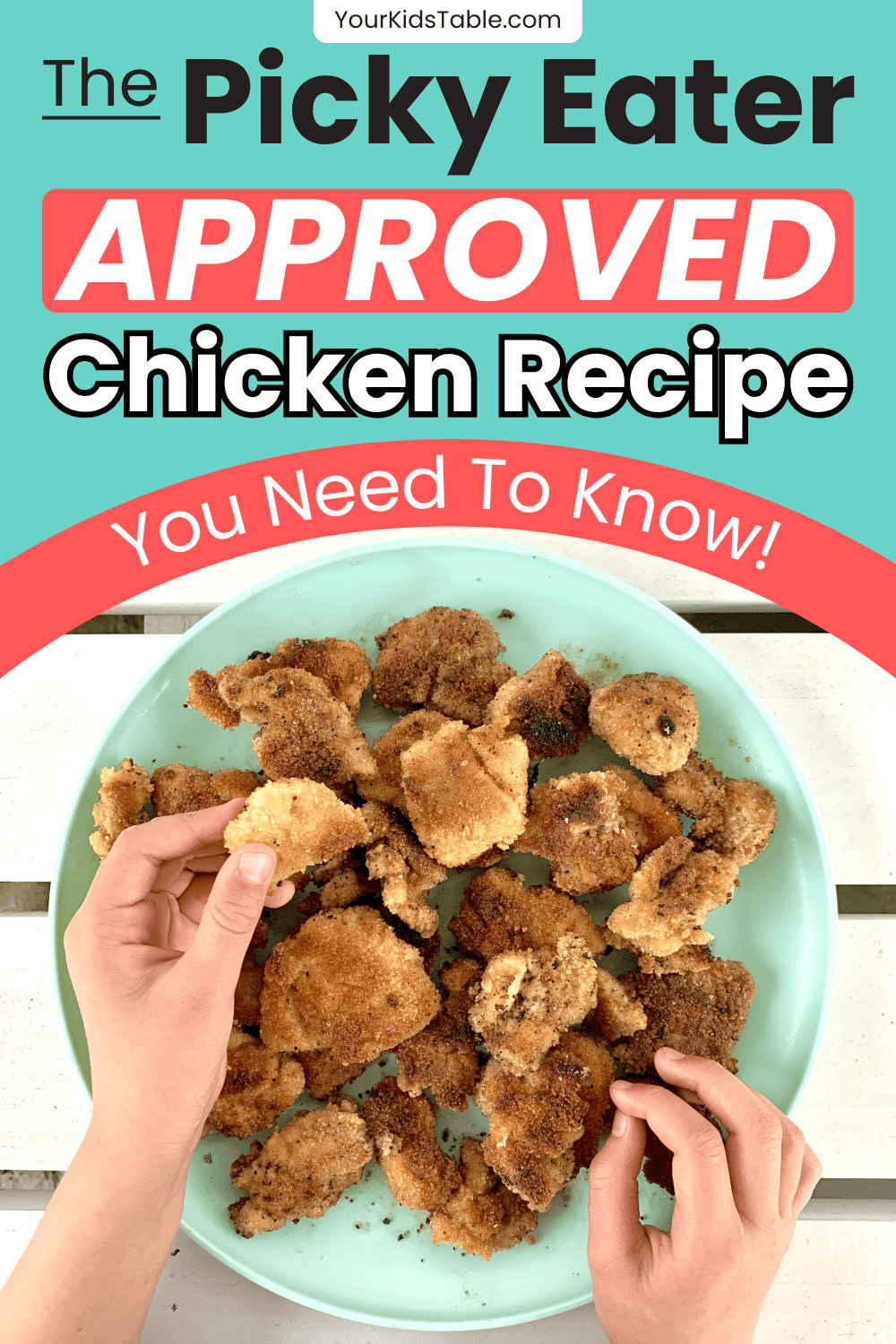
Want your picky eater to eat meat or chicken? I’ve used this recipe to get my own kids, and many others, eating meat because of a special, but easy, technique. Find out what it is and the best way to serve your picky eater.
There are two types of food that most parents of picky eaters want their child to eat more of: meat and vegetables. In this post, I’m going to share with you my own recipe, designed from a feeding therapists perspective to help your child learn to eat meat, or at least start eating other types of meat besides frozen or fast food chicken nuggets.
I used this recipe with my own son, when he was an extreme picky eater, and hundreds of students inside of Mealtime Works have used it successfully too. Because this is one of the recipes we share inside the online program.
This chicken nugget recipe for kids is easy and homemade. But, make sure you pay attention to the way it’s prepared, there’s a special technique, and a few ways I suggest serving it, that can make or break your kid eating it.
And, we’re just about ready to kick off the picky eating video series. This is a special event where I teach parents how to leverage the most successful strategies to move their child from picky to healthy eater. Make sure you grab a spot and we’ll send some free printables your way too.
Why This is the Best Chicken Nugget Recipe for Picky Eating Kids
Picky eaters have such a hard time with meat because it has a ton of texture that’s usually dry and hard to chew. Or, it’s mushy. Most picky eaters like some crunch to their food.
This recipe is different that other chicken nugget recipes because it focuses on making the nuggets thin.
That’s right, I said thin.
That may sound like an odd point to make, but it’s an important one because thin foods have less texture. They’re easier to chew and swallow.
This chicken nugget recipe specifically created for kids also takes into account the size, texture, and breading. These are all important factors for picky eaters, and often how they decide if they eat a food or not.
Have you ever noticed that a picky eater decides if they’re going to eat a food or not the second they look at it?
They’re not just being a pain in the butt, they quickly look at the food and analyze what they think the texture and taste will be like. When they look down and see a crispy, thin, small chicken nugget you made from this recipe, they’re far more likely to be open to it.
Tips for Getting Your Picky Eater to Eat This Homemade Chicken Nugget Recipe
Before you start cooking this easy chicken nugget recipe, there’s a couple of tips to keep in mind:
#1. Keep the size small. The smaller, the better actually. In general, kids love smaller sized foods, but it’s often essential for the picky eater. Smaller also means less texture. Look at the picture below, you can make some nuggets extra small. They don’t all have to be that size, but use the smallest pieces for your picky eater.
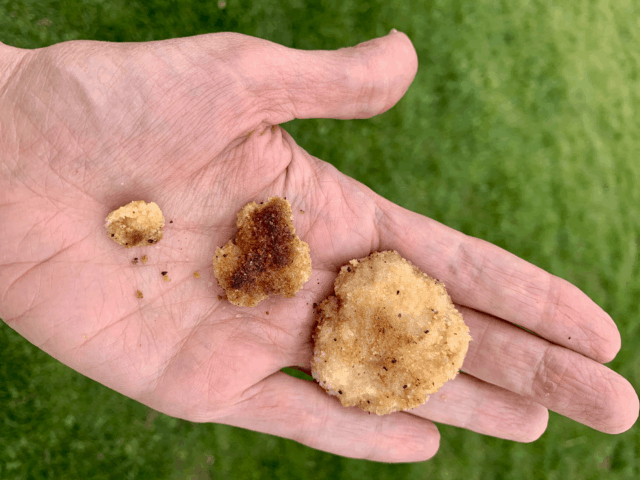
You get to control these details that make a difference for picky eaters when you make your own chicken nuggets.
#2. Don’t skip the thinning out step! Tenderizing the meat makes it thin, juicy, and easier to chew. Read more in the instruction below.
#3. Let your child serve themselves. Put the chicken nuggets on a platter they can manage passing and ask them to take some. Let them know they can take as little as they want. If they look unsure, point out one of the small nuggets and make sure it’s easily accessible for them to grab and not buried under a pile of bigger nuggets.
*If you serve your child, only put 1-2 small nuggets on their plate. We tend to overload plates with the portion sizes we would eat, but this overwhelms many picky eaters and will cause them to become upset or refuse to eat.
#4. Be very careful not to burn these chicken nuggets. Some picky eaters will freak out at any dark spots. That’s an issue to overcome a different day. For now, it’s important that they feel comfortable enough eating this chicken nugget.
#5. Choose the best breading. A lot of picky eaters like breading, which is another reason this recipe is so effective. You’ll see in the recipe below that you have several options for breading your chicken nuggets. Flour and breadcrumbs are often the best choice, but you can also use crunched up cereal, cornmeal, or pretzels!
If you need it to be gluten free, use almond or coconut flour
Choose the breading that is most like other foods your child eats. If your child loves McDonald’s chicken nuggets, then using flour is better because it simulates that breading better than breadcrumbs. But, if your child loves bread and eats anything else that’s breaded. Use breadcrumbs!
And, if you’ve got a picky eater that really loves crunchy and/or breaded food, then double batter the nuggets. To do that, just dip in the egg and the breadcrumbs/flour again before placing in the pan. This will make a very crunchy breading, BUT it does make the nuggets look thicker, which could be a turn off. Make a wise choice about what you think your child will respond the best to.
#6. Do not just try this recipe one time. Try it a bunch of times. Serve it regularly, and serve it with any dips your child likes. Sometimes picky eaters need to be exposed to foods many times over.
Affiliate links used below. See our full disclosure.
How to Make This Chicken Nugget Recipe for Kids
Now for the easy step-by-step instructions for making this homemade chicken nugget recipe for kids a reality!
First, get two shallow bowls. In one bowl, you’ll beat 2 eggs. In the other, you’ll mix your breadcrumbs or flour, salt, and optional garlic powder. I didn’t use pepper because a lot of picky eaters complain of the taste, but if your child likes pepper, add some into the mix.
Keep these bowls nearby, and get out a non stick skillet. Put 4 tablespoons of butter or oil of your choice in the pan.
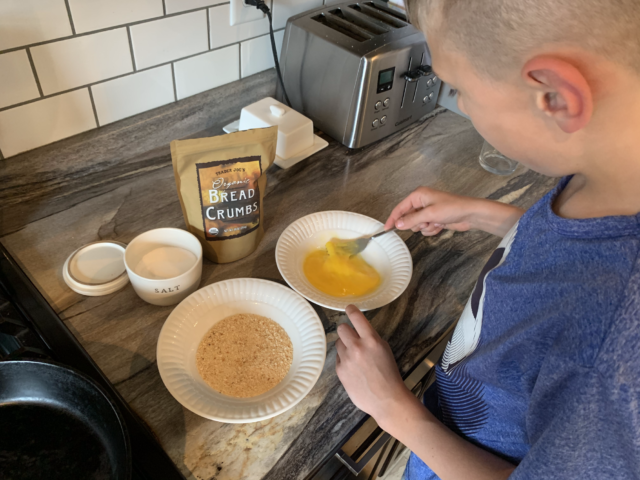
Next, get out your fresh chicken breasts, tenderloins, or thighs. You’ll need about 2 lbs for a family of 4. I recommend using breasts or tenderloins the first time you make these chicken nuggets because the texture is a little more even. We did use thighs in these pics and they taste delicious, but they have more sinewy pieces in some spots.
If you’re using breasts, you’ll want to filet them in half so they are thin. Cut all the chicken into small pieces. Remember to make some extra small sized pieces too.
Then, lay a sheet of plastic wrap down on top of the chicken and use a meat tenderizer or the back of a large serving spoon to pound the meat thin. My grandmother’s old wooden meat tenderizer just broke, so we used a large spoon and it worked well. But, a meat tenderizer is handy, you can grab one on amazon here.
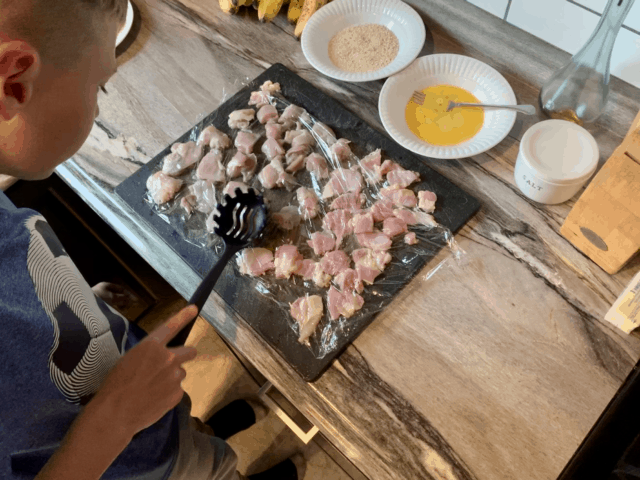
Turn a stove burner onto medium and let the butter melt as you dip the chicken pieces you cut into the egg and then into the breadcrumbs. Roll around the chicken well in the breadcrumbs, flour, or whatever breading you’re using so that it’s well coated.
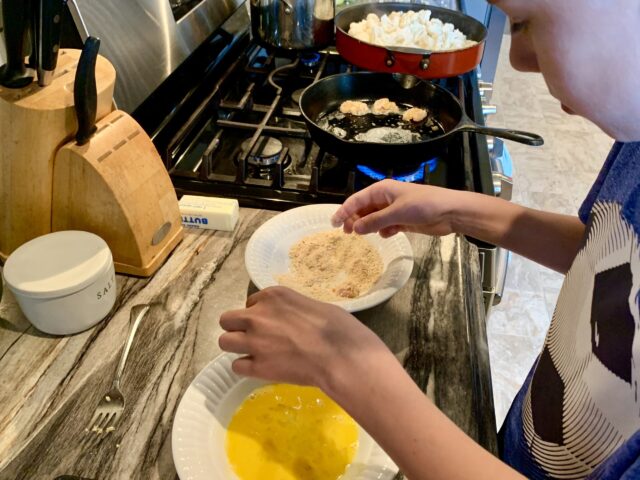
Place breaded nuggets into pan and cook until lightly browned on both sides.
The Easy Homemade Chicken Nugget Recipe for Kids
Chicken nugget recipe for kids
Ingredients
- 2 lbs Chicken breasts or tenderloins
- 2 cups Breadcrumbs, flour, almond flour, or cornmeal
- 2 Eggs
- 1 tsp Salt
- 1/2 tsp Garlic Powder (Optional)
- 4 tbsp Butter
Instructions
-
In one bowl, beat together eggs.
-
In second bowl, mix together breadcrumbs (or flour), salt and optional garlic powder
-
Cut chicken into small pieces
-
Cover chicken with plastic wrap and pound chicken until thin
-
Heat skillet on medium heat and let butter melt
-
Dip chicken into egg and then into breadcrumbs or flour mixture
-
Place breaded chicken into pan and cook until lightly browned on both sides
You got this! Let us know if you plan on making this recipe and what type of breading you’ll use in the comments below. And, if you have any other foods you’d like your picky eater to eat, let us know that too so we can share more recipes!
Need More Help for Your Picky Eater?
Eating homemade chicken nuggets is a huge step in the right direction of getting your picky eater to branch out.
If you’re on a journey to conquer picky eating once and for all (no matter the age of your child, seriously!, join my free picky eater workshop where I share 3 keys to turning picky eating around.
Join me for free here!
More Picky Eating Recipes
No Trouble Baked Potato Skin Recipe for Picky Kids
Scrumptious Gluten Free Meatball Recipe for the Whole Family
Mega List of Vegetable Recipes for Kid’s
Alisha Grogan is a licensed occupational therapist and founder of Your Kid’s Table. She has over 20 years experience with expertise in sensory processing and feeding development in babies, toddlers, and children. Alisha also has 3 boys of her own at home. Learn more about her here.
Can you recommend something to substitute for the butter for a child who is allergic to dairy? Would olive oil work? (Can’t use coconut oil unfortunately, because kiddo has nut allergies too.) Thanks so much for the recipe and your help!
Hey Emily,
You can definitely try the olive oil! We haven’t tried it this way, but hopefully it will work! Glad you like our recipe!
Best,
Desiree
I use olive oil for my frying. A relative once told me it was easier on the liver so I went with it. I make this regularly for my kids, sometimes using crushed pretzels, corn flakes crumbs, mashed potato flakes, oat flour or almond flour combined with ground nuts.
Yum! Love these breading ideas! Thanks for sharing!
Best,
Laura
Your Kid’s Table OT
Avocado oil is great for high heat cooking. Olive will turn into a trans fat at high heats. Tastes grat and healthy fat.
You mentioned baby carrots as a fool proof food for picky eaters. How do you usually serve them especially since they’ve been called out as a choking hazard?
You can utilize the small/thin baby carrots. You are looking for about the size of your pinky finger. You’d serve them in that shape and make sure to model biting them and discussing that they are crunchy, etc.
Best,
Desiree
I meant to clarify – do you prepare the carrots steamed or raw or something else? My child is 14 months.
We were referring to raw baby carrot. However would recommend waiting until she’s able to chew properly before providing them raw, or typically around 18 months.
Best,
Desiree
Recipes dor teens pleaseeee
Hey Thanks for the suggestion! You can modify the recipe for the chicken nuggets to make bigger pieces for teens as well!
Best,
Desiree
Do you have any recommendations for Egg substitutes for breaded items for kids with egg allergies?
Hey Tracy,
You can try milk or coconut milk (thicker consistency)
Best,
Desiree
Thanks Alisha. Can’t wait to try this recipe out!
Tracy: I dip my cutlets in fresh lemon juice instead of egg. Not sure if it would help absorb all the breading as well for this recipe Or as suggested try (coconut oil or coconut milk is thicker and tastes great too)
Awesome! Let us know how it goes!
Best,
Desiree
Thanks for sharing! Wondering if you have a recommendation for replacing the eggs (allergy), something that will get the same end result?
You could try milk or coconut milk (since it’s consistency is thicker than regular milk)
Best,
Desiree