When should we embrace a child’s differences… and when is it a sign they need more support?
It’s one of the hardest questions parents of autistic and neurodivergent kids face.
In this episode, I’m sharing a simple 3-step framework I use as an occupational therapist to help sort through that question. We’ll talk about stimming, aggression, sensory challenges, participation, and how to tell the difference between something that’s simply different and something that’s truly impacting your child’s quality of life.
If you’ve ever worried, “Am I pushing too much… or not enough?” This episode will give you clarity and confidence moving forward.
Get a seat in the new Beyond Behavior—Thriving with Autism Workshop: on Aug 19 (replay provided): yourkidstable.com/autism/


Key Timestamps
2:48 Every child is different
7:15 Starting with acceptance
12:40 One important question
17:35 A lesson from camp
22:10 Moving forward with confidence
Read the Transcript
Welcome to the Connected and Capable podcast. You’re here with Alisha Grogan, and today we are continuing our series on autism. This is really near and dear to my heart as an occupational therapist. Throughout my entire twenty-two-year career, I have worked with a lot of kids with autism. It is truly such a unique diagnosis in that every child that we see with autism is so unique.
You know the phrase, “If you’ve met one child with autism, you’ve met one child with autism.” And so today we’re gonna be diving into a really important question, and I think one that has come up over the last few years as there has, has been a huge movement towards, uh, neuro-affirmation, and that is really understanding that there is not something broken or wrong with autism, but that a child’s and individual’s brain is wired differently.
And so there are different needs, there are different strengths, and we then have to ask the question when we see unique actions or needs or even challenges that an individual with autism has, is that something that we accept? Or is that something that is a sign that maybe they need more support, that they need some help, maybe even some treatment in that area?
And so this is a little bit of a nuanced conversation and question, but I wanna walk us through some, some key steps, a framework if you will, uh, with three steps to really think about if you’re asking that question. I think that this is an important question 100% to be asking if you are a therapist. It should be guiding your treatment, the goals that you’re suggesting.
It should be an important conversation with parents and teachers that you may be on a team with, and certainly for other professionals likewise. So if you’re listening here as a teacher or a coach, and if you are a parent, I think that this is something that you are probably going to ask yourself many times, and hopefully the supports and the people in your life are helping to be a guide in this area.
Now, uh, we’re gonna, we’re gonna dive into these, uh, three steps today. As a reminder, right now we are in the middle of registration for our Beyond Behavior: Helping Kids with Autism Thrive workshop that’s coming up on August 19th. I hope that you grab a seat in that. The link is in the show notes, or you can head to yourkidstable.com/autism.
We’re gonna be diving deep into strategies that are supportive and that help a child, uh, work through their challenges, uh, the things that are impacting their life negatively, and how to do that well. We have some incredible handouts for you, printables. I cannot wait for this workshop. It’s gonna be, um, it’s gonna be so good.
And so I hope you grab a seat whether you’re a parent or a therapist. So let’s talk about… I, y- I feel like I’m being a little bit vague right here when I’m saying autistic challenges, and so I wanna just give some examples of what this might be. This, again, is gonna be very different from individual to individual.
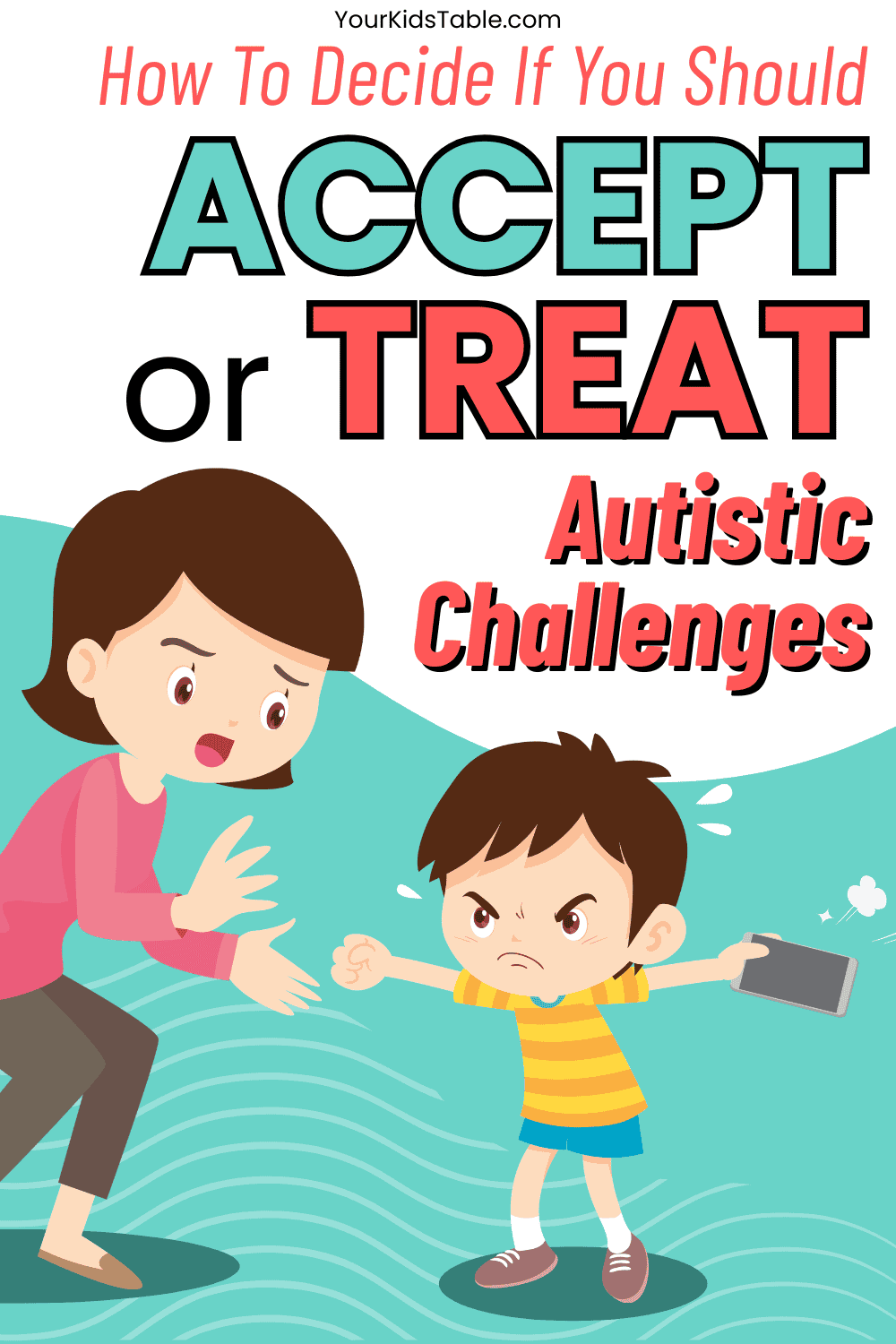
This is going to be different in how it’s perceived, uh, by parents and the professionals that are supporting individuals or kids with autism. And so some examples might be that you might ask yourself this question: how to decide if you should accept or treat challenges. That challenge could be stimming.
That could be not participating. That could be aggression. That could be, uh, refusing to participate in grooming activities. When I say grooming activities, I mean cutting nails, cutting hair, taking a shower, washing hair, like all of those things if a child is refusing to do that. It could also be if a child wanders, elopes, uh, participates in dangerous behavior.
So it might be things that they’re doing, not necessarily things that they’re not doing. This is just, again, uh, just a sampling of what we might be talking about here as a potential challenge. And so as we walk through this framework, it is very important for me to highlight that Most of the time, this is not black and white, okay?
So we definitely need to exercise our executive functioning skill of flexibility even as we’re working through this framework, and to keep in mind that whether you’re thinking about this for your own child, maybe even yourself, or a child that you work with, that it is, it is going to be nuanced, and it is very important that you take a step back and look at that child’s overall picture of their strengths, of their needs before kind of making a concrete and clear decision about this, okay?
All right, so let’s talk about the first step in the framework. I already have mentioned this. Number one is that we have to remember that what you are seeing is one hundred percent individual. Autism is a spectrum of needs, and sometimes some of the challenges or behaviors that we may see may be happening for different reasons under the surface.
If you listened to last week’s episode, I was sharing some of my insights and key takeaways from our sensory summer camp and working with kids with autism and seeing some of the behaviors like throwing something, for instance, uh, having this kind of meltdown. For the child in the story that I shared about, underneath that was, was most likely some anxiety, also some challenges with flexibility, again, probably driven more by the anxiety.
But, you know, emotional regulation, flexibility, these executive functioning skills are part of that. For another child, I have worked with many kids that throw things, it’s not necessarily anxiety. It could be anger, it could be, uh, frustration. There are lots of things that can be kind of underneath that surface.
And so this, this first step of the framework is truly taking the time and what we had walked through last week to look at the clues about what is going on with a child. A lot of times we do not have the verbal communication in, in big episodes, a child may not have any verbal communication, let alone even a, like, assistive technology type of communication.
It may be very limited. And so we really need to become very good observers of what is happening in, with that child and looking for clues and not jumping to conclusions. So step number one, don’t jump to conclusions. Remember that this is 100% individual and that it’s an evolving process of you starting to understand what this child’s need is underneath the action.
Number two, our second part of the framework here, is acceptance is always part of the equation. Sometimes we need to face and re- wrestle with what might be making us uncomfortable. So I want you to just do a personal check. Again, especially as parents, but for sure as therapists, teachers, and coaches as well, that sometimes we see an, an autistic child doing something that seems like it just does not what other kids do.
And so it seems like we need to stop that. And so we need to do a check at this step. Is the thing that I think is a behavior something that is triggering me, or is this actually a challenge? So if a child is stimming and flapping their hands or making a lot of vocalizations… A- and here’s the other thing, it might not be a judgment of this is not, quote unquote, “typical.”
It may be, “Oh my gosh, those vocalizations are super dysregulating me.” Now, there’s some validity to that. Okay? Your regulation is also very important, and gosh, we’re gonna be doing a whole big series and deep dive workshop on that later this fall because it’s so important, the, the adult parent regulation because the, the running, the vocalizations can be pretty dysregulating and it, it is important to recognize that.
But we do kinda have to step back and say, “Is this really a challenge for them? Is this more of a challenge for me? Is it a perspective shift I need to make? Is there another way that I need to support myself because of this, quote unquote, ‘behavior’ or challenge that my child is experiencing?” This also, uh, means though that, like, whatever is happening, that we accept…
Now, this is n- remember, this is only s- this is only the second part of the framework. Maybe you don’t have anything to work through. Maybe it’s very, very clear that this challenge is a significant challenge For instance, if a child is being aggressive, if they are punching holes in the walls, if they are head banging, if they are ripping up and throwing things, if others’ safety is a concern, that’s pretty clear that it’s a challenge.
However, the acceptance is still part of it because we have to accept that this is not this child being bad, again, talked about this a lot in the last episode, and really looking beyond behavior in that there are things happening 100% every time a child is being aggressive, there is dysregulation, probably significantly so, nervous system dysregulation, that may be so uncomfortable and unbearable that a child can ha- hardly tolerate it.
Okay? So there just needs to be an acceptance around not necessarily, “I accept that this child hits every time,” but an acceptance of, “I see that this is hard, and I’m not gonna panic. I’m not gonna panic over it.” But I’m going to accept that this is a challenge right now, and not necessarily that they are broken or…
But instead, moving on to the third step in the framework, which is, is this impacting the quality of life? And so again, clearly when we’re talking about aggression, whether that’s through self-harm or harming others or property, that there is an impact on quality of life, and clearly a quality on impact of life for others around them, but certainly for that autistic child themselves There, you know, again, is potential physical injury with any of that.
But again, when we talk about other things, let’s, let’s focus on some other examples here, like stimming. There are many, many, many different ways that kids can stim. And so a stimming behavior, it is called stimming because they are giving themselves stimulation that is likely needed or is regulating. And so again, there are some stim behaviors that can be dangerous, that may not always be appropriate.
And so we have to then say, “Okay, I accept that, that my child is is stimming, and it may stop there because it’s, wow, you know what? Actually, they stim in increments throughout the day, or maybe they stim a lot in the evening, but gosh, they did all of the other things that day, and this is really regulating to them in the evening or in the morning when they’re, when they’re stimming or if they’re needing a break.
And yeah, it does look different, but gosh, isn’t that awesome that my, my kid is– has learned how to regulate their nervous system? Okay. So acceptance looks like that. As we go to the next step and we’re asking, is that impacting quality of life? In that example, it’s not. It’s not impacting quality of life.
Now, I’ve worked with many kids who, uh, stim so much it’s difficult for them to do or participate in virtually anything else. And so while there’s an acceptance of the stimming behavior, when we get to the third part of this framework, is it impacting quality of life? It absolutely is. Now again, does that mean, oh, we need to stop this?
Because what that’s telling me is that, gosh, this child’s nervous system is probably in so much dysregulation that when they’re not doing this, they feel dysregulated, hence why they’re doing it so much. So– But at the same time, if we are struggling to participate in any meaningful life activities, or should I say, uh…
and actually that’s, that’s the wrong way to put it because stimming is a meaningful life activity. What I mean is, if we are unable to participate at all in necessary activities, uh, that, that are just required for life, like bathing or eating or going to the doctor or participating in an appropriate level at school, then that is impacting the quality of life.
Okay. So whether we’re looking at aggression, we’re looking at stimming, we’re looking at a child maybe that just is not participating
If the quest– if the answer to the question is yes, this is impacting quality of life, then seeking resources, seeking strategies that are supportive of the child, and possibly seeing a specialist for that particular challenge that treats from a neuro-affirming standpoint, is a good course of action
Again, this most of the time is not a black and white situation. And often I shouldn’t say often, but part of the time at least, we’re having to feel that out. This again happened at camp, uh, with one, with one kiddo that frequently didn’t want to participate in drum circle. So I’m asking myself, “Okay, what is going on that he doesn’t wanna participate?”
Like, I’m thinking, this child is an individual. I’m not looking at this from a behavior standpoint and compliance, and he needs to just get over here. This is more of a, why is this going on? Is this part of the demand avoidance? And if it is the demand avoidance, is he struggling to know how to connect? Is there some anxiety going on underneath here?
I don’t know that the first time I see this challenge. But I do need to accept that, okay, this is what’s happening right now. I am not going to engage in a power struggle over this because it’s not something that’s endangering anybody if he chooses not to participate. And I’m left asking myself, is it impacting the quality of life?
Now, for this child, who has, uh, typical language development, for him, I am asking myself, is this impacting his quality of life? Does he actually want to participate in drum circle, but it is overwhelming? Maybe there’s some motor planning that is challenging for him. Maybe he feels unsure of how to act or what others are gonna think of him.
Or is there a sensory need there? Is this too loud for him, and he is not communicating that? So in all of those areas, like what I’m saying, is it impacting quality of life? It seems like it could be. So I have a choice now. Do I start to just continue to show up every day at camp and say, “Yep, it’s totally fine.
He’s not doing drum circle. We’re not gonna encourage him. We’re not gonna, we’re not gonna press him. He doesn’t wanna do it. That’s it. I’m just accepting it.” Or am I saying, “What is the need that is going on here? Would he benefit from participating in this?” That’s a very clear answer. There’s a ton of research that shows how beneficial it is for executive functioning skills that he would certainly benefit from and has some needs in, from the social aspect of this, from the regulation standpoint And so I then need to s- use some strategies.
I need to offer, “Hey, would noise-canceling headphones help? Would you like to choose who you sit next to?” Which, by the way, was the winning strategy also a winning strategy to help him get involved and to let him lead, to engage with him
to bring in his interests were all things that ultimately helped him participate successfully in drum circle at the end of the week And so I think that there is a delicate balance here that we have to consider in are we, are we, are we just accepting? Are we just focusing on what this child needs to, to get to that next skill or to get over this challenge?
My argument here is that I think it’s often a case of both. I think that there are some cases where we do just accept, and I think sometimes that is requiring some of the personal work ourselves All right, I hope that gives you some food for thought today. I hope it gives you a framework. If there is a challenge that you are not sure about, I would love to hear from you in the comments.
And who knows? Maybe it will be on an episode. You can always reply if you’re on our newsletter list, which gosh, I hope you are, uh, ’cause we share tips all the time, and you can reply to any email. We’ll drop a link, uh, to get a free regulation pack in the, in the show notes also, so you can sign up there to, to get that email.
I also hope that you join us in the autism workshop. If you have a child with autism or suspect that you might, or even just any neurodivergent child, if you’re working with kids with autism, this workshop is for you. I cannot wait, uh, to get into some really specific strategies that, that are just helping and supporting kids with autism in the best possible way.
It’s gonna be strategic. It’s gonna be clear. It’s gonna be doable. Head to yourkidstable.com/autism to join us there, and I’ll see you next time
MORE RESOURCES FOR YOU
Grab your free printable copy of our 5 Big Calming Techniques for Big Emotions + Dysregulation– https://yourkidstable.com/emotions-printable/
Ready for a simple plan to overcome the attention, sleep, sensory, and big emotion challenges? I’ll show you how for uniquely wired kids 1-18 years old in just 2-5 minutes a day. Join me in The Connection Hive– https://YourKidsTable.com/TCH
LET’S CONNECT:
Instagram: https://Instagram.com/Yourkidstable
Facebook: https://Facebook.com/Yourkidstable
Pinterest: https://Pinterest.com/Yourkidstable
If you enjoyed this episode, we’d be so grateful if you left us a review! It’s a huge help in encouraging us and letting us know what parents with uniquely wired kids need the most.
Save This on Pinterest
Alisha Grogan is a licensed occupational therapist and founder of Your Kid’s Table. She has over 20 years experience with expertise in sensory processing and feeding development in babies, toddlers, and children. Alisha also has 3 boys of her own at home. Learn more about her here.