
What if some of the hardest moments with your child aren’t about behavior, motivation, or personality at all?
In this episode, I share executive functioning as the next critical piece of the puzzle, and why so many uniquely wired kids struggle in ways that are easy to misinterpret.
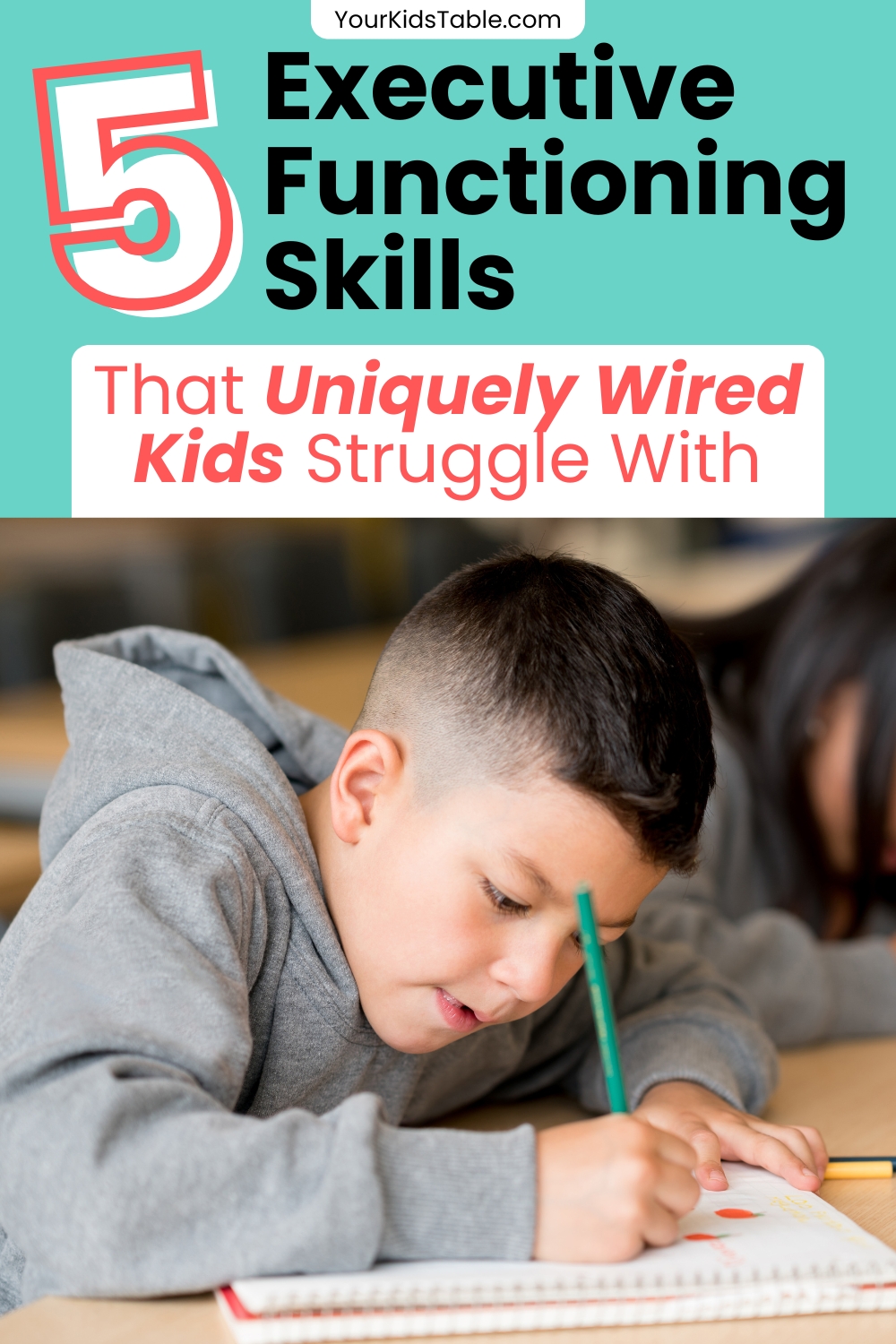
You’ll hear why executive functioning is far bigger than attention alone, 4 more EF skills, and they quietly affect daily life in ways most families don’t recognize.
If you’ve ever found yourself thinking they should be able to do this by now, or wondering why progress feels inconsistent — this episode will help you see your kid (or yourself) in a whole new light.


Key Timestamps
1:45 Why executive functioning gets mislabeled as personality
6:05 Attention isn’t the whole ADHD story
16:20 Perseverance is a brain skill, not a trait
20:00 Working memory & “why won’t they remember?”
23:20 Task initiation: frozen before starting
26:40 Flexibility & meltdowns when plans change
Read the Transcript
Welcome to the Connected and Capable podcast. Today we are diving into five executive functioning skills that uniquely wired kids tend to struggle with. Hey, if you are new here and just showing up for the first time, I just wanna give you a special welcome. And to let you know that I’m just so excited that you are here.
If a friend shared this episode with you or passed it along, welcome. It is true that this is a new podcast Right now. This is our fifth episode, and while it is new, I certainly am not, it is kind of crazy, uh, that I am just starting this now after having been in the online world since 2012. But always working, uh, so much with our resources on the blog and in our membership, that there just really wasn’t space to do this until now.
I am so excited, to be getting into this episode today because it’s really pulling. All of the things that we’ve talked about together. What I’ve seen after two decades as an OT and living with my own child, who is now in his early teen years. And watching his uniquely wired brain develop in real time day after day is that there are four really big areas that are all interconnected and that we tend to see kids with ADHD, autism sensory processing disorder, even anxiety struggle with.
These areas. And so we’ve been walking through them in the last, three, four, actually all of our episodes. And those are retained primitive reflexes, sensory processing. Emotional regulation in today, executive functioning. So to be fair, emotional regulation is one of many executive functioning skills.
So when I talk about executive functioning, we’re really talking about a, whole suite of skills. It’s not just one thing. But it is all of our higher level functioning. It is the types of things that we would describe as having someone that is really mature, that is really capable when they have really well developed executive functioning skills.
The tricky thing is that executive functioning skills are developing all throughout childhood, even into our twenties. And many adults, myself included, can really have some kind of gaps in these executive functioning, especially if you as an adult have some of the diagnoses I mentioned. Or feel that you have some unique wiring or neurodiversity yourself.
It’s very common to see that these skills may not have fully developed. And again, that can be for a variety of reasons, for some of those underlying causes that we already talked about, like the retained primitive reflexes or the sensory processing can all have an effect on executive functioning. And I have.
Taught you about these really important foundational aspects of the brain that are pulling the levers behind so many of the tricky behaviors that we see in our kids, whether that’s melting down, not listening, having really poor attention, struggling to sit still, and I have done them in a very specific order, the order in which they develop.
And so we see retained reflexes so early on in life, in utero. Then the sensory processing starts to develop. It’s only then that our executive functioning skills come on top of that. So it makes total sense that if there are challenges in those areas underneath, we are definitely not gonna see executive functioning develop to its full potential.
Executive functioning skills are so important to talk about because I think this may be. One of the things that I think gets kids mislabeled, what I mean by that is we often attribute challenges with executive functioning to personality traits, to the way a kid is or an adult is. And while there’s some truth in that, this is the way that they are.
It is not a choice and it is not just their personality. It is so much more than that, and that’s what we’re gonna walk through today. I really wanna outline five executive functioning skills. Some, some really big ones, and some ones that might surprise you. Again, we gave a whole episode to. Emotional regulation in in episode four.
So if your kid is having lots of big emotions, they get stuck in them and can’t seem to kind of calm back down and regulate, or they could even be really low and just can’t kinda wake up, that’s emotional regulation. Go back and watch that episode ’cause that is a very important executive functioning skill.
But we’re gonna get into some others today. This episode, and I’m also gonna share exactly what I’ve seen this look like in my own life and how I have at times missed the boat as a parent, even though I’m an occupational therapist and so much of what I do working with kids has executive functioning, skill development built into it naturally.
It all changes when it’s your own kid and you don’t have your OT hat on all the time. Alright, so let’s talk about these executive functioning skills. The first one we’re gonna talk about is a big one, and it’s attention. So our ability to focus and attend on one thing or multiple things at a time is an executive functioning skill.
It’s so important that if you have a DHD or your child has ADHD, or you suspect that they do, that, you know that ADHD is about so much more than attention. ADHD is really not the best term for that diagnosis because it leads us to focus on only two aspects in, in one subtype of ADHD doesn’t even include it, which is hyperactivity, but the attention piece is always there, right?
A lack of being able to attend, particularly to uninteresting. Stimuli, so whatever that is, right? Because we also know that kiddos and folks with ADHD have the ability to hyperfocus when there is something that really interests them so much so that they can get locked into it. So it’s not a black and white situation when we are talking about attention, particularly related to ADHD Now, of course.
Every child that has trouble with attention does not have ADHD because again, this is an executive functioning skill. But I have to say one more thing about ADHD, because this is so huge and something I to did not totally understand until I was a parent and seeing how pervasive in how subtle the.
Executive dysfunction is in my child’s with ADHD Life and that it was across many, if not all, of the executive functioning skills. And that is the case for most individuals with ADHD. So we’re really looking at a, a diagnosis of. Poor or underdeveloped executive functioning skills, not just attention and hyperactivity.
Okay, I hope that’s making sense. So let’s talk about attention. Attention is obviously being able to pay attention when something is not that interesting or being able to still focus on something when you are interested in something else. So of course in kids, we see this show up a lot in school environments, right?
It might be pretty boring, listening to a teacher teach or what is happening, and there are so many layers to this with. How a child is developing in other areas of their brain, their their learning, uh, their visual processing, and how they’re able to kind of look up at the front of the class and kind of copy down on their paper what’s going on.
There’s lots of layers that can make it seem like it might just be an executive functioning skill. But for the purpose of our conversation, we’re gonna kind of just. Think, think of the executive functioning skill a little bit in a silo today, which I try not to do because remember, all of these things are connected.
It’s so rarely just this kind of clear cut black and white, oh, this is exactly the only thing that is going on. It’s just an attention problem. It could be all these other layers of challenges underneath, like being a huge sensory seeker or a retained primitive reflex that’s still firing or being really emotionally dysregulated.
Speaking of that, when we are dysregulated our executive functioning skills tank, we talked about this a little bit in the last episode, and that’s because the frontal lobe goes offline when we are dysregulated and the survival area of our brain takes over. So if you can think yourself, we all have experienced dysregulation when you’re really stressed, really anxious.
Can you think straight? What if somebody comes up and asks you to attend to a two hour lecture on something that you’re really not interested in? Is that gonna be hard? Yeah, it’s definitely gonna be hard. It’s gonna be way harder than if you’ve had a good night’s sleep. You are feeling good. You had some really good interactions with your family, your loved ones that morning.
The the morning went super smoothly. You’re not worried about anything else going on in your life. You feel good. You worked out. You’ve had some quiet time, had a great cup of coffee, and now you’re sitting in that conference and you’re regulated even though it’s something you’re not interested in, your capacity for paying attention is so much higher because you are in the zone of regulation.
When we’re pushed into that dysregulation, our capacity with every executive functioning skill is greatly diminished because. The neurons are not firing there. They’re firing in that survival mode. They are trying. Your brain is trying to get you regulated, not paying attention. It has to deal with something else first, and that’s what we see in our kids.
So all again, all of these things work together. And so we have to focus on the regulation piece, which is why we talked about emotional regulation. Before we got into the rest of these executive function kills. That’s why we talked about sensory processing, because we have to address any sensory needs, any emotional regulation needs.
And again, if there are retained reflexes that are firing, that are causing all of this to be in dysregulation or out of balance, gotta address that, or the executive functioning skills are not gonna be online and even functioning at their capacity. There have been so many kids that I have worked with over the years.
That there are probably some underdeveloped executive functioning skills, but we can’t even get to where their executive functioning skills are operating because they are so dysregulated almost every minute of the day. And so as an OT, the first thing that I’m doing when I see a kid is I’m assessing how are they regulated?
That’s happening in seconds for me. I’m instantly, if I am seeing that they’re dysregulated, my very first move has to be, how do I get them regulated? Not okay. What do I need to do to get them to sit down and work on this handwriting, which is something I might be working on as an OT, or what do I need to do to get them to sit down and try to eat this food?
You know, if I’m, if I’m working on picky eating, I can’t do that. I can’t do that if they are dysregulated. And I want those executive functioning skills firing well to the best of their ability. So that’s really our first step here, so that we can see how well, how well is this child able to attend? And then we can build out supports.
But the attention to task can’t really, can’t really be assessed unless they’re regulated. Okay, so attention is one that we probably all understand. And the other thing that I wanna say before we move on to the next skill is that this is developing throughout childhood. And so it’s a tricky one. And when we look at A DHD, we really do see a range.
You know, again, it’s not a black and white thing where every individual with, with ADHD has this long of an attention span. No, it, it ranges. It’s when their, their struggle with attention has an impact on their life. So for a child that’s typically learning and socialization for adults, that’s work socialization.
Social life. So it’s gonna be a range of what we see from child to child and what they’re able to attend to, what supports that they that they may need. And when we’re looking at attention in a 2-year-old, that’s gonna look so much different than attention in a 10-year-old than attention in an 18-year-old.
Because there are very different points in the development and so it’s very common, right? When we think of the 2-year-old or even the three or 4-year-old, they are just developing attention. We may see signs at a really early age that woo, that attention seems very, very small compared to peers, which could be some red flags.
But it’s also why ADHD is not diagnosed usually until four or five because it’s still developing and we just aren’t sure. We’re not sure. So we’re looking for maybe a two or a 3-year-old to be able to come to the table and sit and eat for at least five to 10 minutes. Okay? That’s an activity that requires attention, but by 10, probably 30 minutes to be able to do that.
That’s gonna vary again, depending on regulation. And I know in my own home, I have an 11-year-old who does not have a DHD and has good attention skills, but sitting for a meal for 30 minutes is, is not, is not always gonna happen, you know, but is he able to sit? Is he able to come to the table? Is this an impact on, on his life that it’s difficult to even sit down and eat?
And that’s just one of many examples. Okay. Moving on to our second executive functioning skill. This is a sneaky one, and it might surprise you, but perseverance is actually an executive functioning skill. We often talk about this as if it is a personality trait. We see it. In the early two thousands, this was on posters, right?
You would walk into a doctor’s office and see perseverance and some mountain climber, uh, about to reach the summit of some high mountain peak. Yes, that is perseverance, but it’s because that individual has really well developed executive functioning skills. You might not define, uh. The ability to do hard things as perseverance.
You might call it hardworking, like that’s a term that we use in my house a lot. It’s a value of mine and my husband’s personally. We have really tried to instill in our children a sense of being hardworking, of doing the hard thing, of pushing through against adversity, and, and that’s in a lot of areas of life.
And of course there’s an unhealthy edge to that, right. That I certainly have experienced in my own life, but it’s when somebody needs help. Even when we’re tired, we’re gonna try to, we’re gonna try to help, especially within our family unit. Somebody’s hurt. I broke my ankle last week. I’ve had to rely on my family a lot, which is hard.
Which is hard, you know, I don’t, I don’t want to inconvenience them. But it does mean that they might be doing something for me when it’s, when it’s hard or when the homework gets really hard that we don’t give up. We may take a break. We need to, might need a reset, but we’re able to move on. We’re able to persevere.
You see, a lot of our uniquely wired kids really struggle with this, and so they end up getting a label as being lazy because they’re not persevering. But what often is happening is the ability to kind of push through when something is hard might be because they’re dysregulated and that capacity is just not there.
And it might also be that when they try to push through or something is feeling hard, they’re getting so emotionally triggered that that is then pushing them into dysregulation. So they weren’t dysregulated to start with, but the hard thing is making them dysregulated. This is super common. Another really big, uh, thing that we see in individuals with ADHD.
So again, if that is you, if you are an adult and you have felt shame around this, I want you to let it go. I want you to let it go because it’s not your personality. It is the result of how your brain is wired. Now, please hear me as always. We first wanna, we wanna acknowledge, we wanna understand, we wanna accept, we wanna support, but also know that your brain is so capable of building and making new connections to build up this skill.
It is a skill that means it’s something we can work on slowly, intentionally with our kids, with ourselves. All right. Executive functioning skill number three is working memory. That working prefix is really important because we’re not referring to recalling when we say working memory, what you ate for breakfast, uh, last week, or a really great memory from last summer.
That your kid had and is now not really remembering the details of, that’s not what we’re talking about. Working memory is kind of the ongoing stuff that we have to hold in our brain from day to day. It’s remembering that you need to hand in a note to the teacher. It’s remembering that when you get home from school that you need to unpack your book bag and put it away.
It’s remembering maybe as a younger child, I’m done with my toys. I need to clean them up. This is something we’ve practiced, something we’ve done a bunch of times, or it’s part of it’s, I’m in my bedtime routine. And the next step is to make sure that I pull out my clothes for tomorrow. That’s part of the routine in your house, but your kid is constantly struggling to hold onto that and remember it.
Now again, this is a tricky one because early in childhood this is still developing. Kids are super forgetful. We have to give them lots and lots and lots of reminders. We start to see in mid to later elementary years. If this is not improving, that a child may have some challenges with this executive functioning skill, they’re not able to kind of hold onto it.
Or remember, in my own son, I felt a lot of frustration in seeing him come home and not remember to use his planner, which was the toll we bought to help him remember with the working memory. That could seem deliberate, and I will be honest. There were times that it did. This is part of my mom, fail moments as an OT in that, oh my gosh, we got you this planner.
We had a plan to help you with this, to help you remember what homework you had to do. We practiced it, we went over it, and you didn’t take it to class or you took it to class and you didn’t remember to write in it. Now, there were some other things going on there, I’m sure socially too, and. My son has a lot of awareness of what’s going on socially and probably did not want to be seen pulling out a planner.
But I also think that we so often feel like, oh my gosh, why are you so forgetful? Why are you so scattered? Why am I so scattered? This working memory is a huge piece of that. And it is not because your kid’s broken or you are, it’s because of an executive functioning skill in their brain. Alright, our fourth.
Executive functioning skill is task initiation. I wish this had a better name. I, I don’t know. It feels so therapyish to me, and I, again, always try to avoid that kind of terminology. I guess executive functioning is, but again, thanks to social media, this becomes such a main term, main stream term, but task initiation, I mean, if you think about it, you kind of know what it means, but this is a huge one.
Okay. Does your kid ever struggle to get started with an activity
again? The older that they get, the more you tend to see this. They have a project that’s due for school. It could even just be their homework. It could, their room is a disaster. They’ve made a, or they’ve made a huge mess with toys. You take it back even younger, you are sitting there. And you’re like, Hey, it’s time to clean up.
They’re frozen and they don’t know what to do. So sometimes we do, kids just kind of freeze. They’re like, I don’t, I don’t know what to do. And then they may drift off to something else. It’s like, uh, I don’t know what to do. And so their attention isn’t holding there. They’re frozen because they don’t know what the first step is.
This particularly happens in overwhelming tasks, but sometimes what can seem like a really simple task to us is a really big task to our child. Something that seems so obvious about where to start is then like not obvious at all to our kids. They don’t understand how to actually start the thing. And now there’s another component to this.
Again, think about this times that you have felt dysregulated yourself. If you have a huge thing to do at work, a huge task at home, or the house is a mess, are you able to tackle it well? Does it feel like your task initiation might be suffering? I bet it does. So sometimes it’s because of the dysregulation.
And so we may see kids when we ask them to do something that is like in their mind a big task that you, we will push them right into a meltdown. There’s gonna be some big emotions because they don’t have the capacity for it, right in that moment or. We’re gonna kind of see this wandering or disconnectedness because they’re not really dysregulated.
That’s a really true sign of Woo. This is task initiation. But again, if they’re not able to plan the steps and they start to feel anxious because they know I don’t know what to do. Mom’s getting mad. The teacher’s getting mad. I can hear that tone in the voice changing. I should be doing something, they start to get dysregulated.
That can also happen. So we kind of see this show up in a couple different ways. And it can change, you know, every time you’re asking your child to do something. But if it feels like they cannot get started, it’s an executive functioning skill that’s called task initiation. Okay. And the last one we’re gonna focus on in this episode.
Flexibility. It’s actually called cognitive flexibility. We see this a ton with uniquely wired kids. We see this a ton with kids that are really stuck in a dysregulated state as well. So when we are talking about cognitive flexibility, we are talking about a change of plans. So let’s, let’s talk about some examples.
You may have seen this play out. You have told your child that it is, there’s a play date happening today. Friend gets sick, play date gets canceled. Are they able to roll with that change? Now, that does not mean that there is not disappointment. Or feeling like, oh man, I wish that would’ve happened.
Like I, I really wish I was still going. I’m, you know, I’m kind of sad about that. It is feeling out of control or really upset because of this change. There’s in unpredictability there. That can really send a kid into fight or flight because of the change and the uncertainty, and this can play out in a ton of different ways.
It can be small changes in a child’s schedule or routine. If a child, let’s say, wears a certain pair of shoes to to gym class every Wednesday or PE and they got muddy the night before. And they have to wear a different pair of shoes. They’re still appropriate for PE class, but they’re, but they’re unable to do it.
That flexibility. I always wear these shoes on Wednesday, but they’re dirty and I can’t wear them.
And now please hear me. Your child may not struggle with all of these executive functioning skills. There are more things like impulse control or self-control planning, self-awareness. These are other executive functioning skills We can dive into more in another episode, but what I think is so important, and what I hope that you take away from this episode is that when you see these challenges in your child, it’s not because of their personality, it’s not because of your parenting style.
It’s because of their executive functioning development or that when they are dysregulated executive functioning skills collapse. But I, what I want you to know is that these are skills. This isn’t fixed. They can grow. They can function at full capacity when we work on regulation. There is so much that you can do to help your child or yourself if you see some of these struggles.
Here’s what I want you to know. For everything that we talk about as we wrap up this episode. Your child’s challenges are telling a story when you understand the real story they’re telling. New connections are capable of being made in the brain, as well as building deeper connections with your kid in this process, because you’re seeing them, you’re understanding them.
You are more regulated as a, as a result of that. That’s how I know that your kid is capable. The brain is capable of building these new connections, these new pathways. And you are capable too. So I want you to just take a deep breath.
You are on that journey by being here, listening and learning. If you know a friend that could use that help too, send this their way. If you need some help with next steps, you wanna dig into this work with building these executive functioning skills. We have some awesome resources in the show notes can continue learning more as a parent inside of the connection hive.
And we have some really exciting resources that are specifically targeted to therapists. I know that there’s a lot of OTs and speech therapists and teachers listening along, and just a huge shout out to you guys for going the extra mile to have the support and resources for the kids that are in your care.
I’m so thankful that you were here. And I’ll see you in the next episode.
MORE RESOURCES FOR YOU
Get CEU’s in our Upcoming Evidence-Based Therapist Mini-Summit: yourkidstable.com/therapist-mini-summit/
Get all the tools in our new Therapist All-Access Membership: https://yourkidstable.com/taam
Ready for a simple plan to overcome the attention, sleep, sensory, and big emotion challenges? I’ll show you how for uniquely wired kids 1-18 years old in just 2-5 minutes a day. Join me in The Connection Hive– https://YourKidsTable.com/TCH
LET’S CONNECT:
Instagram: https://Instagram.com/Yourkidstable
Facebook: https://Facebook.com/Yourkidstable
Pinterest: https://Pinterest.com/Yourkidstable
If you enjoyed this episode, we’d be so grateful if you left us a review! It’s a huge help in encouraging us and letting us know what parents with uniquely wired kids need the most.
Save This on Pinterest
Alisha Grogan is a licensed occupational therapist and founder of Your Kid’s Table. She has over 20 years experience with expertise in sensory processing and feeding development in babies, toddlers, and children. Alisha also has 3 boys of her own at home. Learn more about her here.
Wow I found this explanation of Executive Functioning so helpful. I have always struggled to fully get it, I can honestly say I get it now!!
I’m so glad to be of a small help! Thanks for this feedback and for following along Katherine!
Best,
Laura
Your Kid’s Table OT