
If you’ve ever felt like sensory strategies sound helpful in theory… but impossible to actually fit into real life, this episode is for you.
We’re talking about small, realistic ways to build regulation into the moments that are already happening throughout your day using quick sensory “doses” that can help with focus, emotional regulation, transitions, and big behaviors.
You’ll also hear:
- Why sensory strategies don’t have to be complicated to work
- The idea of “habit stacking” and how parents are using it in everyday life
- How movement, deep pressure, vibration, and even hydration can impact the nervous system
- Ways to help sensory seekers and easily overwhelmed kids differently
- Practical ideas you can start using immediately at home, in the car, during homework, transitions, and more
If your child seems dysregulated often, struggles with transitions, or you’re just trying to make daily life feel calmer and more manageable, this episode will leave you with simple ideas that actually feel doable.
Links and Resources Mentioned:


Key Timestamps
04:39 – Habit stacking sensory tools
06:59 – Weighted input & crawling
13:33 – Vibration & fidgets
18:25 – Movement for regulation
25:08 – Why water helps regulate
Read the Transcript
Before we jump in today’s episode, I wanna thank our sponsor, Fun and Function. If you’ve listened to this podcast for any length of time, you know that I’m always talking about regulations, sensory supports, movement, and making daily life easier for your uniquely wired kids. That’s one of the reasons I’m excited to partner with Fun and Function, because they have so many therapist-created tools that actually support kids in real life.
They are an online store with high quality, durable sensory swings, fidgets, oral motor tools, calming supports, seating options, and so much more. All of it designed by therapists and educators to help all kids thrive at home, in the classroom, or in therapy sessions. And honestly, I love that their products are designed with neurodivergent kids in mind, not just as random toys, but as tools that support participation, regulation, and connection.
They’ve also given our podcast listeners some special offers. Use the code YOURKIDSTABLE, that’s Y-O-U-R-K-I-D-S-T-A-B-L-E5 at checkout to save 5% on anything in their shop. Or for even more perks, sign up for Fun and Function’s email list through our exclusive link to get 10% off, free resources, and a chance to win a sensory tools giveaway. Some of those tools I’ll be talking about in today’s episode.
Just head to Fun and Function at funandfunction.com. That’s F-U-N A-N-D F-U-N-C-T-I-O-N.com, and use your code YOURKIDSTABLE5 or sign up through our exclusive link in the caption for even more rewards. All right. Let’s jump into today’s episode.
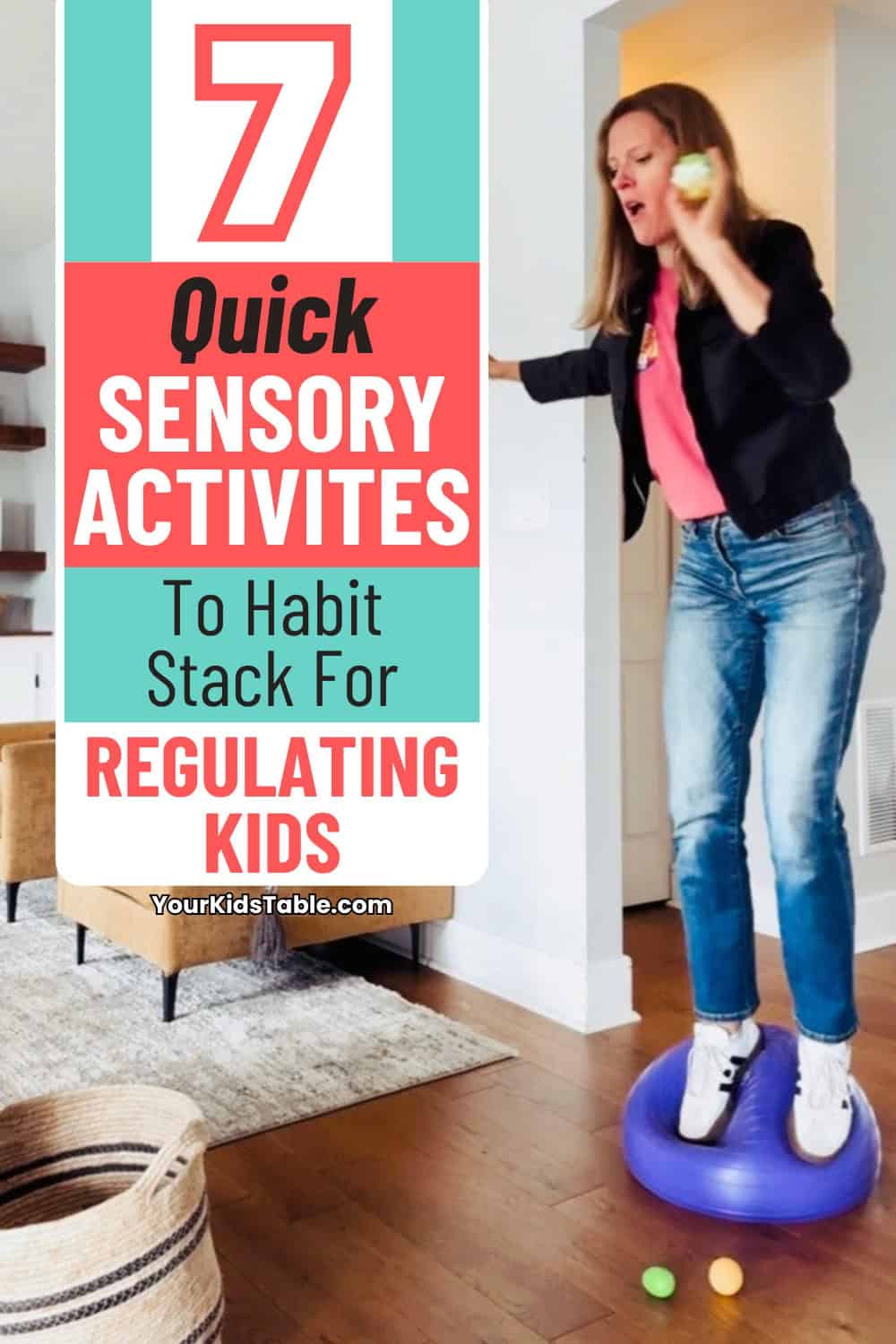
Okay, friends. I’m so excited to be here with you today. We are talking about seven quick sensory activities to habit stack for your kids’ regulation. Listen, this has been a bit of a hot topic for me lately, something we’ve been talking a lot about in our parent membership, The Connection Hive, because let’s be honest, most of us are aware that our kids are dysregulated. They’re out of balance. They’re snapping. They’re having, uh, flip outs, big emotions. They’re struggling to pay attention.
They are not regulated. But you also may be very aware that there are all of these awesome regulating activities to do. You may see some really cool videos of stuff as you scroll on Instagram or TikTok, but getting that into your daily life might feel like a bit of a stretch at the best, if not downright impossible. And let me assure you that you are not alone in that. We are very busy. Uh, most of us living in Western culture Are busier than we’ve ever been with so many activities on our to-do list, it feels like there’s very little time.
And so the thought of trying to fit in long stretches of sensory activities or even using a sensory diet, which is a wonderful thing, but can be very structured and feel very overwhelming if you’ve had a therapist say, “Hey, here’s a sensory diet. You need to do these activities at this, this, this, and this time of day so that your kid can be regulated.” And what happens, what I see so often, is that parents get so overwhelmed by that, and then nothing happens. And to be quite honest with you, I have experienced that myself as a parent.
When there is something that my kids need to be working on, whether I’ve had a kid that has to work a lot on speech articulation, that’s something that we’re working on right now, and even though he is in speech therapy, I know that for him to make the progress that he wants to make at this age, and he is aware that his articulation is not clear and that people can’t always understand him, that we also need to be working on it at home.
I’m grateful for our speech therapist for really breaking it down and simplifying it, which is what my goal always is as an OT when I’m working directly with kids, when I’m running summer camp for kids, and I’m, I’m trying to give parents specific ideas. I’m trying to always break that down because, listen, if it doesn’t feel doable, we’re just not… We’re not gonna do it. We’re not gonna do it. And so, of course, this is something we talk about a lot in The Connection Hive. And recently, we introduced this concept of habit stacking.
So we have a whole lesson in The Connection Hive on that, uh, and it was inspired from, to be quite honest, from a few different places, including one of our very own members who mentioned, “Hey, you know what? I’m working on regulating my own system, and I’m doing some regulating movements while I’m cooking dinner. Like, I’m waiting for the meat to gra- to brown up anyways or that pot of water, uh, to boil, so I’m taking a few minutes, and I’m gonna do these cross crawls.
I’m gonna do some of these, these movements that I know are just gonna help fill my cup up a little bit.” That’s inspiring, and it’s awesome to see other parents starting to do the same thing. So we’re calling that habit stacking because you’re, you’re basically pairing it with something that you already have to do instead of carving out individual time to, say, do a complicated sensory diet.
Let’s talk about how we can actually give our kids meaningful doses of regulation throughout the day because, again, if you have a uniquely wired kid- That has sensory needs, that you know has a diagnosis of ADHD or autism, also known to have, uh, high, high likelihood of sensory needs, let alone a variety of other challenges, and some kids don’t even having this diagnosis, but we know that they are struggling with focus, attention, emotional regulation.
They are either over-sensitive to sensations or they’re seeking them out, or most commonly, some mix in between, then we can literally have a massive impact on their day by looking for consistent times, it doesn’t have to look the same way every day, to give them some regulating input. And we can do this really strategically, and it really can become part of our life. So we’re gonna walk through seven today.
I wanna give you seven quick ideas, and my hope is that you can take a couple of them and try them in the next few days. All right, so let’s get into this. The very first suggestion that I’m gonna offer as a regulating dose that you can just about use anytime, anywhere, that your kid is having to sit and do something. And to be honest, there are some exceptions to this. It doesn’t ev- necessarily have to be when they’re sitting, but what we’re really talking about here is a focus activity.
This tends to be where we feel the rub. Maybe your kid’s trying to do homework. I know we’re here at the beginning of June, so school’s probably wrapping up for you. Hopefully, your kids aren’t having too much homework as we head in here. But they might have some summer reading that you’re working on, they… that you want them to do every day, but they struggle to sit still.
You may want them to be able to sit in church or sit at library story time, or to just be able to come to the table for a meal and to be able to sit for five or 10 minutes with the rest of the family. Now, there are lots of strategies to approach this, but a quick regulation hack is to use a weighted lap pad There are lots of options for weighted lap pads. You can absolutely DI one- DIY one yourself. One of our favorite ways to do this is just to take a clean tube sock and fill it with dry beans, and then tie a really, really tight knot in it at the top.
That couple of pounds of weight laid across the child’s lap or over their shoulder or around their neck actually gives them consistent proprioceptive input. Remember, proprioception is one of our hidden senses, so we can’t see it, but it is responsible for our sense of body awareness, and it almost always gives us a sense of calm. That’s why there are sensory weighted vests. That’s why there are weighted toys and tools, because it can just feel really soothing to have that weight.
Now, it’s not something you wanna use all day long because the body will eventually habituate to it, but when you have a 5, 10, 15, 20-minute segment of time that your kid maybe would benefit from being able to sit and listen to the story, sit and read that book, then a weighted lap pad can be super beneficial. There are so many options that we have for using these, as I mentioned, and so they come in different animals, different shapes.
Our sponsor of today’s episode has some really awesome options, uh, like this weighted snake. What I like about this guy is he is long, and he is filled with weighted beads. For those of you watching on YouTube, I know some of you are listening, just picture a long, skinny green snake that is filled with little pellets that make him heavy. He can get draped around the neck, which some kids really like, and then you can sort of play with his tail. He can be coiled up on your lap, which is also really, you know, giving a lot of input over a wider area. Lots of options, but definitely consider having some type of weight available, seeing if your kid responds to that. It’s a quick dose of regulation that may help them focus.
One more thing that I wanna point out. As we’re going through these seven quick sensory activities, the point here is that we are consistently giving little doses to their nervous system throughout the day Please hear me. Bigger sensory activities like do setting up an obstacle course or having a bunch of time on a trampoline or a sensory swing are so beneficial. So if those are already part of your day, that’s fantastic. You can think about just layering these in to just help with those transitions, help with those times when dysregulation seems to get really high, and these little activities can just help lower that dysregulation and bring them closer into that zone of regulation.
All right, activity number two. This one might sound silly, but it is powerful, and it is to crawl to the next activity. So a lot of times we see kids fall apart and get dysregulated when it’s time to switch from one activity from the next. Maybe you have a young kid, it’s time to clean up toys, or simply time to pause playing because it’s time for lunch.
A meltdown ensues or maybe some arguments or maybe just some ignoring, but going to your kid and saying, “Oh my gosh, let’s have a crawling race to see who gets to the table first,” or, “Let’s, let’s crawl like bears over to the table.” Crawling is a super brain activity. It is immensely beneficial. It gives tons of sensory input, a lot of that proprioception, but it does a lot of different things. You’re coordinating both sides of the body. It’s a rhythmic movement, which is soothing to the brain and body. It requires some higher motor planning, which makes our brain light up in different areas and takes it out of the dysregula- dysregulation zone that it can sometimes get stuck in.
The benefits go on and on and on. I should probably do a whole episode on crawling and why it’s so beneficial. Now, I know you might be listening and you’re thinking, “Well, that’s great, but I have an 8-year-old.” I would say still do it with an 8-year-old, even a 10-year-old. I have an 11-year-old in my house right now, and I would do this activity with him. Sometimes it just takes multiple attempts and being silly.
Anytime, anywhere you can get crawling in, it’s a fantastic idea because it is going to be a pretty big dose of regulation. We often may need to demonstrate this. If we yell from across the room, “Hey, why don’t you crawl to the table?” and our kid has never done that before, they might be like, “What are you talking about?” Or, “Why am I gonna do this?” Right? For adults or teens that are might be looking to do this, again, I think you can sell an adult on it.
The teen might be a little bit tricky. Uh, this can be really helpful if you have a younger child that the teen is helping or demonstrating with, so they’re still getting the benefits of crawling. Because yes, even our uniquely wired teens can really benefit from crawling. It’s just that I think the sell is gonna be a little bit harder for them. And so if this is one that your teen is just not willing to give it a go, that’s okay. Uh, you might be able to incorporate it into some exercise time, or just straight up saying, “Hey, this is super beneficial. Let’s crawl around on the carpet and see how we feel before and after.”
All right. Number three quick regulating sensory activity is using vibration, and this comes in a lot of different ways as well. Now, I wanna say one important thing about vibration, and that’s that some kids don’t love it. So if you bring out anything that vibrates, like you have a vibrating back massager or any type of tools in your house, and you try to give them to your kid and they turn away or say they don’t like that, it is important that we respect it. When we first use vibration on our bodies, like this is a vibrating neck pillow, which is really awesome from Fun and Function.
It has a little clasp here that you can close it. If I turn this on It initially is a little bit of a jolt. It’s kind of a rousing, like, “I’m gonna wake up, I’m gonna really pay attention,” if I use it really short like that and turn it off. If I sit here for a long time with this on my neck, like maybe a minute or two, it’s gonna start to get very relaxing. For those of you that have ever sat in a massage chair, you know that sensation, right? It kind of alerts you as soon as you get in that chair, but then soon you are ready to fall asleep.
You will also sometimes see kids take a vibrating tool, like this is another option. This one is just from Target, and, uh, it’s… Gosh, I think this was $5. But you turn this on, and sometimes kids will put this right up to their ear. The reason that they do that is because it’s stimulating their vestibular sense, another one of our hidden senses that’s deep in our inner ear, and it’s actually vibrating it and giving it a lot of input. Sometimes kids will put the vibration in their mouth. Again, a lot of vibrating input. All of those things are fine, and actually a sign that, ooh, this is a regulating activity.
This is a regulating activity for your kid. So when do you use the vibration? Well, you can use it a couple different times. If your kid is struggling to pay attention, it might be, “Hey, let’s, let’s put this on.” I’m gonna turn it on and off a few times, on and off as I run it up and down their arms. If I’m looking for them to relax, they’re just really struggling, maybe they’re feeling very anxious, maybe they’re really wound up, I’m gonna put this on, uh, if they l- you know, if they like it, and we’re gonna chill. We’re gonna chill with this on for a while. Maybe even if, as they’re having their screen time to help keep them regulated, okay? So again, way to just put this right into the day.
All right, quick sensory activity number four that’s gonna give a dose of regulating input are fidgets. Okay, now fidgets come in all different kinds of shapes and sizes. I love these ones that Fun & Function, uh, just came out with. They are these double pack of mini rollers. They’re very soothing. They do not make noise. They have two toned green colors on them so that you, as you roll them, you can see the different color coming. So there’s a little bit of a visual stimulus there, but it’s very low.
I like that there’s two because you can have one in each hand and be rolling it simultaneously. But here’s the thing, like fidgets can be a paperclip. Also, fidgets can be a necklace, a button, a tag on the bottom of a shirt. So there are lots of ways that we can have fidgets, but what I wanna recommend for regulation is that you have a couple of fidgets on hand for when your kid is struggling in a tough spot.
Maybe they’re in the middle of the store, maybe they’re in the car. So you can’t get them out and let them run around. Uh, you might not even be able to eliminate a lot of input, but giving them a fidget gives them something to focus their attention on, and it gives them a small amount of sensory input, which is going to give them that little dose of regulation. I think it can be helpful to have a couple of these on hand so that your child has a chance to pick through them. Some families even like to just have a basket of fidgets, maybe that, that vibrating toy is inside of there, a couple of other things so they can just grab it when they need it.
All right, number five is a big one, and I wanna make sure that we really talk about specific ways to incorporate this in our everyday lives. And this quick sensory activity is just to move. So often our kids are stuck in sedentary positions, and when they get home from school or they’ve been on screens for a while, they kind of feel funky, they’re a little bit dysregulated, maybe a lot dysregulated, and they’re not sure what to do. And so sometimes they need our guidance in just helping them move.
Now again, we wanna be careful here because if you’ve ever said to your kid, “Hey, why don’t you go outside and play?” Or, “Let’s go on the playground,” or, “Let’s go to the park,” and they’re like, “No, no, no, I don’t wanna do it. I don’t wanna do that,” especially as kids are getting older, you may hear that from them. If that’s the case, we want to give them a path to just make this part of their routine. So maybe they’re getting off the bus from school and you meet them there with their bike or their scooter. You take their book bag and they can zip down the street and get a dose of movement right in your daily activity. This is a great activity to use during those transition points, just like when a kid is getting home from school.
It might also be, “Hey, I’m gonna hop on this scooter board and I’m going to lay on my belly and push with my hands to head to the bathroom to start brushing my teeth for bed.” So you’re incorporating this movement into their day. So this does take some intentionality and some thinking about it in advance. This is particularly important if you have a kid that is a sensory seeker. They are moving all the time. They have a hard time sitting still. They are likely looking for this movement in this intentional way.
And so looking at the transition times where you can automatically slide that in- Will be the simplest thing to do, or setting aside that time in your schedule to make sure that they have a chance to move. If your kid tends to get more wound up with movement, that happens sometimes for our sensory seekers, they likely need some organization and structure around that activity.
So structure and organization can be, “Hey, we’re gonna ride your bike home.” That has a destination. It has a clear beginning and a clear end, as opposed to just running around wild in a backyard or a playground. Again, that can be so great for so many kids, and running around wild is part of being a kid, so I’m not saying not to do that. But if you’re really trying to work on regulation, having that intentional structured movement of point A to point B, or in a game where, “Hey, let’s, let’s do a relay race. I’ll run first and hit the tree. When you run down, you hit my hand, and I’ll run back.” Whatever. Something similar that you’re putting the structure and routine about it. You could do that with multiple kids. You could do that with just one kid.
You could also set up time that there are just obstacles on their way to their next activity. Maybe they have to climb up a small step stool and then hop down. Maybe they have a sticker on the floor that says, “Do five jumping jacks.” Quick little things can be very helpful in setting those up in their routine so that they’re automatically incorporating that movement. Moving Is a very powerful regulation tool. It’s one of the most powerful regulation tools we have.
Now, I will say if your kid is very dysregulated because they are overwhelmed by sensations, it’s too loud, it’s too bright, they might not need a lot of movement at that time, or their movement needs to be very small. Getting up and taking a small walk, getting some fresh air outside and just walking around a little bit could be incredibly regulating and is probably going to be a better fit than fast or intense, or, “Hey, let’s run from this point to this point.” They need more soothing, calming movement, like rocking and walking. Okay?
All right, let’s talk about number six. This is our sixth quick regulating sensory activity to just add into your day. I love this idea. This also came from another Connection Hive member, uh, and that was using a balance tool, and again, these come in many shapes and sizes. I’m holding up a half circle here from Fun and Function. I love this purple, uh, half circle. We’re gonna be using this at sensory summer camp this year, and I’m really excited to put that into play.
Kids can sit on this, but if you put it just in the way of where they’re often walking around your house, like maybe there’s a hallway or just a passage, some sort of passage between two rooms that they’re just… You know that they’re gonna walk by. A kid will likely not avoid, unless, unless they have some vestibular sensitivities and they don’t really like movement, they will likely hop on this for a c- few seconds.
You can also do this with a mini trampoline if you have one of those. You could do this with a balance beam. You can do this with a two-by-four, even just a three to four-foot length, and they will walk across it. These little moments of them hopping on the balance board or the balance ball and hopping off Are gonna give them just a little shot of regulation because it’s in their pathway. Again, one of our Connection Hive members, uh, told us when we talked about habit stacking in our bonus lesson, she said, “I brought up this surfboard tool that we had to help us learn how to surfboard, and I just put it in the way, and the whole family is hopping on and off of it just as they walk through.” It feels good. It makes them smile.
They are feeling regulated just by having this in their path. And you can switch up your tools every few days or couple weeks, move them into different locations when you notice that everyone or a kiddo or two in your home needs that bit of regulation. If you’re a therapist listening, I love having this obstacle right as they walk into your therapy space, so they, they have to hop on that trampoline or they have to hop on that balance ball to get over, uh, to whatever, wherever you are or wherever you’re working on. So lot of different areas to put this in
All right. Let’s move on to our seventh and last quick regulating sensory activity, and this one is likely going to surprise you because it is drinking water. And I know that that might sound so basic, but I see so many kids that just don’t have bo-wa-bottled water around them. They don’t think to ask for a drink. But truly, there are a couple of things happening when we take a drink, and it’s more than what it seems. So of course, the actual hydration piece is helpful, right?
When we are hydrated, we do feel more regulated, or rather I should say, if we’re dehydrated, we’re not getting enough water, maybe we’re not fully dehydrated, we… that will start to affect our attention, our focus, our regulation. So the hydration piece in and of itself is really helpful. But here’s the other thing. There’s a lot of sensory going on when we take a drink of water.
Sometimes it can be really helpful to have a very cold drink of water. That can be very alerting. That can really help a child focus. So that cold sensation flooding their mouth and down their throat can be very regulating. Also, kids are often drinking through some type of straw cup. Even as teens, whether they have their Stanley or they’ve picked up a drink from, you know, Starbucks or Dunkin’ Donuts, they’re drinking through a straw.
When we drink through any type of straw, and especially if your kiddo is drinking through a really thick straw, like as a toddler or preschooler, and it has a valve in it so it doesn’t spill, it requires a lot of proprioceptive input. We have to bring our lips together, and that sucking that we have to do to pull the liquid up actually gives us a dose of proprioceptive input. I also love that many of our kids will use this receptacle of whatever they are drinking out of to get some more proprioception by biting on the straw.
CamelBaks are particularly good for this. They have a silicone top. They are pretty sturdy. I’m not saying they’re not, they’re not indestructible, but they can take some decent wear and tear by kids kind of just chewing on the tops of those spouts- Getting some proprioceptive input, having that around. That’s another item I really love for the car, I really love for the store, I really love to just always have around because it’s going to give quick doses of that regulation.
If I notice that my kid is just on the early stages of starting to get dysregulated, I so often say, “Oh, let’s get a drink.” Or sometimes I just hand them their drink and say, “Here, why don’t you go just take a drink?” Because if their dysregulation is building and I say, “Hey, go get your drink,” now I’ve asked them to do something. I’ve asked them to transition. That might be too hard for them in that moment, and so me just handing them the drink or it being right by them on a regular basis can be very helpful for giving them a small, quick dose of regulation.
I could go on and on here and probably list 20 more ideas for putting these into your kid’s day, but I wanna keep this super doable. I want you to be encouraged in knowing that there are so many simple things that we can do. If you’ve ever felt like, “Gosh, I don’t know how to fit in regulating activities. My kid seems like they’re all over the place all day long, and I’m not really sure how to go about this,” I encourage you to pick just a couple of these and to give them a try in the next few days.
See if it’s helping move that needle down into regulation and out of that dysregulation. These sensory activities are powerful, and layering these into our day ultimately helps our kids learn how to self-regulate. They may not on a conscious level know that they are grabbing their water bottle again because it helps them regulate, but these patterns that they habit stack with their… the other activities that they’re already doing, whether they’re driving in a car or coming home from school or doing their summer reading, when we stack these options for giving them sensory input, it helps them stay more regulated consistently throughout the day. That helps them feel grounded and secure, and it allows them, from a regulated state, to be doing everything that they were meant to do with playing and socializing and learning and communicating.
I hope that this inspired you. I would love to hear if you are trying one of these strategies. Let us know below in the comments if you’re watching on YouTube or Spotify, and if you’re watching on Apple, we would love to hear just a review of how it was helpful for you. It’s been so good to be with you. You can also download our free sensory toolkit below if you wanna know more sensory activities to start weaving into your kid’s day to have a huge impact. You can grab that below. All right, friends, take a deep breath. You are doing a great job, and I will see you back here next time
MORE RESOURCES FOR YOU
Grab your free printable copy of our 5 Big Calming Techniques for Big Emotions + Dysregulation– https://yourkidstable.com/emotions-printable/
Ready for a simple plan to overcome the attention, sleep, sensory, and big emotion challenges? I’ll show you how for uniquely wired kids 1-18 years old in just 2-5 minutes a day. Join me in The Connection Hive– https://YourKidsTable.com/TCH
LET’S CONNECT:
Instagram: https://Instagram.com/Yourkidstable
Facebook: https://Facebook.com/Yourkidstable
Pinterest: https://Pinterest.com/Yourkidstable
If you enjoyed this episode, we’d be so grateful if you left us a review! It’s a huge help in encouraging us and letting us know what parents with uniquely wired kids need the most.
Save This on Pinterest
Alisha Grogan is a licensed occupational therapist and founder of Your Kid’s Table. She has over 20 years experience with expertise in sensory processing and feeding development in babies, toddlers, and children. Alisha also has 3 boys of her own at home. Learn more about her here.