
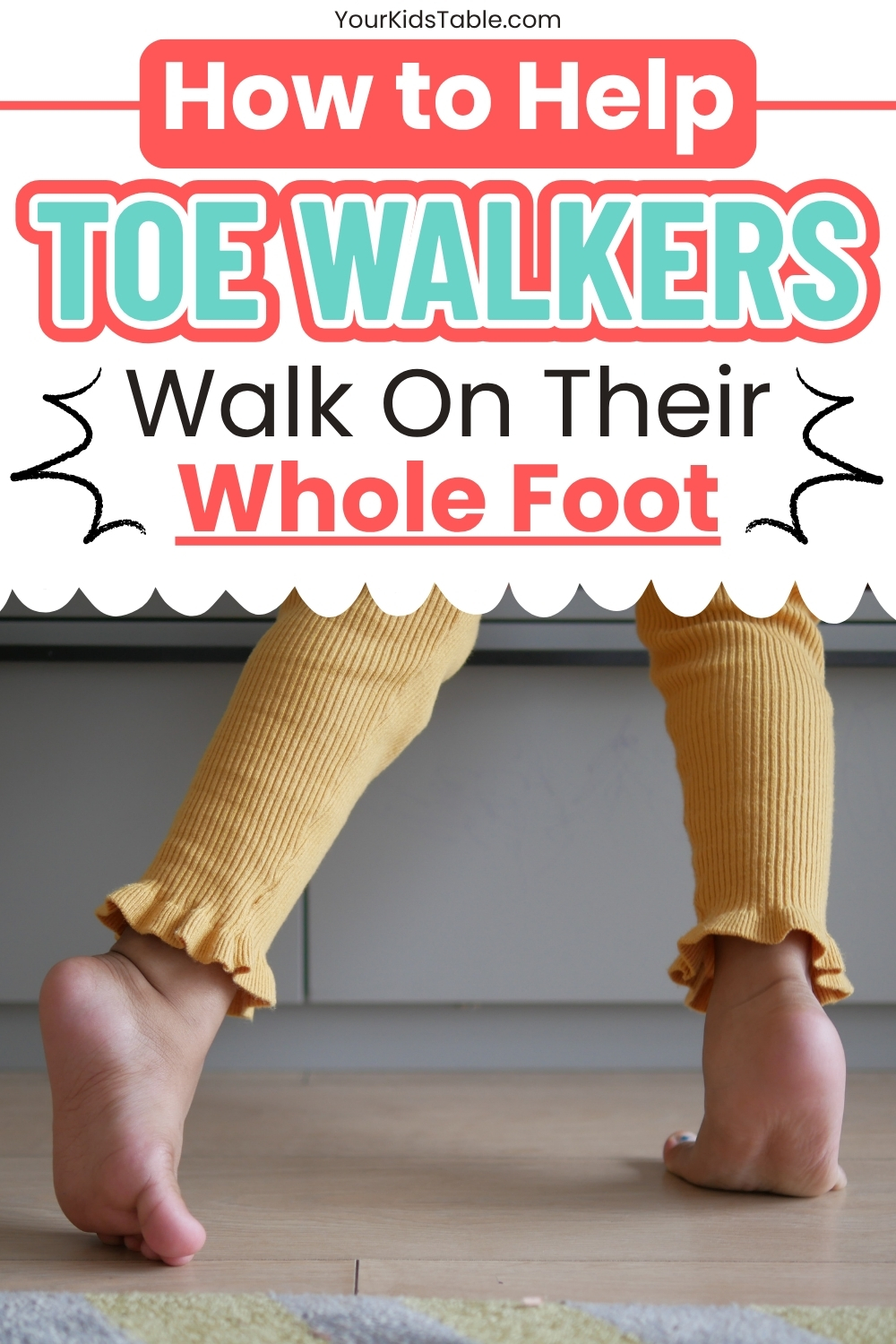
Toe walking seems like an odd habit, and while it can become habitual there are almost always underlying reasons kids are toe walking!
Getting to the bottom of what’s causing your kid to tip toe all over the place is key for helping them walk on their whole foot, which is important because long term toe walking can cause physical issues.
But, I do have one thing you should no matter why your kid is walking on their toes and several more ways you can start helping your kid right now! We’ll also talk about what to do when you get conflicting advice from professionals about how to handle toe walking!
If this episode was helpful leave us review, we greatly appreciate every single one.
Links Mentioned in This Episode
10 Sensory Red Flags that are Easy to Miss
Retained Primitive Reflexes 101


Key Timestamps
2:00 The real question you need to ask
4:00 A surprising reason kids do this
6:00 The hidden driver most miss
9:00 When it’s not just one cause
12:30 What actually helps (and what doesn’t)
17:30 Where to start first
Read the Transcript
Welcome to the Connected and Capable podcast. I am Alisha Grogan, and I am so excited to be talking today about how to help your kid. If they are a toe walker, that means they walk on their toes instead of the entire sole of their foot. Uh, typically this happens when they are. Barefoot or in socks, but it can’t even happen in different types of shoes.
And there are multiple reasons kids do this. And it’s important that we get to the bottom of why, because that will determine how we are going to help them overcome to walking, which is important because if kids persist in toe walking, it can cause. Muscle and joint problems down the line, but again, we gotta get to the root cause of that first.
Now this episode is inspired by a comment from Lacey that we got on Spotify under our 10 sensory red flags episode. So I talked about 10 sensory red flags that are easy to miss, and toe walking was one of them. So Lacey asked my child toe walks and has for a while now. I don’t know what to do as she’s five and a half years old.
Her pediatrician wants her to start physical therapy. Her OT has mentioned wearing high top shoes and I’ve read about braces. Her cranial sacral therapist said no high tops and no braces, that we need to keep doing stretches. I don’t know what to do. She does have some sensory regulation issues and I’m at ground zero with learning all of this, so this is such a good question.
And I wanted to dive in and answer this today because I know that Lacey is not alone. So let’s first talk about why do kids toe walk. Lacey already mentioned one reason, and as a pediatric OT that looks at everything through a sensory lens, this is the first thing that I am often considering. Not always, and we’ll get to some other reasons.
But from a sensory standpoint, and again, it was in our 10 sensory red flags episode, that was episode eight. If you missed that one, it’s definitely worth a listening ’cause there are some surprising things on there that you would think, oh, is this, is this related to their sensory processing? Their sensory system?
Well, it can be. Sometimes kids are walking on their toes. Because they like the input that it gives them. Okay? It gives a lot of proprioceptive input. So remember, proprioception is one of our hidden senses that helps give us our sense of body awareness. It lets us know how to move around in our environment, make sure we don’t bump into things.
A lot of sensory kids seek proprioceptive input because it’s calming to the system. Okay. And we use this a ton. Like this is something I work with a lot of families in the hive in treatment, in my sensory camp is like let we give a lot proprioceptive input because it’s so regulating to the system that toe walking.
Is a, is a very direct way to get proprioceptive input continuously, because the receptors for proprioceptive input are located in the joints. And so when a kid pops up on their toes, okay, so imagine they’re popped up here on their toes. For those of you watching the video on YouTube, YouTube, you can see I’m pretending that my hand is my foot right now.
My fingers are pressing so hard. Into the ground really pretending these are our toes. There’s an increased amount of pressure to the toes and the bottom, like the, the ball of the foot, right? Also up here in my ankle where it is locked, there is a ton of proprioceptive input happening there. So if your kid has other sensory processing needs, like they love to crash into things, they love to climb into tight spaces, or they are running wild all the time, they jump nonstop.
That’s a clear sign that they’re seeking extra proprioceptive input. And toe walking would fall into that category. And so this is purely from a sensory standpoint. Now, I wanna go just a layer deeper because it’s also possible that a child might be toe walking because they have a retained primitive reflex.
Definitely check out episode two if that’s a new concept. To you. I know it is not part of every everyday language yet, but retained primitive reflexes are reflexes that babies are born with and should go away by age two. If they don’t go away by age two, they continue to fire in the brain. Now I want you to just stop real quick and think about what a reflex is.
Imagine, adult reflex that we have, like when you tap your knee in that certain spot. Your leg automatically kicks out. If you’ve had that experience at a doctor’s office, you, you’re not moving your leg. It’s kind of wild, right? Like your brain automatically sends that signal because there is this reflex present.
Well, there could be a reflex firing that is pushing a child to go up onto their toes and walk that way. It’s not a conscious decision. It is possible. That it can be both sensory and retained reflexes a hundred percent. Because retained reflexes can cause sensory processing challenges, and so if that reflex is still firing in the brain, it is causing the toes to go up.
The reflex in particular because there are a bunch of different reflexes that can get stuck or retained, still firing in the brain to varying degrees. Sometimes they’re firing really strong, sometimes they’re firing just a little bit. But the big one, and there are several that it could be, is the TLR.
Now it’s an abbreviation because that reflex stands for tonic labyrinthine reflex. And this is involved in helping kids get their balance. It’s involved in helping push them into upright positions. And that’s why it’s there developmentally, right? So if this reflex is still firing, it could be the reason that a child is still walking on their toes, right?
So that’s reason number two. Third reason is there could be. Physical reasons. This isn’t a sensory standpoint. It’s not from the reflexes, but it could be anatomical. A child may have a shortened achilles tendon. They may have just tightness in their, in their calves. They may have weakness in their leg muscles, and they are overcompensating for that by standing up on their toes.
So what do we do about it now? As a parent, if you are listening, you may not be able to sort out, which is the cause. Not to mention sometimes there could be all three of these factors may be in play, and we’re gonna get to the part. Second part of Lacey’s questions here is, what do I do about it?
Because all of these different specialists are telling me different things. I am reading different things. So what is the best thing to do? Number one, it is important to do stretching. Okay? If your kid is walking on their toes, even because of a sensory or reflex in retained reflex reason, they may be getting really tight calf muscles as a result of that, and so helping them stop walking on their toes will involve having them participate in stretches to make sure that they’re.
Their calves are loose enough to be able to tolerate walking flatfooted. Remember that it is important to do this work of helping your child get to walking flatfooted because this is ultimately what can’t happen again, even if it’s a sensory or retained reflex challenge that is underneath the surface causing the toe walking.
If we don’t, if we don’t help kids overcome that, then it could develop these kind of anatomical or physical issues as a result. So this is definitely worth your time in addressing. And so the first thing I wanna do is I wanna, I would just wanna stretch a kid, and the best way to do that is to have them sit down flat on the floor and put their feet out in front of them.
That is automatically going to stretch their. Stretch their legs, depending on their age. They can also lay flat on their back and scoot up against a wall and put their legs straight up in the air. And see if they are able to maintain that. Now, this is also a hamstring stretch, so if your kid has tight hamstrings, that may be part of what is going on as well.
But here’s what I wanna say. This is a very good clue. If you get your kid into this position, even just sitting with legs straight out in front of them and they are really uncomfortable or unable to do it, then it can be a good sign that, whoa, there’s some like anatomical stuff going on here. In this case, pediatric physical therapists are often a great resource if you have the option to seek out treatment.
Again, you can do stretches on your own at home, depending on how old your kid is, how the severity of this. I should also mention that there can be neurological reasons. Four, this calf tightness. And so sometimes we will see this in kids with cerebral palsy. And again, this is coming from a neurological standpoint, still really beneficial to help these kiddos stretch, because that tightness can get really uncomfortable.
We know, we all know what it’s like to have a really tight muscle and it can be pretty uncomfortable. So stretching is the first thing that I wanna consider now. Second, if I am suspecting that this is related to their sensory needs as Lacey is, ’cause she’s like, I see my kiddo has some other sensory signs.
You see that they are also proprioceptive seekers in other areas. They love to crash into stuff. They love to jump. They love to climb into tight spaces. They give really big, deep bear hugs, or they love getting them, they love crunchy foods. All of these are signs. That a kid is proprioceptive seeker, like they, they need more than the average kid and they love it because it feels so regulating.
If that is your kid, then I want to deliberately put in other proprioceptive activities during the day, like a lot of the things that I just talked about so that they are getting their needs met in that way instead of through the walking on the toes. Okay, now we have to talk about an important thing here because no matter what the underlying cause is, this can become habitual.
So I see kids with a lot of things that start out with sensory needs. Whether that’s sucking their thumb, whether that’s chewing on their shirt, whether that’s biting their nails, pulling their hair, licking their hair. There’s all kinds of sensory things that kids do, right? The kind of concern us as parents or, or have real implications and valid reasons for wanting to address.
And while there, there was a sensory need. What ends up happening is as a child does it, so like let’s say the first few times a child walks on their toes, it’s like, I want this proprioceptive input. This feels so good. I need proprioceptive input right now. Over time, it becomes just what their brain has learned to do.
They wired a pathway and that that pathway is lighting up and it’s a habit. And so there’s not necessarily a sensory need every time a child is walking on their toes, particularly when they’ve been doing it for a really long time. So giving kids extra proprioceptive input through specific activities like jumping and running and climbing and hanging upside down and walking on their hands like in a wheelbarrow walk.
All of those things listen, are great for your kids’ development. I mean, they’re, they’re gonna be wonderful for them. But if you are doing those things and you’re not seeing a decrease and you know this is linked to sensory or strongly suspect it is, then there’s probably a large habit component to this.
Now, before we get into like some more specifics of what you can do. To help your kids start walking on their feet, I do wanna make sure that we talk about this TLR reflex. If that reflex is still firing,
doing exercises and activities that help integrate it, that’s means to make that reflex go quiet so it stops ping ping pinging in the brain all the time and sending the signal to pop up on the toes. There are certain movements that basically are saying to the brain, it’s time to let this go. It’s time to make this reflex go quiet.
It doesn’t need to fire anymore. Those movements, which you would do for five to 10 minutes a day for 30 days in most cases, sometimes a little bit longer, or it can take longer and be three or four times a week. And there are a variety of specific detailed activities for those. I will link up the hive in the show notes if that’s something that you want to explore.
That’s where we teach those in particular, that is going to be a game changer. You can also do a, like a, a screening, a little test with your kid. To see, oh, is this reflex still firing? Okay, so there are, you know, seven or eight key reflexes that I like to focus on. TLR is one of them, and basically you can put your kid in these positions and if their body moves in a certain way, it’s very indicative of the fact that this reflex is still firing, particularly if you’re also seeing signs associated with that reflex.
Okay, so I just want you to know that like that reflex can go away. It absolutely can. Whatever the cause is, whether it’s sensory, whether it’s reflexes, whether there’s an anatomical factor going on here that still leaves the question that Lacey posed. What am I supposed to do? Like I have some professionals recommending shoes.
Uh, keeping my kid in high tops. Other kids recommending, I mean, other professionals recommending just doing stretches. And so at five and a half years old, this is clearly a clinical judgment call and a clinical preference as you are seeing, which is frustrating. So. As a parent because you’re like, listen, I just, I want a cohesive answer on what is the best thing to do.
I would first continue to focus on those stretches that you said that you’re already doing. Lacey, I would also. Do some other activities to help her start walking barefoot. I would maybe play some games that require walking on the heel instead, and I wouldn’t even say, Hey, this is a game that we’re playing to.
Stop you from toe walking. I would just present it as a game, like maybe doing hopscotch, but doing it on your heels instead of jumping. I would play a game in the grass and say, Hey, let’s walk around on our. On our heels, which actually reminds me of one thing that I did not mention earlier in terms of a sensory reason.
Sometimes kids do walk on their toes, not because they are seeking sensory input because, but because they are avoiding it. So if your child has a lot of sensitivities to touch, they don’t like getting messy, they don’t wanna walk around bare feet. Uh, barefoot and they are avoiding touching different things, like they don’t like the sand, they don’t like the grass.
They may be popping up on their toes because of a sensory sensitivity. And if that’s the case, we’re gonna use a totally different approach. Again, proprioceptive activities will still be beneficial, but they really need help. Their brain needs help. Learning how to process that touch input more efficiently so that it’s not sounding the alarm all the time.
Right, and that can come through specific types of sensory bin play. That consistency in there, of course, is really important. That can also come from like a therapeutic brushing program, like the Wilbarger Brushing program. Those things are really helpful if it’s based in a sensory sensitivity. More often I do see kids walking on their toes from a sensory standpoint because they are seeking that input, so.
When we are talking about how we are helping them overall, we’ve already talked about stretches. We’ve talked about games, walking on their heels if they’re tolerant to it, walking barefoot and doing kind of challenges to make footprints, footprints in the sand, make footprints in mud, make footprints in.
You can do flower. Different types of things that they walk through. You can also do squats or squatting activity. It’s very difficult to stay, well, it’s not super difficult depending on how tight your muscles are, but squatting does force kids down into putting their body weight into their heels. So for younger kids, you can think of squatting like, you know, that seems like an exercise that a kid might not be interested in, but you can do something silly like sing a song.
It could be anything. Like the Ants go marching is one of my favorites. You may have heard me mention it before because it has such a rhythmic beep, but the Ants go marching one by one and you can squat down every two seconds and when you stand up high five each other. Okay. So it’s kind of this interactive thing you’re playing back and forth.
Your kid is getting into the squats. If you have an older kid that’s still struggling with this, it could be set up just as an exercise, like, Hey, let’s do 10 squats right now. That’s gonna help shift that weight down. Also, doing different types of pretend animal walks. So this is one of my favorite activities.
There’s a ton of benefits to it, but think about different animals that could be beneficial for your child to walk flat footed on. So that could be walking like a bear, but you may have to prompt them, like, uh, keeping their knees straight so they’re not in a crawling position, but they are walking on the, on the bottoms of their feet.
They could pretend and stomp. Like a dinosaur, like they’re walking around like a dinosaur stomping so that they are getting all the way on their foot. A lot of kids will get creative if they’re really big toe walkers and kind of work around this, but it can be a fun game to play. I personally think that shoes can be really helpful if you are dealing with a kid that is at risk of affecting their anatomy, their joints.
They have been toe walking so long or so excessively, or their muscles are so tight from a neurological standpoint, kids are gonna get put in braces to alleviate that, right? So if that’s, if they cannot stop doing it, but using high tops can be very beneficial, especially to help if there is that habitual component.
Now, if there is a reflex firing. Your child may start, may still get up off of their feet, even in a high top boot. And for me, we’re not really addressing the underlying cause. Again, if the high top is able to stop at the high top shoe and give that child some relief from the tension and the tightness in their leg and in their joint, then I’m for it.
I am. I am definitely for it. And I wonder. It’s a professional that told you don’t focus on high tops. We need to do the stretches. She’s trying to address the underlying cause, which I really appreciate, but I think that there’s, there can be room for both, especially depending on how often she’s popping up on her toes.
If it’s literally all the time, that might be a good way to give her some relief because you’re not stretching all day, particularly. Maybe she puts them on after you stretch so that she’s a little bit looser and a little bit more, a little bit more comfortable. Okay guys, that’s toe walking 101. In a nutshell, I hope it was helpful to you, Lacey.
I so appreciate this question. If you’re listening right now and you’re like, oh my gosh, I have a question I would love to hear, I would love for you to leave it. You can leave a comment on Spotify on Apple. Under our video on YouTube, there are multiple places we check. All of them. So if there’s something you want me to talk about, you have a specific question, it might just end up in an episode soon.
So go ahead and leave it. We love to hear your feedback. If you’re on Apple or Spotify, we would so appreciate you leaving a review or rating it. If this is helpful for you, you like what you’re hearing and you wanna hear more, I am so grateful that you are here. And I just wanna remind you that it says so much to me about.
The parent or the therapist that you are, that you are making time to listen, to learn, to figure out how to help your kid or the kids that you work with. So take a deep breath. Take a deep breath, and know that you are capable and your child is capable with the right tools, with the right support, and through that powerful connection.
You have with them and building new connections and pathways in the brain.
MORE RESOURCES FOR YOU
Grab your free printable copy of our 5 Big Calming Techniques for Big Emotions + Dysregulation– https://yourkidstable.com/emotions-printable/
Ready for a simple plan to overcome the attention, sleep, sensory, and big emotion challenges? I’ll show you how for uniquely wired kids 1-18 years old in just 2-5 minutes a day. Join me in The Connection Hive– https://YourKidsTable.com/TCH
LET’S CONNECT:
Instagram: https://Instagram.com/Yourkidstable
Facebook: https://Facebook.com/Yourkidstable
Pinterest: https://Pinterest.com/Yourkidstable
If you enjoyed this episode, we’d be so grateful if you left us a review! It’s a huge help in encouraging us and letting us know what parents with uniquely wired kids need the most.
Save This on Pinterest
Alisha Grogan is a licensed occupational therapist and founder of Your Kid’s Table. She has over 20 years experience with expertise in sensory processing and feeding development in babies, toddlers, and children. Alisha also has 3 boys of her own at home. Learn more about her here.