What if your child’s big emotions aren’t random… and they’re not a behavior problem either?
In this episode, Alisha dives into Emotional Regulation 101, and unpacks why some kids flip from calm to overwhelmed in seconds, why meltdowns can feel so sudden, and the hidden brain shift that changes everything about how we respond.
You’ll hear a perspective most parents never get about what’s really happening under those reactions, why talking through emotions often doesn’t work in the moment, and one surprisingly simple starting point that can begin to shift the pattern over time.
If you’ve ever felt like you’re walking on eggshells around your child’s moods—or wondered why nothing you’ve tried seems to stick—this conversation will help you see those moments in a completely new way.


Key Timestamps
2:30 What emotional regulation really is
6:45 An important analogy for big feelings
12:10 Why fight/flight shuts regulation off
17:55 2 other factors that can cause dysregulation
22:40 The #1 way to help kids build emotional regulation
Read the Transcript
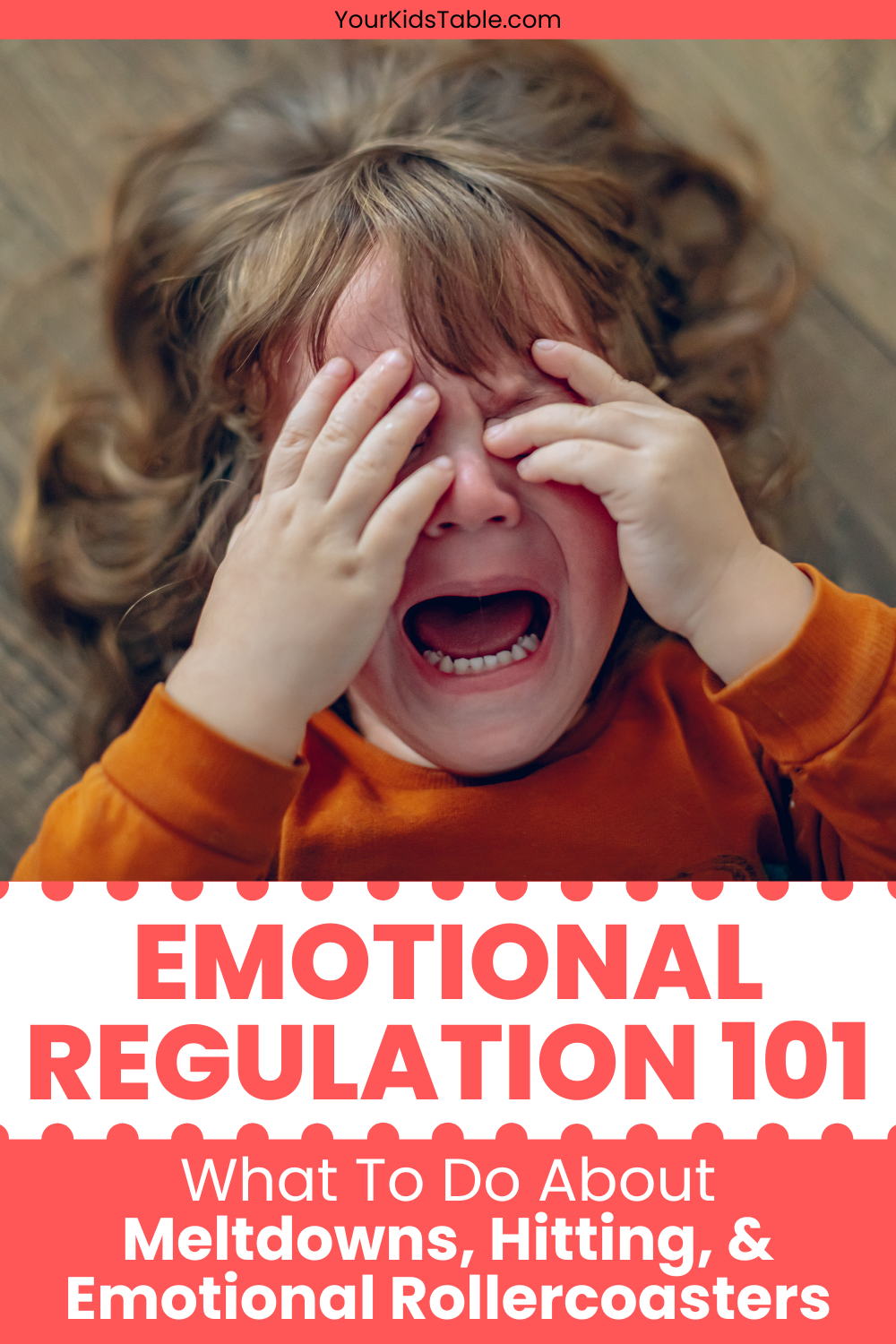
Does your kid have frequent and big emotions that seem to come out of nowhere? Maybe one minute they’re running around happy, the next minute they are crying…or maybe they’re sitting there playing really nicely with their brother, and three seconds later everyone is in tears and your daughter has hit your son out of nowhere, seemingly.
Maybe your kid struggles with a lot of meltdowns, a lot of hitting or aggression. It feels like you are on a rollercoaster ride with their emotions. Well, friend, you are in the right place. Today’s episode is Emotional Regulation 101. What to do When Your Kid is struggling with these big emotions that escalate quickly or seem to come out of nowhere? We’re gonna talk about what emotional regulation is, why it matters.
And what’s really underneath it. There is a really important key here that is just not talked about enough. That is a major game changer. But I also wanna share with you a quick beginner strategy that is an absolute game changer when it comes to helping your child emotionally regulate. Now, if you are joining us for the first time, maybe a friend sent you this podcast.
I just wanna welcome you and thank you for being here. Heck, if you hit play today and you’re sitting here listening right now or walking or while you’re doing the dishes, I just want to commend you. There are so many things that you could be listening to or doing, and you are here learning how to help your child or that child in your life, or maybe even yourself because yes, this all applies to us as adults, to you, and many of us are walking around with uniquely wired brains that we’re really never given the tools or taught.
How to understand why we do the things we do and really how to help ourselves. So this could also be helpful for you if you don’t know me yet. My name’s Alicia Grogan, and I’m a pediatric OT of more than 20 years. I have a uniquely wired brain myself, and so does one of my kiddo. I’m a mom of three, so I know what it’s like to live this in the trenches.
So with that, let us jump into it by first talking about what the heck is emotional regulation. I feel like this has become quite a buzzword, which is kind of awesome because honestly, 10 years ago I did not use the word regulation. I started my blog your kids table.com, way back in early 2012. And I avoided using the word regulation because it was not everyday language.
It was not something people used or knew. And I always try to use everyday language that parents can understand because when we get caught up in jargon, it can really slow us down, confuse and overwhelm us, but. Regulation is no longer that you have likely heard of regulation. You likely have some understanding at least of what it is.
But I wanna be really clear here about what it is. Regulation is a skill. It is not a personality trait, and it is developing all the way into our late twenties and truly even beyond. As somebody who has struggled with anxiety and has a history of trauma, I am still learning how to emotionally regulate.
In fact, I’m probably doing some of my most important work with it at this point in my life. So you’re never too old to work on this emotional regulation skill, which is all about helping us regulate. Our emotions, how to calm them down, and in some cases even wake them up a little bit. Regulation is about us being in a zone where we are able to attend, where we are able to be present, where we are able to learn and connect with others when we are emotionally dysregulated.
All of those things are very difficult. Now, I wanna be clear here. Nobody is ever in a constant state of regulation, nor should we be. That is not the human experience. Our emotions are important. It is important that we don’t ignore them because they give us very valuable clues. As to why we are struggling with feeling angry or sad or really anxious, there is a reason and our body is telling us it needs to be addressed.
So emotional regulation is not ignoring our emotions. It is not saying that they are bad, but instead. It’s recognizing those emotions and knowing how to move ourselves back into kind of our zone of optimal functioning. We can’t always live in that place, but for so many of our uniquely wired kids, again, whether they have a diagnosis or not, so your kid may have a diagnosis of A DHD or autism or sensory processing disorder.
They may have some retained primitive reflexes. They may have some quirks and some unique wiring that is causing them to be more emotionally reactive and also get stuck in their emotions. So emotional regulation is really our ability to move out of them and not stay stuck in them. It’s not. To never have those emotions.
So I wanna give you a quick analogy to think about emotional regulation. I think this will be really helpful if you think about emotional regulation as a thermostat when it’s set around 70 degrees, give or take, things are comfortable when the thermostat gets turned up. That is when we are kind of wild, anxious, having quick thoughts filled with anger.
Even excitement can all be when the thermostat is turned up. This makes us on edge and sometimes we cannot get that thermostat turned back down. However, the thermostat can also get turned way down, and we can also move into emotional dysregulation. It’s not just when we turn it up, sometimes we might see our kids being really zoned out, really disconnected, really out of it, really tired and sluggish and it’s, it’s like they just are in this constant state.
Of just waking up and they cannot raise their regulation enough to be able to attend and focus. So some of the emotions that we typically see with this are sadness and even depression. Okay. So this thermostat kind of moves throughout the day when emotional regulation is well tuned. For a lot of our kids, and again, some of us as adults, this thermostat can get stuck and the brain really struggles to turn it back down or to turn it up into that optimal zone of functioning.
I hope that analogy helps you and when you see your child in this state know that it’s likely not a choice that they have. Now there’s a reason for that, which we’re gonna get into in just a minute. But before we go there, I do wanna make sure that I mention that emotional regulation is a one of a whole bunch of different executive functioning skills.
We are pulling it out and highlighting it here from executive functioning, which our next episode is gonna be all about and includes things like impulse control and decision making and planning, and. Starting hard things and continuing to do hard things like perseverance. Those are all executive functioning skills.
Organization is another one that’ll all be in our next episode. Emotional regulation is also one of those skills, I cannot say it enough. This is a skill and we often tend to look at people and be like, wow, they’re so emotional. Now, an individual may be more in touch with their emotions. And that kind of gets back into our sensory system with interoception.
We talked about that in the last episode, and pretty soon we’ll have to do a whole lesson kind of here on one of these podcast episodes, all on interoception. It’s one of those hidden senses. That helps us identify our feelings. And so some people truly aren’t as aware or as in tune to their emotions, and some people are really getting a lot of strong signals that they’re feeling emotions.
So that can be tied into this emotional regulation piece. But today we’re really talking specifically about this skill. This skill is part of this executive functioning. All of these executive functioning skills take place in a special part. Of our brain called the prefrontal cortex. You may have heard of it before.
This is also becoming more of a mainstream term, and again, this part of the brain is not fully developed until our twenties. And it is very, uh, has very little development early on in life, which is why we see it and accept it as very common behavior. For toddlers to be on this emotional rollercoaster, to have huge tantrums to flip out over the smallest thing, it’s because their executive functioning is not developed yet, but it does continue to slowly develop throughout childhood.
We do tend to see in our uniquely wired kids, those kids with ADHD and autism and sensory differences, that this is often more underdeveloped compared to their peers that do not have this unique wiring. So the good news is that there are ways to strengthen and to develop this skill no matter what age your kid is or you are.
I am certainly living proof of that and this is something I work on with my kids all the time. Something that is part of our treatment. Uh, when I’m working with other kids, it’s always the top of my mind because it is one of the most important skills. We can help our children build. And I’m gonna share a really good starting point for you as we get to the end of this episode.
So hang in there with me. But I wanna talk about the fact that this also can be a struggle for kids, this emotional regulation because of retained primitive reflexes, in particular, the Morrow reflex, that’s the MORO reflex. That reflex is still firing in your child’s brain when it shouldn’t be. Then you may see this reactivity.
Now, if retained primitive reflexes are brand new to you and you’re like, Alicia, what are you talking about? Go back and listen to episode two. You wanna check that one out? But I want you to know that there are these kind of factors underneath that. It could be partially due to that interoceptive sense that’s their sensory processing.
It can also be because of these retained reflexes. Now, I have to admit that in my own life I have seen this play out in one of my own children who has had some retained primitive reflexes, in particular the moro and the ATNR. There were some significant stretches of time that I found myself starting to feel like I was walking on eggshells around him because I wasn’t sure what was going to set him off, and I wanted to try to avoid the massive upset.
It was not a full blown meltdown. A meltdown is when a child has lost total control. Their, their thinking part, that executive functioning part of their brain has totally shut off. They are operating from a total survival mode. Kids, when they’re in full meltdown mode, there is not a lot we can do to intervene in that moment.
My son was often not quite there, but he would be 70 to 80% there often still really difficult to take instruction or to use any strategies because he was so escalated, his thermostat was turned so far up and it would get turned up very quickly. Now, a lot of the reflex work that we have done has been helpful for that, as well as the strategy that I’m gonna share with you, which is a long-term solution to helping to build this skill.
There is no magic fairy dust with building emotional regulation. It is something that requires just consistency and time. But what I love about it is that. It is something that’s very doable in our everyday lives. Now, I want to also caution you that if you were raised, as many of us were to ignore your emotions, likely because your parents were taught to ignore their emotions when your child is having big emotions.
It may feel very triggering to you because you are not allowed to express those big emotions. I mention this because our response to these big emotions from our kids, the meltdowns, the aggression, just the super fast light switch, emotions that seem to pop up can feel very dysregulating to us. And so it’s really important that we acknowledge that in general, even if you grew up in a home with a, a high support of emotions and feelings, it can just be jarring when your child is yelling or throwing things or screaming or hitting right?
That’s dysregulation. That can be pretty dysregulating to our own system. But even more so, and we can be very quick to snap and get very angry and want to try to control our child. If you’re feeling those things, that’s usually a trigger. And so I just wanna encourage you as you’re listening here, to just dig a little deeper there.
Uh, we’ll have to do another episode soon on just some of our own healing as adults, because so much of our parenting that we do. In essence ends up being a re-parenting of ourselves if we take that opportunity. Woo. That has certainly been the case with me many times. Many times, as it still continues to be on a regular, on a regular basis.
So again, I wanna make sure, and I, I cannot say this enough, that emotional regulation is not avoiding emotions. It’s about not getting stuck in them and not having a way out. It is also about hair trigger reactivity. Okay, now we have to discuss another really important topic that is just crucial for any child that is struggling with anxiety, depression, just worry in general.
Maybe it’s not full-blown anxiety, but just a kid that worries a little bit more. Kids that have really big emotions and seem to be hair trigger. As I said already, we all experience emotions. Some of us may not acknowledge those emotions, but they are there and they are part of our human experience. How many of our kids.
And ourselves are getting stuck in these emotions because our fight, flight, or freeze response is getting activated once the fight, flight or freeze is activated. The thinking, emotional regulation part of the brain, so the part that is developing that emotional regulation goes offline. They have done brain scans of this and it literally goes dark in the brain, all activity stops and deep in the back part of our brain in the emotional regulation, uh, where there’s no emotional regulation, but it is all about survival.
And this little part of our brain called the amygdala takes over. And the sole goal is survival. Even though. Your child may not be in a life-threatening position. The brain is interpreting it that way. And here’s the tricky part. The more a child fight, flight, or freeze gets activated, the more often the brain defers to that pathway.
Okay? So when the brain makes that connection, it becomes a little road in the brain. The brain starts to survey the environment to make sure that it’s not gonna be in danger mode again, this constant surveillance is this sort of blended state for being in fight, flight, or freeze. This is often what we are seeing in kids that are on edge, that snap very easily, that get angry at the.
Drop of a hat that it seems to come outta nowhere, that the emotions are big and they are explosive. The survival part of their brain has taken over. This is huge. I want you to let that sink in for a moment because when your child’s brain is in survival mode. If it’s, if you’re seeing those behaviors, it most certainly is.
Not only are they not able to problem solve or take in ideas or calm, they all also are not responsible for kind of these choices that they’re making. It is all about survival. And that really changes our perspective. If we can understand this, it really changes the way that we show up with our kids.
Again, that might require us doing some of our own work with our own kind of emotions and how we’ve been allowed to feel them. But when you understand that a, that a switch has kind of been flipped in their brain. They’re not in a problem solving thinking rational state. Then it allows us to support them in a new way and to not be triggered and dysregulated at least as easily.
So what can we do to start building this emotional regulation skill? There are lots of ways that we can do this. For my connection Hive members. You know that we have a, a whole list of activities, but our first activity, which we have an awesome printable that goes with this kind of show kids is to start naming the emotions.
That sounds so simple, but it is so powerful. This is often one of my first recommendations for parents. Because kids feel very outta control in these emotions, but we have to help them understand that it’s an emotion and also what that emotion feels like in their body. Maybe you’ve thought about this before, maybe you haven’t consciously thought about it, so you can right now.
Imagine what your body feels like when it’s angry. Can you think about that right now? Do you feel hot? Does your chest tighten? Do your fist, do your hands go into fists? Do you feel tense? Is your heart racing? What are the physical symptoms that you are feeling? Those physical symptoms? Or would allow your brain to say, Hmm, I’m angry.
Now, these symptoms can kind of vary from person to person, from child to child. They are a somewhat unique experience. But when we can start to help our kids identify, Ooh, that’s anger. Ooh, that’s anxiety. Ooh, oh, that’s feeling really lonely or sad. Then we can start to build ways to help them deal with that.
Sometimes it is talking to somebody depending on their age, maybe journaling that might be going outside and get a fresh, some fresh air for a couple of minutes. It can be things that simple for kids and adults who have had a history of being stuck in this fight or flight. It likely is going to take more.
They might need some sensory activities to help calm their body down. Guess what those sensory activities do? They may release endorphins depending on which sensory activities they are. Probably most of them are, which are gonna start to help calm the body because when the body’s in survival mode, a whole bunch of chemicals like adrenaline and cortisol get released.
And so those endorphins start to counteract that and bring calm to the body. The movement from sensory activities? Well, not all sensory activities involve movement. If you’re using a sensory brush on your child and you’re doing it to them, that’s not really movement on their part. It could be soothing and relaxing, but when they’re able to tap into movement, it forces their brain to shift gears and move out of that survival mode because other areas of the brain, including that executive functioning.
Have to get involved, so it brings it back online. Now, the caveat here is if your child is in full, full fight or flight, they are not gonna be able to listen to directions. That’s why this work is so important to make as part of your daily life. It’s not something you have to spend 10 minutes a day doing, but starting to intentionally ask these questions and to model.
Ooh. Wow. That kind of upset me when that, when that that car ran the red light. It scared me. It really scared me. I can feel my heart racing. Oh, I’m gonna take some deep breaths to calm down because I can now see that I’m safe. We’re all safe. That that was okay. You can also model all kinds of emotions. Oh my gosh, that was so funny.
I’m laughing so hard and that made me feel so good. I can feel my face smiling. I feel so comfortable. I feel very light. So starting to model that for your kids. Just in everyday conversations as it comes up, starts to create this language and understanding. Now, again, this takes time and it takes consistency.
What I want you to hear is that it doesn’t need to be done perfectly, okay? So for any other recovering type, a’s like myself being intentional, continuing to learn, being here. Listening to Connected and capable podcasts is going to help you. It’s going to help you stay connected to these strategies and build that connection with your child where this starts to become a way of life.
That’s my hope for you. Now, if you wanna go deeper and you wanna learn more about emotional regulation strategies, you want my personal support, I love when I get to work with you guys directly. Truly, uh, I hope you check out the connection Hive. That’s our membership for parents of uniquely wired kids.
We have something new and exciting coming for therapists as well. I know we have many OTs and speech and PTs and teachers that listen. I just wanna shout out to you and thank you for being here. Thank you for sharing this with your clients. Thank you for listening along. I’m truly so honored. Uh, and humbled to have you here listening.
So grateful for every one of you that tuned in. Check out our show notes for all of the things that I referenced here, and I’m so excited for you, uh, to just maybe see your child in a little bit of a new way and to also, uh, begin this intentional work of building the skill of emotional regulation, a gift that will last a lifetime.
All right, friends. I’ll see you next time.
MORE RESOURCES FOR YOU
Grab your free printable copy of our 5 Big Calming Techniques for Big Emotions + Dysregulation– https://yourkidstable.com/emotions-printable/
Ready for a simple plan to overcome the attention, sleep, sensory, and big emotion challenges? I’ll show you how for uniquely wired kids 1-18 years old in just 2-5 minutes a day. Join me in The Connection Hive– https://YourKidsTable.com/TCH
LET’S CONNECT:
Instagram: https://Instagram.com/Yourkidstable
Facebook: https://Facebook.com/Yourkidstable
Pinterest: https://Pinterest.com/Yourkidstable
If you enjoyed this episode, we’d be so grateful if you left us a review! It’s a huge help in encouraging us and letting us know what parents with uniquely wired kids need the most.
Save This on Pinterest
Alisha Grogan is a licensed occupational therapist and founder of Your Kid’s Table. She has over 20 years experience with expertise in sensory processing and feeding development in babies, toddlers, and children. Alisha also has 3 boys of her own at home. Learn more about her here.